Rice Cookers That Get the Texture Right Every Time
The Zojirushi NS-ZCC10 is our top rice cooker for its consistent, fluffy results and fuzzy-logic temperature control. The Cuckoo CRP suits those wanting pressure-cooked texture, while the Tiger JBV works well as an affordable multicooker. Owners report all three hold rice warm for hours without drying it out.
Reliable rice without babysitting a pot starts with the Zojirushi NS-ZCC10, which leads this list for fuzzy-logic control and even cooking. The Cuckoo CRP follows for pressure-cooked texture, and the Tiger JBV rounds out the top three as a versatile budget multicooker. Seven real models appear below so you can match one to your kitchen and the grains you cook most.
Temperature sensing, inner-pot quality and keep-warm behavior matter more than a spec sheet reveals, which is what makes this category tricky to shop. To pick these seven, we compared published specifications, cooking method, capacity and menu options, then weighed them against how owners report each cooker performing over months of daily use.
The best picks, ranked
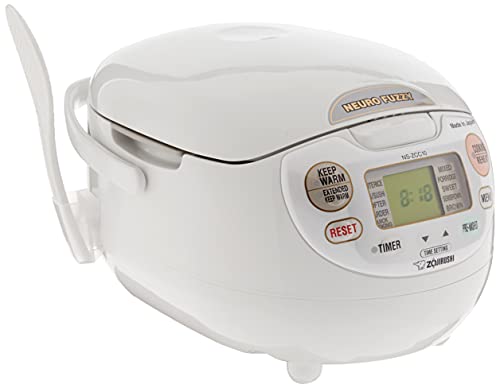
Zojirushi NS-ZCC10 Neuro Fuzzy
Fuzzy-logic control adjusts cooking time and temperature as this cooker senses the rice, which owners report gives consistently even, fluffy results across white, brown and sushi rice. A thick nonstick inner pan and extended keep-warm mode make it a set-and-forget choice. It costs more than basic switch cookers.
Pros
- Fuzzy-logic sensing adapts to different grains
- Thick nonstick inner pan heats evenly
- Extended keep-warm holds rice without drying
Cons
- Higher cost than basic switch cookers
- Slower cook time than pressure models

Cuckoo CRP-P0609S
Internal pressure drives water into each grain, and owners report this produces plumper, stickier rice than standard micom cookers, a texture prized for Korean and sushi-style rice. Turbo, GABA and mixed-grain modes add versatility, and a voice guide helps first-time users. The interface still takes time to learn.
Pros
- Pressure cooking gives fuller, stickier grains
- GABA and mixed-grain modes add versatility
- Detachable inner lid is easy to clean
Cons
- Interface takes time to learn
- Pressure release adds a few minutes to cooking

Tiger JBV-A10U
White, brown and synchro-cooking modes plus a slow-cook function make this a flexible pick for smaller households. Owners report even results and simple operation. It lacks pressure cooking, but a tinted glass lid and clear menu keep daily use easy for anyone new to a micom cooker.
Pros
- Micom sensing with a useful slow-cook mode
- Simple, clearly labeled menu buttons
- Compact footprint suits smaller kitchens
Cons
- No pressure cooking function
- Keep-warm is shorter than premium Zojirushi models

Instant Pot Duo 7-in-1
Rice cooking is one of seven functions here, alongside pressure cooking, slow cooking and steaming, which owners value for saving counter space. Its rice program handles white and multigrain well. It lacks the dedicated grain-by-grain fuzzy logic of specialist cookers, so results land good rather than perfectly dialed in.
Pros
- Replaces several appliances in one unit
- Fast pressure cooking for rice and beans
- Large capacity suits families and batch cooking
Cons
- Rice results are less tuned than dedicated cookers
- Bulkier than compact rice-only models

Aroma Housewares ARC-954SBD
White rice, brown rice, steaming and slow cooking all fit into this affordable digital cooker, along with a delay timer for scheduled meals. Owners report it is easy to use and covers the basics well. Its thinner inner pot and simpler sensing sit a step below premium micom cookers.
Pros
- Affordable with useful steam and delay features
- Generous 8-cup capacity for the price
- Simple digital controls are easy to learn
Cons
- Thinner inner pot heats less evenly
- Basic sensing compared with fuzzy-logic cookers

Panasonic SR-DF181
One-touch white and brown rice cooking, a porridge setting and automatic keep-warm keep this cooker simple. Owners report dependable, no-fuss results and easy cleanup. Anyone who wants reliable rice without navigating a long menu of modes tends to gravitate toward this model over the fuzzy-logic competition.
Pros
- One-touch operation is beginner friendly
- Large capacity for families and gatherings
- Nonstick pan wipes clean easily
Cons
- Fewer specialty modes than micom cookers
- Less precise texture control on brown rice

Hamilton Beach 37549
Big households and meal preppers get a high-capacity, two-in-one design here that also steams vegetables. Owners report it is simple and dependable for cooking large quantities. Basic switch-style control means less fine-tuning than digital or pressure models, a fair tradeoff at this price point.
Pros
- Very large capacity for batch cooking
- Steam basket doubles for vegetables
- Straightforward controls and easy cleanup
Cons
- Basic switch control offers little fine-tuning
- Less even results than sensing cookers
How to choose
Fuzzy logic vs pressure vs basic: which cooking method wins? The biggest divide between rice cookers is how they cook. Basic switch and one-touch models simply heat until the water is gone, leaving texture to chance. Fuzzy-logic micom cookers like the Zojirushi and Tiger sense temperature and adjust on the fly for more even results. Pressure cookers like the Cuckoo build internal pressure to force water into each grain, producing the plumper, stickier rice many owners prefer for Korean and sushi styles.
How many cups of rice cooker do you need? Rice cooker capacity is rated in cooked cups, not the mug you drink from, and one uncooked cup roughly doubles when cooked. A 5.5-cup cooker suits one to three people. Families or meal preppers should look toward 8 to 14 cup models instead. Cookers also perform best when at least a third full, so buying far larger than needed can hurt results on small batches.
Can a rice cooker handle brown rice and other grains? A simple cooker is fine for white rice only. Rotating through brown rice, mixed grains, sushi rice or porridge calls for dedicated settings, since each grain needs a different water ratio and cook time. GABA, multigrain and porridge modes, found on the Cuckoo and Zojirushi, handle that range far better than a single one-touch button.
What makes an inner pot and keep-warm mode worth paying for? A thick, well-coated nonstick inner pot heats more evenly and resists sticking, which is why premium cookers use heavier pans. Extended keep-warm modes hold rice at a safe, moist temperature for hours without drying, worth having if your household eats at different times. For cleaning, a removable inner lid and a dishwasher-safe pot save real effort.
How they compare
| # | Model | Capacity | Best for | Score | Price |
|---|---|---|---|---|---|
| 1 | Zojirushi NS-ZCC10 Neuro Fuzzy | 5.5 cups cooked | Best overall | 9.4 | Check price |
| 2 | Cuckoo CRP-P0609S | 6 cups cooked | Best for texture | 9.1 | Check price |
| 3 | Tiger JBV-A10U | 5.5 cups cooked | Best multicooker value | 8.8 | Check price |
| 4 | Instant Pot Duo 7-in-1 | 6 quart, roughly 8 cups cooked rice | Best multitasker | 8.6 | Check price |
| 5 | Aroma Housewares ARC-954SBD | 8 cups cooked | Best budget | 8.4 | Check price |
| 6 | Panasonic SR-DF181 | 10 cups cooked | Best simple cooker | 8.2 | Check price |
| 7 | Hamilton Beach 37549 | Up to 14 cups cooked | Best for large batches | 8.0 | Check price |
Common questions
What is the best rice cooker overall?
Based on specifications and owner feedback, the Zojirushi NS-ZCC10 is our overall pick. Its fuzzy-logic control adapts cooking to the grain, its thick inner pan heats evenly, and its extended keep-warm mode holds rice for hours without drying it out.
Is a fuzzy-logic rice cooker worth it?
For daily use across different grains, yes. Fuzzy-logic cookers sense temperature and adjust cook time automatically, so brown rice, sushi rice and porridge all come out more consistently than on a basic switch cooker. Anyone who only cooks plain white rice can get by with a simpler model.
Pressure vs micom rice cooker: what is the difference?
A micom cooker uses a microchip to sense and adjust temperature for even cooking. A pressure cooker like the Cuckoo builds internal pressure to drive water into each grain, producing plumper, stickier rice. Owners often prefer pressure for Korean and sushi styles and micom for versatile everyday rice.
How many cups of rice cooker do I need for a family?
Capacity is measured in cooked cups, and uncooked rice roughly doubles when cooked. One to three people are well served by a 5.5-cup cooker. Families or meal preppers should look at 8 to 14 cup models like the Panasonic or Hamilton Beach instead.
Can a rice cooker cook brown rice well?
Many can. Cookers with dedicated brown, multigrain or GABA settings, such as the Zojirushi, Cuckoo and Tiger, adjust water and time for those grains. A basic one-touch cooker can manage brown rice but with less consistent texture, since it does not vary the program by grain.
Does an Instant Pot make good rice?
The Instant Pot Duo makes good rice through its pressure rice program and doubles as a slow cooker and steamer. Owners value the versatility, though results land less finely tuned than a dedicated fuzzy-logic cooker built specifically for grain-by-grain accuracy.
How do you keep rice from sticking to the pot?
Rinse rice before cooking to remove excess surface starch, use the correct water ratio, and let the rice rest on keep-warm for ten minutes before fluffing. A thicker nonstick inner pot, like those in premium cookers, also reduces sticking compared with thin budget pans.
How long does rice take in a rice cooker?
White rice usually takes 25 to 40 minutes in a micom cooker, while brown rice and multigrain take longer. Pressure cookers can be faster once at pressure but add time to build and release it. Basic switch cookers are quick but offer less texture control.
Are expensive rice cookers worth the extra cost?
Higher-end cookers like the Zojirushi and Cuckoo justify their cost through better sensing, thicker inner pots, longer keep-warm and more grain settings. Budget models like the Aroma still cook rice reliably, so the right choice depends on how many grain types you cook and how much consistency you want.
Our take
The Zojirushi NS-ZCC10 remains the rice cooker to buy for most people, thanks to fuzzy-logic control, even heating and a long keep-warm mode. Choose the Cuckoo CRP-P0609S for plumper pressure-cooked texture, or the Tiger JBV-A10U for a flexible, well-priced cooker in a smaller kitchen.
You might also need

Which Salt and Pepper Mill Grinds Evenly Every Time?
7 Silicone Egg Rings for Perfectly Round Eggs Every Time
Why Your Air Fryer Isn’t Working Right (and Fixes)
