How to Choose a Robot Mower for Your Lawn Size
For most yards, the Husqvarna Automower 115H delivers the steadiest all-round performance with proven wire navigation. Owners who prefer to skip wire installation should consider the Segway Navimow i105N, which maps boundaries by GPS. Budget-focused shoppers with a compact or irregular lot do well with the Worx Landroid M WR140.
A mowed lawn without pushing a machine starts with matching coverage to your actual yard. Husqvarna Automower 115H handles typical, moderately sloped lots reliably, and Segway Navimow i105N removes the boundary wire with GPS mapping instead. Worx Landroid M WR140 suits budget-minded owners with a smaller or oddly shaped lot.
Robot mowers get confusing fast, since coverage ratings, slope limits, and boundary systems vary by model and rarely mean the same thing twice. We compared seven current listings on stated coverage area, navigation type, incline handling, and how much setup work each one demands before ranking them.
The best picks, ranked

Husqvarna Automower 115H
Husqvarna’s 115H suits yards up to about 0.4 acre and mows in short, frequent sessions rather than one long pass. Clippings mulch back into the grass for an even finish. A rain sensor and automatic docking keep the schedule running with little owner input.
Pros
- Even, mulched cut from frequent short sessions
- Quiet operation suits early morning starts
- Returns to dock on its own for rain or low battery
Cons
- Needs a boundary wire installed around the perimeter
- Coverage caps near 0.4 acre for larger lots

Segway Navimow i105N
Navimow i105N maps a lawn through GPS and a virtual boundary set in the app, so no wire goes into the ground. It handles inclines up to 45 percent, among the steepest ratings in its class. Coverage tops out near 0.12 acre, sized for compact and mid-size lots.
Pros
- Skips boundary wire installation entirely
- App-based virtual mapping speeds up setup
- 45 percent slope rating handles moderate hills
Cons
- GPS signal needs a clear view of open sky
- Rated coverage stays under a fifth of an acre
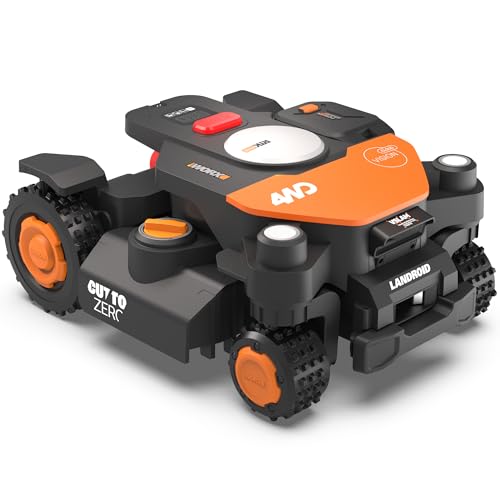
Worx Landroid M WR140
Landroid M WR140 covers up to 0.25 acre and threads through narrow side yards that stop other robots. Owners report it handles L-shaped and irregular lots well for the price. Add-on modules let the mower gain features later without a full upgrade.
Pros
- Navigates narrow side yards other robots miss
- Reasonable price relative to its coverage class
- Add-on modules expand functionality later
Cons
- Companion app feels dated next to newer rivals
- Wire install takes longer than wire-free setups

Gardena Sileno Minimo
Sileno Minimo targets small urban lawns under 0.06 acre, where a full-size robot would be overkill. Its run cycle stays quiet enough for close neighbors and early starts. Gaps as narrow as roughly two feet are passable, useful for townhouse side yards.
Pros
- Runs quietly enough for tight urban lots
- Fits through gaps around two feet wide
- Weather-resistant housing handles light rain
Cons
- Coverage suits only small lawns under 0.06 acre
- Scheduling options stay limited to the app

Greenworks Optimow 50H
Optimow 50H climbs slopes up to 47 percent, well past what most wired mowers in its coverage class manage. Scheduling and boundary edits run through Greenworks’ companion app. Coverage reaches 0.12 acre, fitting a typical mid-size, uneven yard.
Pros
- 47 percent slope rating leads its coverage class
- App handles scheduling and boundary edits directly
- 0.12 acre coverage fits a typical mid-size lot
Cons
- Boundary wire installation adds setup time
- Charging dock has a bulkier footprint

Mammotion Luba 2 AWD 5000
Luba 2 AWD 5000 pairs all-wheel drive with RTK positioning to cover up to 1.25 acre without a perimeter wire. Its 80 percent slope rating tackles banks that stop most wheeled robots. A 15.7 inch cutting deck cuts down total mowing time on big properties.
Pros
- 1.25 acre coverage suits large properties
- 80 percent slope rating clears steep banks
- RTK positioning removes the need for a wire
Cons
- Costs more than compact wired models
- RTK antenna needs careful placement for signal

Sunseeker Orbit X7
Orbit X7 combines a camera with GPS to map open lawns and mow in straight, efficient rows instead of random passes. No boundary wire is needed for setup. Best results come on flatter yards with few scattered obstacles like furniture or toys.
Pros
- Row-by-row mowing pattern speeds up coverage
- No boundary wire needed for setup
- Simple app scheduling once mapping is done
Cons
- Less reliable around dense or scattered obstacles
- Best results limited to flatter terrain
Compared at a glance
| # | Model | Coverage | Best for | Score | Price |
|---|---|---|---|---|---|
| 1 | Husqvarna Automower 115H | Up to 0.4 acre | Best overall | 9.4 | Check price |
| 2 | Segway Navimow i105N | Up to 0.12 acre | Best for wire-free GPS setup | 9.2 | Check price |
| 3 | Worx Landroid M WR140 | Up to 0.25 acre | Best value | 9.0 | Check price |
| 4 | Gardena Sileno Minimo | Up to 0.06 acre | Best for small urban lawns | 8.8 | Check price |
| 5 | Greenworks Optimow 50H | Up to 0.12 acre | Best for sloped, mid-size lots | 8.6 | Check price |
| 6 | Mammotion Luba 2 AWD 5000 | Up to 1.25 acre | Best for large properties | 8.3 | Check price |
| 7 | Sunseeker Orbit X7 | Up to 0.25 acre | Best for open, obstacle-free lawns | 8.0 | Check price |
Before you buy
How much lawn a robot mower can actually handle Coverage ratings assume an open, regular-shaped lawn. Beds, trees, and paths cut into that number fast, so a mower rated for 0.4 acre may struggle on a broken-up 0.3 acre lot. Measure the actual mowable area before choosing a class, and size up if obstacles are frequent. An undersized robot will not finish its pass before it needs to recharge.
Boundary wire versus GPS and RTK navigation Wired mowers use a perimeter cable staked or buried around the lawn edge, adding install time but staying reliable once set. GPS models like the Navimow i105N draw a virtual boundary in an app instead. RTK systems add a fixed base station for centimeter-level accuracy on large or irregular plots. Tree cover and tall buildings can weaken GPS signal, so a wire still suits shaded yards better.
Slopes, hills, and traction on uneven ground Every model publishes a maximum slope percentage, and pushing past it risks slipping or stalling. Optimow 50H and Luba 2 AWD 5000 both post ratings well above 40 percent, aimed at yards with banks or grade changes. Wet grass reduces grip below the stated figure, so treat the number as a ceiling, not a target. All-wheel drive helps on mixed terrain where a single-axle robot loses traction.
Small city lots, large acreage, and noisy neighbors A compact mower like the Sileno Minimo suits row houses and small yards where quiet operation matters most. Large-property owners need coverage well past an acre, which narrows the field to models like the Luba 2 AWD 5000. Rain sensing parks a mower automatically in wet weather, protecting both the cut and the machine. A PIN lock or alarm deters theft, worth checking since these units sit outdoors.
Common questions
How does a robot lawn mower cut grass?
Small pivoting blades snip grass tips during frequent short passes. Clippings fall back into the lawn as fine mulch instead of collecting in a bag.
What size lawn works best for a robot mower?
Match the mower’s rated coverage to your measured mowable area, not the total lot size. Complex shapes with beds and paths need a model rated above your actual square footage.
Which is better, boundary wire or GPS navigation?
Wire suits shaded or oddly shaped lawns since it needs no sky view. GPS and RTK systems skip installation but depend on a clear signal overhead.
Can a robot mower handle steep slopes?
Up to its rated maximum, yes. Check the stated slope percentage and stay under it, since wet or loose ground reduces traction below that figure.
Is a robot mower worth it for a small yard?
Compact models like the Gardena Sileno Minimo are sized and priced for lots under 0.06 acre. A larger, pricier robot would be unnecessary there.
Does rain stop a robot mower from working?
Most models are weather-resistant, and many include a rain sensor that sends the mower back to its dock. Cutting wet grass is possible but tends to clump.
How long does a robot mower run before recharging?
Typically one to two hours per outing before it docks on its own. Coverage is measured per day, so the mower resumes on its own schedule until the lawn is done.
Are robot mowers safe around pets and kids?
Blades stop when the housing is lifted or tilted, and most use small low-torque blades. Supervision around young children and pets is still recommended, as with any outdoor power tool.
What maintenance does a robot lawn mower need?
Plan to replace the small cutting blades every couple of months. Clear grass buildup from the underside and keep charging contacts clean for reliable docking.
Husqvarna Automower 115H vs Worx Landroid M WR140, which fits a tight budget?
The Landroid M WR140 costs less to buy and still covers up to 0.25 acre. The Automower 115H asks more upfront but adds a stronger slope rating and a more refined cut.
Our take
Husqvarna Automower 115H remains the steadiest pick for a typical, moderately sloped yard. Segway Navimow i105N suits anyone who wants to skip wire installation, while Worx Landroid M WR140 saves money on a compact, irregular lot. Large or steep properties call for the Mammotion Luba 2 AWD 5000, and small urban lawns fit the Gardena Sileno Minimo best.
You might also need

A Lawn Mower That Matches Your Yard Size and Terrain
Picking the Right Lawn Mower for Your Yard Size

How to Choose Hunting Decoys That Fool Wary Game
