RV Battery Monitors: Shunt Accuracy vs Bluetooth Ease
Victron’s SmartShunt delivers the most accurate amp hour tracking of the seven RV battery monitors compared here, across lithium and lead-acid alike. Renogy’s 500A Bluetooth monitor comes close for less money and adds a built-in display. The AiLi shunt meter covers basic monitoring at the lowest cost, without an app.
This comparison of seven RV battery monitors is led by the Victron Energy SmartShunt, the Renogy 500A Bluetooth monitor, and the AiLi shunt meter. Shunt-based models track real amp hours moving through the battery, while clamp-on units like the Battery Tender BM2 estimate charge from voltage alone.
RV electrical systems range from a single lead-acid battery to multi-battery lithium banks running solar and an inverter, which makes one right answer hard to pin down. Manufacturer specifications and owner reports on shunt rating, chemistry compatibility, app connectivity, and install complexity shaped how these seven were grouped.
The shortlist, ranked

Victron Energy SmartShunt 500A/50mV Battery Monitor
A 500A/50mV shunt gives this monitor real amperage and state of charge data instead of a voltage guess. Bluetooth pairs straight to the VictronConnect app, skipping the need for a separate display panel. Lithium, AGM, gel, and flooded batteries are all supported with adjustable charge efficiency settings.
Pros
- Shunt-based readings track real amp hours, not just voltage
- VictronConnect app logs history and sends low battery alerts
- Compatible with lithium and lead-acid chemistries
Cons
- No built-in display, phone or tablet required for readings
- Shunt installation means running heavier battery cables

Renogy 500A Battery Monitor with Bluetooth
Voltage, current, and remaining capacity show up in Renogy’s DC Home app over Bluetooth, backed by a 500A shunt. Lithium and lead-acid banks both work with adjustable capacity settings built into the app. A backlit LCD screen gives a local readout when a phone is not handy.
Pros
- Includes a physical LCD screen in addition to app access
- 500A shunt handles high draw inverters and multiple batteries
- Adjustable battery capacity settings for lithium or lead-acid banks
Cons
- App history and graphing are less detailed than Victron’s
- Shunt wiring adds install time compared to voltage-only units
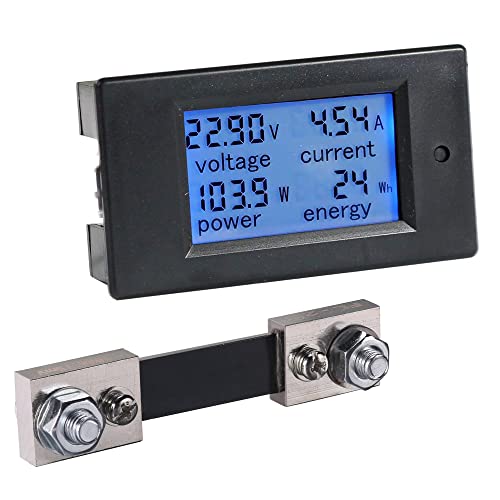
AiLi Battery Monitor Meter DC 8-100V with Shunt
Voltage, current, and amp hour tracking all land on a compact panel-mounted LCD here, no app required. An 8 to 100V range covers both 12V and 24V RV systems on the same unit. Without Bluetooth, every reading has to be checked at the panel rather than from a phone.
Pros
- Lower cost than most shunt-based competitors
- Wide voltage range covers 12V and 24V RV setups
- Simple wired display avoids Bluetooth pairing issues
Cons
- No app means no remote monitoring or history logs
- Included shunt amperage is lower than Victron or Renogy units
Bogart Engineering TriMetric TM-2030-RV Battery Monitor
Larger house battery banks are the target here, paired with a dedicated shunt and a wall-mount display. Owners report solid handling of multi-battery lead-acid and lithium banks through programmable charge parameters. Permanent RV installs running alongside solar charge controllers suit this unit particularly well.
Pros
- Designed specifically for larger multi-battery house banks
- Programmable settings match complex solar and charging setups
- Hardwired display avoids Bluetooth range or pairing limits
Cons
- No smartphone app for remote checks away from the RV
- Setup and menu programming take longer than app-based monitors

Xantrex LinkLITE Battery Monitor
A shunt paired with a dash-mount display reads voltage, current, and state of charge on the LinkLITE. Calibration leans toward flooded and AGM lead-acid banks common in older RV electrical setups. Day-to-day checks stay simple thanks to a two-button interface with no menu diving required.
Pros
- Calibration suits lead-acid and AGM banks out of the box
- Two-button interface keeps daily use simple
- Shunt-based accuracy beats voltage-only meters
Cons
- Lithium battery support is more limited than newer monitors
- No Bluetooth or app connectivity for remote viewing

Ampere Time Battery Monitor 500A Shunt with Bluetooth
A 500A shunt feeds this monitor’s Bluetooth app, which is tuned specifically to LiFePO4 charge and discharge curves. State of charge, cycle count, and remaining amp hours all track for lithium banks in particular. Lead-acid presets exist too, but lithium calibration is clearly the main selling point.
Pros
- Charge curve calibration matches LiFePO4 batteries closely
- Tracks cycle count alongside amp hours and voltage
- Bluetooth app pairs easily with Ampere Time’s own batteries
Cons
- Lead-acid accuracy is secondary to the lithium tuning
- App feature set is narrower than Victron’s VictronConnect

Battery Tender BM2 Bluetooth Battery Monitor
Clipping onto battery terminals, the BM2 sends voltage readings straight to a phone app over Bluetooth and skips shunt wiring entirely. Basic state of charge alerts are the goal for owners who do not want to run new cables. Amp hour tracking is unavailable since the unit reads voltage only.
Pros
- Installs in minutes by clamping onto battery terminals
- No shunt or cable routing required
- Compact size fits tight battery compartments
Cons
- Voltage-only readings are less precise than shunt-based amp hour tracking
- Cannot log real current draw from individual appliances
Side by side
| # | Model | Monitoring type | Best for | Score | Price |
|---|---|---|---|---|---|
| 1 | Victron Energy SmartShunt 500A/50mV Battery Monitor | Shunt-based | Best overall | 9.4 | Check price |
| 2 | Renogy 500A Battery Monitor with Bluetooth | Shunt-based | Best value | 9.1 | Check price |
| 3 | AiLi Battery Monitor Meter DC 8-100V with Shunt | Shunt-based | Best budget | 8.8 | Check price |
| 4 | Bogart Engineering TriMetric TM-2030-RV Battery Monitor | Shunt-based | Best for multi-battery bank monitoring | 8.6 | Check price |
| 5 | Xantrex LinkLITE Battery Monitor | Shunt-based | Best for lead-acid and AGM battery banks | 8.3 | Check price |
| 6 | Ampere Time Battery Monitor 500A Shunt with Bluetooth | Shunt-based | Best for lithium and LiFePO4 battery banks | 8.1 | Check price |
| 7 | Battery Tender BM2 Bluetooth Battery Monitor | Voltage-only, no shunt | Best for simple voltage-only monitoring without a shunt | 8.0 | Check price |
How to pick the right one
How Do RV Battery Monitors Work? Two categories cover most RV battery monitors on the market today. Shunt-based monitors measure actual current flowing in and out of the battery through a precision resistor, giving accurate amp hour and state of charge data. Voltage-only monitors, like the Battery Tender BM2, read terminal voltage and estimate charge level from that single number. Shunt-based systems from Victron, Renogy, AiLi, Bogart Engineering, and Xantrex generally track remaining capacity more closely than voltage alone.
Shunt-Based vs Bluetooth Voltage Monitors: Which Fits Your Rig? Wiring a shunt between the battery negative terminal and the RV’s negative bus takes more install time than a clamp-on unit. Bluetooth voltage monitors like the BM2 clamp onto terminals and pair with an app in minutes, with no rewiring involved. That extra install step on shunt-based units buys amp hour tracking, useful for sizing solar arrays or inverters correctly. Owners who just want a quick charge check before a trip may find a voltage-only monitor is plenty.
Choosing a Monitor for Lithium vs Lead-Acid Battery Banks Lithium and LiFePO4 batteries hold a flatter voltage curve than lead-acid, making voltage-only readings less reliable for judging state of charge. Ampere Time’s 500A shunt unit calibrates specifically for LiFePO4 discharge curves as a result. Xantrex LinkLITE and Bogart TriMetric skew toward lead-acid and AGM calibration, common in older RV electrical systems. Owners with mixed or upgraded battery banks can switch chemistry presets in either the Victron or Renogy app.
Monitoring Multi-Battery Banks and Larger RV Electrical Systems Multiple parallel batteries need a monitor rated for the bank’s combined peak current draw, not just one battery’s output. Both the Bogart TriMetric TM-2030-RV and Victron SmartShunt handle 500A shunts, enough for multi-battery lithium banks paired with large inverters. Solar charge controllers and inverters should route through that same shunt point, or the displayed numbers will not match the bank’s actual state. Anyone adding lithium batteries to an existing lead-acid system should confirm the monitor supports mixed or reconfigurable chemistry settings first.
Frequently asked questions
What is a shunt in an RV battery monitor?
A shunt is a low-resistance resistor wired into the battery’s negative cable, letting the monitor measure actual current flowing in and out rather than just voltage.
How do I install an RV battery monitor?
Shunt-based monitors need the shunt wired between the battery’s negative terminal and the RV’s negative bus bar, then the display or Bluetooth module connected. Voltage-only monitors like the BM2 simply clamp onto the battery terminals with no rewiring.
Which RV battery monitor works best with lithium batteries?
Ampere Time’s 500A shunt monitor calibrates specifically for LiFePO4 charge curves. Victron’s SmartShunt and Renogy’s Bluetooth monitor also support lithium presets alongside lead-acid settings.
Can one monitor track multiple batteries in a bank?
Yes, as long as every battery in the bank routes through the same shunt point. The Bogart TriMetric and Victron SmartShunt are both rated for 500A, enough for larger multi-battery banks.
Is a Bluetooth battery monitor accurate enough for RV use?
Bluetooth shunt-based monitors like Victron’s SmartShunt or Renogy’s model measure real current, which keeps them accurate. Bluetooth voltage-only monitors like the BM2 are less precise since they estimate charge from terminal voltage alone.
What is the difference between a battery monitor and a voltmeter?
A voltmeter only shows terminal voltage at a single moment. A battery monitor with a shunt tracks amp hours used and remaining, giving a fuller state of charge picture.
Does shunt amperage rating matter for RV setups?
Yes, since the shunt has to handle peak current from inverters, appliances, and charging sources combined. Larger inverter setups typically need a 500A shunt like those on the Victron, Renogy, or Bogart monitors.
Can I use a battery monitor without installing a shunt?
Yes, voltage-only monitors like the Battery Tender BM2 clamp directly onto battery terminals with no shunt wiring, trading some accuracy for a much simpler install.
How long does a shunt-based monitor take to install?
Most owners report an hour or two for wiring the shunt and mounting a display, longer on RVs with tight access to the battery compartment.
Battery monitor vs built-in RV converter display, which is more accurate?
A dedicated shunt-based monitor almost always beats a built-in converter display, since converters typically estimate charge from voltage rather than measuring real current.
Our take
Owners chasing the most precise amp hour tracking across battery chemistries should look at the Victron SmartShunt first. Renogy’s monitor offers similar shunt-based accuracy at a lower barrier to entry, and the Battery Tender BM2 fits anyone who wants basic voltage alerts without running new wiring.

