RV Converter Chargers Compared by Amperage and Battery Type
Progressive Dynamics PD9260CV, WFCO WF-8955-AD and IOTA DLS-55 with IQ4 rank highest among seven RV converter chargers compared here. The PD9260CV suits rigs needing 60 amps and lithium compatibility. WFCO’s unit dominates OEM fifth wheel installs, and the IOTA DLS-55 offers the best value for owners upgrading from single-stage converters.
Progressive Dynamics, WFCO and IOTA build some of the best-reviewed RV converter chargers on the market. Progressive Dynamics’ PD9260CV leads for owners wanting lithium compatibility and 60 amp output, while WFCO’s WF-8955-AD ships as the standard OEM choice in large fifth wheels. IOTA’s DLS-55 adds four-stage charging at a lower cost once paired with its IQ4 controller.
Choosing the right unit is tricky because amperage needs, battery chemistry and mounting footprint differ by rig and battery bank size. Getting any of the three wrong risks slow charging or a converter that will not fit the existing cutout. We compared rated amperage, charging stage count, battery-type compatibility and how closely each footprint matched common OEM converters, then weighed owner feedback on noise, heat and lithium support.
Our top picks

Progressive Dynamics PD9260CV
Progressive Dynamics built this 60 amp charger around its four-stage Charge Wizard, switching automatically between bulk, absorption, float and equalization modes. A remote control panel unlocks a lithium charge profile for owners who upgraded their house batteries. Many Class A and fifth wheel manufacturers install this unit at the factory.
Pros
- Four charge stages reduce battery sulfation over time
- Remote panel adds lithium and desulfation modes
- Widely used as OEM equipment so replacement parts are easy to find
Cons
- Remote control sold separately on some listings
- Larger footprint than basic single-stage converters
WFCO WF-8955-AD
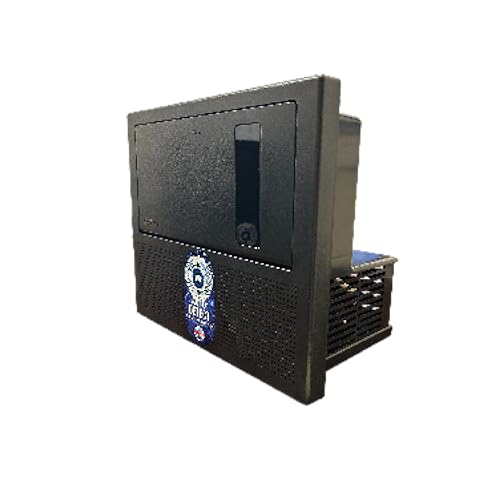
WFCO’s WF-8955 series delivers 55 amps and ships as factory equipment in many Forest River, Keystone and Jayco units. Three-stage charging auto-detects wet cell, AGM or gel batteries without manual switches. Owners report stable output even when roof air conditioning and a full battery bank draw power at once.
Pros
- Auto-detect battery sensing needs no manual setup
- Common OEM part so cross-referencing model numbers is straightforward
- Handles simultaneous AC load and battery charging without derating
Cons
- No lithium-specific charge profile
- Cooling fan can be audible under heavy load

IOTA DLS-55 with IQ4
IOTA pairs a 55 amp converter with an optional IQ4 smart controller for four-stage charging on the DLS-55. Skip the IQ4 module and it runs a simpler two-stage profile, which keeps the base cost down. Compact dimensions make it a common upgrade for owners replacing an aging single-stage converter.
Pros
- Lower cost than comparable 55 amp units with built-in smart charging
- IQ4 controller is a simple add-on upgrade later
- Compact size fits tight converter bays
Cons
- Four-stage charging requires buying the IQ4 controller separately
- No included digital display

Xantrex TRUECharge2 40
Xantrex runs a three-stage charging algorithm on the TRUECharge2, with selectable profiles for flooded, gel, AGM and calcium batteries. A remote panel with LED status lights ships with the 40 amp model. Marine-grade construction resists the corrosion that RV converters near battery compartments often face.
Pros
- Selectable profiles cover flooded, gel, AGM and calcium batteries
- Marine-grade housing resists moisture and corrosion
- Remote panel shows charge stage at a glance
Cons
- 40 amp output is lower than some 55 to 60 amp competitors
- Heavier than comparable converters in its amperage class
Powermax PM3-55
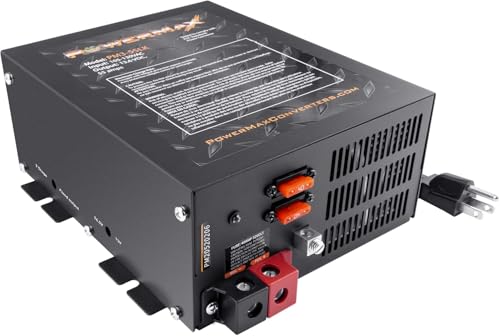
Powermax’s PM3 series delivers 55 amps with automatic three-stage charging in a compact wall-mount enclosure. Cooling fans engage only under load, keeping noise down during light use. Basic LED indicators ship in place of a full digital readout.
Pros
- Lower price point than name-brand OEM converters
- Load-activated fan reduces noise during light charging
- Compact enclosure fits aftermarket installs
Cons
- No lithium charge profile
- Build quality reports are less consistent than premium brands

Parallax Power Supply 8345
Parallax’s 8345 outputs 45 amps and matches the physical footprint of older Magnetek and Parallax converters. That makes it a straightforward drop-in replacement. Three-stage charging protects battery life better than the single-stage units it typically replaces, and analog design skips digital displays entirely.
Pros
- Matches mounting holes of older converters for easy swaps
- Three-stage charging is a clear upgrade from single-stage originals
- Straightforward wiring with no programming required
Cons
- No remote panel or app connectivity
- 45 amp ceiling limits use with larger battery banks

Progressive Dynamics PD9140CV
This 40 amp converter suits pop-up campers, small travel trailers and cargo trailer conversions with modest battery banks. It shares the four-stage Charge Wizard technology found in Progressive Dynamics’ larger units, scaled down for lighter electrical loads. Compact sizing eases installation in cramped power centers.
Pros
- Four-stage charging in a smaller, lighter unit
- Fits power centers with limited clearance
- Lower amperage keeps cost down for small battery banks
Cons
- 40 amps is insufficient for large house battery banks
- Not intended for high-draw fifth wheels or Class A coaches
Compared at a glance
| # | Model | Amperage | Best for | Score | Price |
|---|---|---|---|---|---|
| 1 | Progressive Dynamics PD9260CV | 60A | Best overall | 9.4 | Check price |
| 2 | WFCO WF-8955-AD | 55A | Best for large fifth wheels | 9.2 | Check price |
| 3 | IOTA DLS-55 with IQ4 | 55A | Best value | 8.9 | Check price |
| 4 | Xantrex TRUECharge2 40 | 40A | Best for lithium and AGM banks | 8.7 | Check price |
| 5 | Powermax PM3-55 | 55A | Best budget | 8.4 | Check price |
| 6 | Parallax Power Supply 8345 | 45A | Best for travel trailer upgrades | 8.2 | Check price |
| 7 | Progressive Dynamics PD9140CV | 40A | Best for small RVs and campers | 8.0 | Check price |
What to look for
What Does an RV Converter Charger Actually Do? A converter charger takes 120V AC shore or generator power and steps it down to 12V DC to run lights, fans and other RV electronics. At the same time, it charges the house battery bank using a multi-stage algorithm similar to a standalone smart charger. Most units combine both jobs in one metal enclosure mounted near the main power distribution panel.
How Many Amps Does Your RV Need? Amperage needs scale with battery bank size and how quickly you want to recharge. A rough guideline puts the charger at 10 to 20 percent of total battery bank capacity in amp-hours, so a 200 amp-hour bank pairs well with a 30 to 40 amp charger. Larger banks in fifth wheels often call for 55 to 60 amps instead. Undersized converters just take longer to reach full charge rather than risking damage.
Converter Charger vs Inverter Charger: What Is the Difference? A converter charger only steps AC down to DC and charges the battery; it cannot turn battery power back into AC for household outlets. An inverter charger, like many Xantrex and Victron combo units, handles both directions, converting DC to AC when off-grid and AC to DC when plugged in. Most factory-installed RV power centers use a simple converter charger, saving inverter chargers for boondocking-focused builds.
Which Converter Charger Works Best for a Lithium Battery Upgrade? Lithium iron phosphate batteries need a charge profile without the trickle or equalization stages built for lead-acid chemistry. Progressive Dynamics’ PD9260CV and Xantrex’s TRUECharge2 offer selectable or remote-activated lithium profiles that cap voltage appropriately. Charging a lithium bank with a lead-acid-only converter can leave it undercharged or trigger its internal protection circuit.
Good to know
What is the best RV converter charger for lithium batteries?
Progressive Dynamics’ PD9260CV and Xantrex’s TRUECharge2 both offer selectable lithium charge profiles that skip the equalization stage lead-acid batteries need, based on their published specifications.
How many amps should an RV converter charger be?
Match roughly 10 to 20 percent of your battery bank’s amp-hour capacity. A 100 amp-hour bank suits a 20 to 30 amp charger, while 400 amp-hour banks often need 55 to 60 amps.
Can I replace my RV converter charger myself?
Many owners swap converters themselves when the replacement matches the original’s mounting footprint and amperage. Parallax’s 8345 is designed as a drop-in replacement for older Magnetek converters.
Is a 55 amp converter charger enough for a travel trailer?
For most travel trailers with a single or dual battery lead-acid bank, 55 amps charges efficiently without excess heat. Larger lithium banks may benefit from 60 amp units instead.
What is the difference between a converter charger and an inverter charger?
A converter charger only steps AC down to DC to charge batteries. An inverter charger also converts DC battery power into usable AC for outlets when off-grid.
Which RV converter charger is best for boondocking?
Boondocking owners often prefer units with a dedicated lithium or AGM profile, such as the IOTA DLS-55 with IQ4 or Xantrex TRUECharge2, since these support deeper daily discharge cycles.
How long does an RV converter charger take to recharge a battery?
Recharge time depends on amperage and battery depth of discharge. A 55 amp charger can bring a moderately depleted 200 amp-hour bank back to near full in a few hours during the bulk stage.
Is WFCO or Progressive Dynamics better for RV converter chargers?
WFCO units are common OEM equipment with reliable auto-detect charging. Progressive Dynamics’ Charge Wizard line adds more charge stages and a remote lithium mode option, according to each brand’s listed specifications.
Do RV converter chargers work with AGM batteries?
Yes. Units like the WFCO WF-8955-AD auto-detect AGM chemistry, and the Xantrex TRUECharge2 includes a selectable AGM profile alongside flooded, gel and calcium settings.
What size RV converter charger fits a small camper?
Pop-up campers and small trailers with modest battery banks typically pair well with a 40 amp unit like the Progressive Dynamics PD9140CV, which keeps cost and size down.
The verdict
Progressive Dynamics’ PD9260CV covers the widest range of rigs thanks to its 60 amp output and remote lithium mode. Owners running large fifth wheels or needing a drop-in OEM match should look at WFCO or Parallax instead. Budget-focused upgrades from single-stage converters fit better with the IOTA DLS-55 or Powermax PM3-55.