Science Kits That Keep Curious Kids Experimenting
The Thames and Kosmos Chem C1000 leads for older children who want genuine chemistry with a proper manual. Snap Circuits Jr. SC-100 is the strongest electronics introduction. For younger scientists, the Learning Resources Primary Science Lab Activity Set turns everyday curiosity into structured play.
The Thames and Kosmos Chem C1000 is our overall pick for real chemistry at home, Snap Circuits Jr. SC-100 is the best electronics starter, and the Learning Resources Primary Science Lab Activity Set suits the youngest scientists. Each targets a clearly different age band, so start there rather than with the feature list.
Science kits are tricky because the box count tells you nothing about how long the kit stays interesting. Many kits promise dozens of experiments but consume their chemicals in a single afternoon, leaving parts that cannot be reused. Others contain reusable components that support open ended building for years. We compared how many experiments are genuinely repeatable, whether consumables are replaceable, the clarity of the instruction manual, the level of adult supervision required and how honest the stated age range is.
Before you buy
Match the kit to the age, not the enthusiasm Age ranges on science kits are more meaningful than on most toys, because the limiting factor is usually reading comprehension and fine motor control rather than interest. A seven year old handed the Chem C1000 will need an adult reading every step, which drains the independence that makes these kits rewarding. Buying slightly below the child’s reading level generally produces more actual experimenting.
Consumable kits end, reusable kits continue This is the biggest practical divide in the category. Chemistry sets, crystal growing kits and geodes are consumed as they are used. Snap Circuits and the Primary Science Lab set can be rebuilt endlessly. Neither is wrong, but a consumable kit is a weekend activity while a reusable one can occupy a child on and off for years. Check whether refills are available before buying a consumable set.
The manual is the product Two kits with identical contents can produce completely different experiences depending on the manual. The best ones explain why a reaction happens, suggest variations to try, and build concepts in sequence. The weakest ones list steps with no explanation, which produces a magic trick rather than a science lesson. Thames and Kosmos manuals are consistently the strongest in this ranking.
Plan for supervision and mess Any kit involving chemicals, hot water, hammers or plaster needs an adult present and a surface you do not mind ruining. Owners report that setting up on a covered table or outdoors removes most of the friction that otherwise stops these kits from coming out again. Goggles should be worn for anything involving breaking, heating or mixing, and several kits here include them.
What we recommend

Thames & Kosmos Chem C1000 Chemistry Set
The Chem C1000 is a genuine chemistry set rather than a novelty, with real glassware, a spirit burner and a manual that teaches the reasoning behind each reaction. It is aimed at older children and rewards working through the experiments in order. Owners report the manual is the standout element, reading like a proper introductory textbook.
Pros
- Manual explains the science, not just the steps
- Real laboratory glassware and equipment
- Chemicals are replaceable from refill sets
Cons
- Requires close adult supervision throughout
- Too advanced for younger primary age children

Snap Circuits Jr. SC-100 by Elenco
Snap Circuits replaces wires and soldering with colour coded components that snap onto a grid, so a child can build a working circuit in minutes and understand what each part does. Nothing gets consumed, which means the kit stays useful for years. Based on specifications the project book covers a hundred builds and scales up with expansion sets.
Pros
- Nothing is consumed, so it lasts for years
- Concepts transfer directly to real electronics
- Expandable with larger Snap Circuits sets
Cons
- Batteries are not included
- Small parts need organising or they scatter
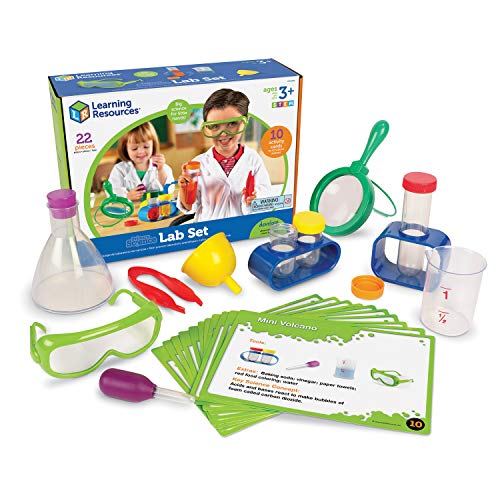
Learning Resources Primary Science Lab Activity Set
This set gives young children chunky, genuinely functional lab tools including beakers, a magnifier, tweezers and goggles, sized for small hands. It has no chemicals, which is exactly right at this age. Owners report it turns kitchen experiments with water, food colouring and household items into something that feels properly scientific.
Pros
- Tools are sized and shaped for small hands
- No chemicals to worry about at this age
- Reusable indefinitely with household materials
Cons
- Needs a parent to supply the experiments
- Too simple for children over about seven

National Geographic Mega Fossil Dig Kit
Children chip real fossil specimens out of a moulded plaster block with the included tools, which turns identification into a genuinely earned reward. The specimens are actual fossils rather than replicas. Based on specifications the kit includes a learning guide that explains what each find is and how it formed.
Pros
- Real fossil specimens, not plastic replicas
- Patient, absorbing activity for an afternoon
- Finds become a keepable collection
Cons
- One time use, the block cannot be reset
- Digging makes a considerable mess

Thames & Kosmos Kids First Science Laboratory
This bridges the gap between a toy science set and a real chemistry kit, using safe household materials with proper laboratory equipment. The manual is illustrated for children who are still building reading confidence. Owners report it is the right stepping stone before a child is ready for the Chem C1000.
Pros
- Safe introduction to real lab equipment
- Illustrated manual suits early readers
- Uses common household materials
Cons
- Fewer experiments than larger sets
- Some parts feel lightweight in use

4M Crystal Growing Kit
Growing crystals over several days teaches patience alongside supersaturation and nucleation, which is a rare combination in a kit at this price. The finished crystals are genuinely attractive and children tend to keep them. Based on specifications the kit produces several crystals in different colours from the included compounds.
Pros
- Teaches patience and observation over days
- Results are attractive and worth keeping
- Very low cost for the learning involved
Cons
- Chemicals are consumed and not refillable
- Requires adult help handling hot water

National Geographic Break Open 10 Geodes Kit
Cracking open a geode and finding crystals inside delivers an immediate result, which suits children who lose interest in longer experiments. The geodes are real and no two are identical. Owners report it works particularly well as a group activity at parties or with siblings, since everyone opens their own.
Pros
- Immediate, satisfying result every time
- Real geodes with unique interiors
- Works well as a shared group activity
Cons
- Once opened, the kit is finished
- Needs a hammer and adult supervision
How they stack up
| # | Model | Age range | Best for | Score | Price |
|---|---|---|---|---|---|
| 1 | Thames & Kosmos Chem C1000 Chemistry Set | Roughly 10 and up | Best overall | 9.4 | Check price |
| 2 | Snap Circuits Jr. SC-100 by Elenco | Roughly 8 and up | Best for electronics | 9.2 | Check price |
| 3 | Learning Resources Primary Science Lab Activity Set | Roughly 3 and up | Best for young children | 9.0 | Check price |
| 4 | National Geographic Mega Fossil Dig Kit | Roughly 6 and up | Best for discovery play | 8.7 | Check price |
| 5 | Thames & Kosmos Kids First Science Laboratory | Roughly 5 and up | Best first chemistry set | 8.5 | Check price |
| 6 | 4M Crystal Growing Kit | Roughly 10 and up | Best value | 8.2 | Check price |
| 7 | National Geographic Break Open 10 Geodes Kit | Roughly 6 and up | Best gift kit | 8.0 | Check price |
Common questions
What age is right for a first real chemistry set?
Around ten for a set with real glassware and a burner like the Chem C1000. Younger children get more from a chemistry style kit using safe household materials, such as the Thames and Kosmos Kids First Science Laboratory, which introduces the same equipment without the risks.
Are science kits safe for children?
The kits here are designed for home use within their stated age ranges, but several require adult supervision for chemicals, heat or hammering. Read the manual before the first session, use the included goggles, and keep chemical kits stored out of reach of younger siblings between uses.
Do science kits run out after one use?
Some do. Crystal growing kits and geode kits are consumed entirely. Chemistry sets consume chemicals but often offer replacement packs. Snap Circuits and basic lab tool sets are fully reusable, which is why they tend to hold a child’s attention across a longer period.
Which kit is best for a child who loses interest quickly?
Something with an immediate result. The National Geographic Break Open Geodes kit rewards effort within minutes, and Snap Circuits produces a working circuit almost instantly. Long duration projects like crystal growing suit children who already enjoy waiting for a result.
Can science kits actually help with schoolwork?
They help most with intuition rather than curriculum coverage. A child who has built a series circuit with Snap Circuits or watched a reaction change colour has a mental picture to attach to the classroom explanation later. The kits with strong explanatory manuals contribute the most here.
Do I need to buy extra materials?
Sometimes. Snap Circuits needs AA batteries, geode kits need a hammer and a cloth, and the Primary Science Lab set relies on you supplying household materials to experiment with. Check the included contents list before wrapping a kit as a gift so the first session is not delayed.
Are chemistry set refills available?
For Thames and Kosmos chemistry sets, yes, replacement chemical packs are sold separately, which extends the life of the kit considerably. Most smaller consumable kits do not offer refills, so treat those as single project purchases rather than long term investments.
What makes a science kit worth keeping?
Reusable components, a manual that explains the reasoning, and room to grow. Owners report that kits which allow open ended experimentation beyond the printed projects get returned to repeatedly, while kits with a fixed set of steps tend to be finished and shelved.
The verdict
The Thames and Kosmos Chem C1000 is the strongest science kit here for children ready for real chemistry, largely because its manual teaches reasoning rather than just steps. Snap Circuits Jr. SC-100 is the better long term buy for younger children, since nothing is consumed and the kit expands. For preschool and early primary age, the Learning Resources Primary Science Lab Activity Set makes everyday curiosity feel like proper science.


