Scratching Posts Cats Use Instead of Your Sofa
The SmartCat Ultimate Scratching Post is our top pick because its height and weighted base suit full body stretching. The PetFusion Ultimate Cat Scratcher Lounge is better value for cats that prefer horizontal cardboard, and the Amazon Basics Cat Scratching Post is the sensible budget option.
The SmartCat Ultimate Scratching Post is the one we would buy first for a determined scratcher, with the PetFusion Ultimate Cat Scratcher Lounge as the better value pick for cats that scratch horizontally and the Amazon Basics Cat Scratching Post as the budget starting point.
Scratching posts fail for predictable reasons rather than mysterious ones. A post that wobbles teaches a cat that furniture is safer, a post shorter than a full stretch never gets used, and a surface the cat dislikes gets ignored no matter where you put it. We compared published dimensions, base weights and surface materials, alongside the patterns that show up repeatedly in verified owner reviews, to identify which posts survive real daily use.
What matters most
Height and stability decide everything A cat scratches partly to stretch, so a post shorter than its full extended body will never compete with the arm of your sofa. Equally important is the base, because a post that rocks under pressure feels unsafe and gets abandoned. When comparing two posts, weight and height beat looks and colour every time.
Cats have surface and orientation preferences Some cats are vertical scratchers, some work horizontally on the carpet, and some prefer an angled surface. Sisal fabric, sisal rope, cardboard and carpet all feel different under the claws. If your cat targets rugs, buy a horizontal cardboard scratcher rather than another upright post and you will see faster results.
Placement matters as much as the product Put the post where the unwanted scratching happens, not where it looks tidiest. Cats scratch to mark territory in social areas and to stretch after sleeping, so beside the sofa and near the bed are the two highest value positions. Moving a rejected post to one of those spots often fixes the problem on its own.
Plan for wear and replacement Cardboard scratchers are consumables and will need replacing, which is fine if the model takes replacement inserts. Sisal fabric lasts the longest, and rope wrapped posts sit in between but can unravel. Owners report that keeping a worn post in place while introducing a new one avoids the cat rejecting the replacement outright.
The shortlist, ranked

SmartCat Pioneer Pet Ultimate Scratching Post
This post gets the two fundamentals right, standing tall enough for an adult cat to stretch fully and sitting on a base heavy enough that it does not shift mid scratch. The woven sisal fabric wears down slowly and does not shed loose string the way rope wrapped posts do. Owners consistently report it being the post that finally redirected a sofa scratcher.
Pros
- Height suits full body stretching, which most posts miss
- Sisal fabric outlasts wrapped rope
- Base stays stable under an enthusiastic cat
Cons
- Plain look that some owners dislike
- Only offers vertical scratching

PetFusion Ultimate Cat Scratcher Lounge
Half scratcher and half lounger, this curved cardboard piece appeals to cats that scratch horizontally and then sleep where they scratched. The recycled cardboard is dense enough to last far longer than flat pads. Expect cardboard crumbs, which is the trade off for a surface most cats take to immediately.
Pros
- Doubles as a bed, so cats stay near it
- Reversible surface extends its life
- Very high acceptance rate among cats
Cons
- Sheds cardboard crumbs onto the floor
- Not suitable for vertical scratchers

Amazon Basics Cat Scratching Post
A straightforward carpet and sisal post with a dangling toy, this is the low commitment way to find out what your cat prefers before spending more. It is shorter and lighter than the SmartCat, so a large cat can shift it. For kittens and lighter adults it does the job.
Pros
- Lowest cost way to test what your cat likes
- Included toy encourages first use
- Quick to assemble
Cons
- Base can shift under a heavy cat
- Rope loosens with hard use
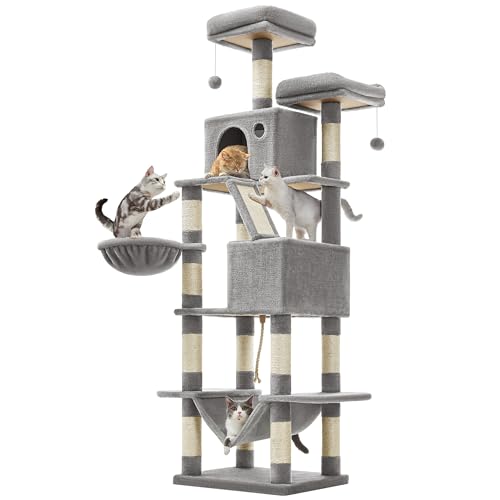
FEANDREA Cat Tree with Sisal Covered Posts
When two or more cats compete for territory, a tree with several sisal posts spreads the scratching across levels and reduces conflict. Owners report the platforms get as much use as the posts. It takes real floor space, so plan the location before ordering.
Pros
- Multiple scratching posts reduce competition
- Adds vertical territory as well as scratching
- Good value for the amount of structure
Cons
- Occupies significant floor space
- Assembly takes time

Catit Style Scratcher Bench
This low bench style scratcher tucks against a wall or under furniture where a tall post would not fit, and it looks tidier than most cat gear. The corrugated insert is replaceable, which keeps it useful long term. It suits horizontal scratchers rather than cats that reach up.
Pros
- Fits in apartments where tall posts do not
- Replaceable insert instead of a whole new unit
- Understated design
Cons
- No vertical scratching option
- Replacement inserts are an ongoing cost

Necoichi Cozy Cat Scratcher Bowl
The bowl shape gives cats a curved wall to scratch and a rim to rest against, which suits cats that like to feel enclosed. Owners report it becomes a favourite sleeping spot as much as a scratcher. The cardboard construction means it is not for heavy vertical clawing.
Pros
- Doubles as an enclosed resting spot
- Curved wall suits side scratching
- Easy to move between rooms
Cons
- Light enough to slide on hard floors
- Wears through faster than sisal

TRIXIE Mijas Scratching Post
A compact post with a plush platform sized for kittens and smaller cats learning where scratching belongs. The footprint is small enough for a hallway or bedroom corner. Adult cats will outgrow the height quickly, so treat it as a first post rather than a lasting one.
Pros
- Right scale for kittens
- Small footprint for tight rooms
- Platform encourages perching
Cons
- Too short for a stretching adult cat
- Plush attracts hair and needs vacuuming
How they compare
| # | Model | Height | Best for | Score | Price |
|---|---|---|---|---|---|
| 1 | SmartCat Pioneer Pet Ultimate Scratching Post | Tall enough for a full adult stretch | Best overall | 9.4 | Check price |
| 2 | PetFusion Ultimate Cat Scratcher Lounge | Recycled corrugated cardboard | Best value | 9.2 | Check price |
| 3 | Amazon Basics Cat Scratching Post | Sisal rope with carpet base | Best budget | 9.0 | Check price |
| 4 | FEANDREA Cat Tree with Sisal Covered Posts | Multi level cat tree | Best for multi cat homes | 8.8 | Check price |
| 5 | Catit Style Scratcher Bench | Replaceable corrugated insert | Best for small spaces | 8.6 | Check price |
| 6 | Necoichi Cozy Cat Scratcher Bowl | Corrugated cardboard | Best for cats that curl up | 8.3 | Check price |
| 7 | TRIXIE Mijas Scratching Post | Sisal wrapped post | Best for kittens | 8.0 | Check price |
Questions worth asking
How tall should a scratching post be?
Tall enough that your cat can reach up and stretch fully without folding at the elbows. For an average adult cat that means roughly thirty inches or more, which rules out many cheap posts.
Why does my cat ignore its scratching post?
The three usual causes are a post that wobbles, a post that is too short, or a surface the cat dislikes. Location is the fourth. Try moving it next to the furniture being scratched before assuming the post itself is wrong.
Is sisal or cardboard better?
Sisal lasts much longer and suits vertical scratching. Cardboard is cheaper, appeals strongly to cats that scratch horizontally, and needs replacing more often. Many households end up with one of each.
How many scratching posts does one cat need?
At least one per cat plus one spare is a common recommendation, placed in different rooms. Cats scratch to mark territory, so a single post in a back room rarely covers the whole home.
Does catnip help a cat accept a new post?
Often, yes. Rubbing dried catnip into the surface or using a spray gives the cat a reason to investigate. Roughly a quarter of cats do not respond to catnip at all, so it is not a guaranteed fix.
Will a scratching post stop my cat damaging furniture?
It substantially reduces it when the post is the right height, stable and correctly placed. Combining a good post with keeping claws trimmed and covering the targeted spot temporarily is what owners report works best.
Are cat trees better than plain posts?
For multi cat homes, usually yes, because they add vertical territory as well as scratching surfaces. For a single cat in a small flat, a well made single post is easier to place and cheaper.
How often should a cardboard scratcher be replaced?
Owners typically report a few months of regular use before the surface is chewed through. Flipping reversible models roughly doubles that.
The verdict
The SmartCat Ultimate Scratching Post remains the most reliable answer for a cat that scratches furniture, because its height and weighted base address the two reasons posts usually fail. Add or substitute the PetFusion Ultimate Cat Scratcher Lounge if your cat works horizontally, and consider the FEANDREA tree when several cats share the space.