7 Scroll Saws Serious Woodworkers Rely On
Among seven scroll saws compared, the DeWalt DW788 leads for stability and control layout, the Delta 40-694 suits long shop sessions with its cast iron table, and the WEN 3921 delivers the best value through a rotating head and built-in air pump. Throat depth and blade clamp design separate the rest.
A scroll saw’s throat depth, blade clamp style and table material decide whether it suits fine fretwork, intarsia or thicker stock. The DeWalt DW788, Delta 40-694 and WEN 3921 top this comparison for stability, session comfort and value respectively.
Vibration and blade breakage frustrate many first-time buyers, since specs alone rarely show how a saw feels mid-cut. We compared throat depth, blade clamp design, table construction and speed range using manufacturer specifications and owner-reported feedback from Amazon listings.
Before you buy
What to Look For in a Scroll Saw Throat depth sets the maximum distance from blade to frame, so a 20 inch saw like the DeWalt DW788 or Delta 40-694 handles larger workpieces than a 16 inch model. Cutting capacity, typically 2 inches at 90 degrees across this comparison, determines maximum stock thickness. Blade clamp design ranges from thumbscrews to tool-free levers, affecting how often a user tolerates blade changes. Table material also matters: cast iron tables found on the Delta 40-694 and Shop Fox W1713 dampen vibration better than stamped steel.
What Causes Scroll Saw Vibration and How to Reduce It Arm geometry drives most vibration differences between models. Parallel link arms, used on the DeWalt DW788, keep the blade moving in a straight vertical line and cut side-to-side shake. Rotary or C-arm designs, common on budget saws like the WEN 3920, transmit more motion into the table at higher speeds. Bolting the saw to a bench or stand reduces walking regardless of arm type, and a cast iron table adds mass that absorbs residual vibration.
Matching a Scroll Saw to Fretwork, Intarsia and Puzzle Cutting Fretwork with fine detail benefits from tool-free blade changes, since patterns often call for dozens of pierce cuts per project. The SKIL SS9503-00 and Rikon 10-600VS both simplify that swap, though the Rikon’s lever clamp handles the fastest changes. Intarsia projects cut multiple wood species at varying thicknesses, so a saw with a stable table and consistent tension, like the Shop Fox W1713, keeps pieces flush. Puzzle makers cutting long, repetitive curves favor a rotating head such as the WEN 3921, which lets stock pass beside the arm instead of only through the front throat opening.
Blade Selection and Dust Control Pinned blades anchor into slotted clamps and suit thicker, straighter cuts, while pinless blades thread through unslotted clamps and allow tighter turns for detailed patterns. Several saws here, including the Delta 40-694 and Shop Fox W1713, accept both styles, widening blade sourcing options. Dust management varies by design: built-in air pumps like the one on the WEN 3921 blow chips off the cut line, while the SKIL SS9503-00 routes dust through an integrated port to a shop vacuum. Clear sightlines from either method reduce blade wander on tight curves.
The top picks, ranked
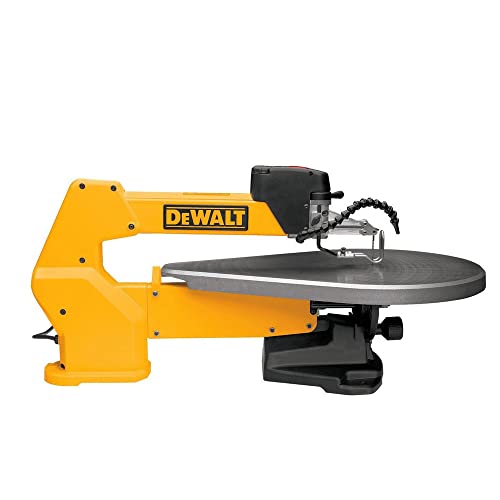
DeWalt DW788 Variable-Speed Scroll Saw
The DW788 uses a parallel link arm design that keeps blade travel vertical, reducing side-to-side vibration during intricate cuts. Its 20 inch throat depth and 2 inch cutting capacity at 90 degrees handle both fretwork and moderately thick stock. A front-mounted tension lever lets users adjust blade tension without reaching behind the machine.
Pros
- Parallel link arm minimizes vibration on detailed cuts
- Front tension lever speeds up interior cutout changes
- Table tilts 45 degrees in both directions for beveled work
Cons
- Highest price point among the seven saws compared
- Blade clamp thumbscrews can wear with heavy daily use

Delta Power Tools 40-694 Scroll Saw
The Delta 40-694 pairs a 20 inch throat depth with a cast iron table that dampens vibration over multi-hour sessions. All speed and tension controls sit at the front of the machine, so operators never reach around the arm. It accepts both pinned and pinless blades, widening blade sourcing options.
Pros
- Cast iron table reduces vibration during long production runs
- Front-mounted controls keep hands away from the blade arm
- Accepts pinned and pinless blades for wider sourcing
Cons
- Heavier build needs a permanent bench spot
- Dust blower tube requires occasional repositioning

WEN 3921 Two-Direction Scroll Saw
The WEN 3921 rotates its head 90 degrees, letting long workpieces pass beside the arm instead of only in front of it. A 16 inch throat depth and 2 inch cutting capacity cover most fretwork and craft projects. A built-in air pump clears sawdust from the cut line automatically.
Pros
- Rotating head extends effective capacity on long stock
- Built-in air pump keeps the cut line visible
- Lightweight enough for easy shelf storage
Cons
- More vibration than parallel link designs at higher speeds
- Blade clamps require a hex key rather than tool-free levers

Rikon 10-600VS Scroll Saw
The Rikon 10-600VS uses lever operated blade clamps instead of thumbscrews, cutting blade swap time for fretwork projects that need frequent changes. Its cast iron table stays flat under tension and the saw runs stable through the top of its speed range. Throat depth measures 16 inches with a 2 inch cutting capacity.
Pros
- Lever clamps make blade changes faster than thumbscrew designs
- Cast iron table resists warping under blade tension
- Runs stable near the top of its speed range
Cons
- Shorter throat depth than the 20 inch DeWalt and Delta models
- Fewer included accessories than DeWalt or Delta

SKIL SS9503-00 Scroll Saw
The SKIL SS9503-00 uses a tool-free blade change lever aimed at new users still learning blade tension. An integrated vacuum dust port connects directly to a shop vacuum for better line-of-sight while cutting. Its 16 inch throat and compact footprint fit smaller workbenches.
Pros
- Tool-free blade change lowers the learning curve for beginners
- Integrated dust port connects straight to a shop vacuum
- Compact footprint suits smaller workbenches
Cons
- Minimum speed runs higher than rival saws, limiting slow-speed control
- Table casting is thinner than the cast iron models here

Shop Fox W1713 Scroll Saw
The Shop Fox W1713 sits on a heavy cast iron base that limits walking across the bench when cutting thicker stock. Blade tension holds steady through long sessions instead of drifting mid-project. It accepts both pinned and pinless blades and offers a 2 inch cutting capacity.
Pros
- Heavy cast iron base reduces bench movement on thick cuts
- Tension stays consistent through extended cutting sessions
- Accepts pinned and pinless blades
Cons
- Rear-mounted tension knob is awkward to reach mid-cut
- Dust blower moves less air than competing models
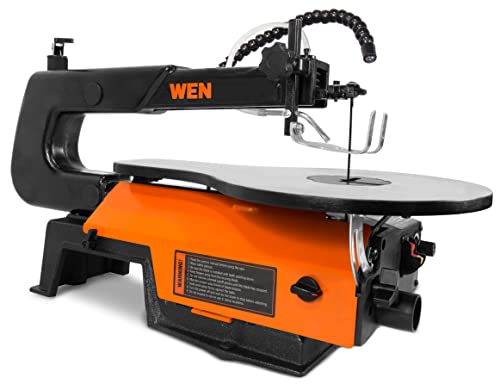
WEN 3920 Scroll Saw
The WEN 3920 delivers a full 400 to 1600 SPM variable speed range despite being the lowest-cost saw in this comparison. A 16 inch throat depth and table that tilts 45 degrees cover typical fretwork and craft cutting. Its lighter frame makes it easy to move on and off a bench.
Pros
- Full variable speed range despite the lower price point
- Light frame makes it easy to move on and off a bench
- Table tilts 45 degrees for beveled cutting
Cons
- Benefits from bolting down to control vibration at speed
- Blade clamps are fiddly with the thinnest fret blades
How they stack up
| # | Model | Throat Depth | Best for | Score | Price |
|---|---|---|---|---|---|
| 1 | DeWalt DW788 Variable-Speed Scroll Saw | 20 in | Best overall | 9.4 | Check price |
| 2 | Delta Power Tools 40-694 Scroll Saw | 20 in | Best for long sessions | 9.1 | Check price |
| 3 | WEN 3921 Two-Direction Scroll Saw | 16 in | Best value | 8.9 | Check price |
| 4 | Rikon 10-600VS Scroll Saw | 16 in | Best blade change system | 8.7 | Check price |
| 5 | SKIL SS9503-00 Scroll Saw | 16 in | Best for beginners | 8.5 | Check price |
| 6 | Shop Fox W1713 Scroll Saw | 16 in | Best for thick stock | 8.3 | Check price |
| 7 | WEN 3920 Scroll Saw | 16 in | Best budget | 8.0 | Check price |
Common questions
What is the best scroll saw for beginners?
The SKIL SS9503-00 suits beginners best, with a tool-free blade change lever and an integrated dust port that keeps the cut line visible while a new user learns blade tension and feed rate.
How much throat depth do I need on a scroll saw?
A 16 inch throat, found on the WEN 3921, Rikon 10-600VS, SKIL SS9503-00, Shop Fox W1713 and WEN 3920, covers most craft and fretwork projects. Larger portrait-style patterns or wide intarsia layouts benefit from the 20 inch throat on the DeWalt DW788 or Delta 40-694.
What causes a scroll saw to vibrate?
Vibration usually comes from arm geometry and table mass. Parallel link arms, like the DeWalt DW788 uses, move the blade in a straighter vertical path than rotary arm designs, and heavier cast iron tables absorb more shake than lighter stamped steel ones.
Are pinned or pinless scroll saw blades better?
Neither type is universally better; pinned blades suit thicker, straighter work and pinless blades allow tighter detail turns. The Delta 40-694 and Shop Fox W1713 accept both, so the choice depends on the pattern rather than the saw.
Can a scroll saw cut thick wood?
Most benchtop scroll saws, including all seven compared here, cut up to 2 inches thick at 90 degrees. The Shop Fox W1713’s cast iron base and steady tension make it a practical pick for repeated cuts through thicker stock.
What speed setting should I use on a scroll saw?
Slower speeds near the bottom of each saw’s range suit hardwoods and fine detail, while faster speeds near the top suit softer wood and straight cuts. Ranges vary by model, from 400 SPM minimum on the DeWalt DW788 and Delta 40-694 to 550 SPM minimum on the SKIL SS9503-00 and Shop Fox W1713.
Is a scroll saw good for intarsia projects?
Yes, a scroll saw is the standard tool for intarsia, which involves cutting multiple wood species to fit together in a flat mosaic. A stable table and consistent tension, as on the Shop Fox W1713, help keep individual pieces flush during assembly.
Why do scroll saw blades keep breaking?
Blades usually break from excessive feed pressure, dull teeth, or tension set too loose or too tight for the clamp. Tool-free or lever clamps, like those on the DeWalt DW788 and Rikon 10-600VS, make it easier to reset tension correctly after each change.
Do scroll saws need to be bolted to a workbench?
Lighter saws, such as the WEN 3920, benefit most from bolting down since their frame mass alone does not fully control vibration at higher speeds. Heavier cast iron models, like the Delta 40-694, stay steadier without permanent mounting.
What is the difference between a 16 inch and 20 inch scroll saw?
The number refers to throat depth, the maximum distance from the blade to the frame. A 20 inch saw, like the DeWalt DW788, reaches further into large panels than a 16 inch saw, though both share the same 2 inch cutting capacity across this comparison.
The bottom line
For most workshops, the DeWalt DW788 and Delta 40-694 justify their higher price through steadier cuts and front-accessible controls. Buyers on a tighter budget still get a full speed range and a 45 degree table tilt from the WEN 3920. Match throat depth and blade clamp style to project size and blade-change frequency before deciding.