Sensory Toys That Actually Hold a Toddler’s Attention
The Fat Brain Toys Dimpl leads because the silicone bubbles give satisfying resistance and there is nothing to break. The Manhattan Toy Winkel is the pick for babies under one, and the Sassy Bumpy Ball is the budget option that still delivers real texture variety.
The Fat Brain Toys Dimpl is the sensory toy to buy first because the silicone bubbles push through with a satisfying resistance that children return to repeatedly, and there are no batteries, no sound and nothing to snap off. The Manhattan Toy Winkel suits babies who are still learning to grasp, and the Sassy Bumpy Ball offers genuine texture variety at a very small outlay.
Sensory play is not the same thing as noisy play, and the toys that hold attention longest are usually the ones offering resistance, texture and a clear cause and effect rather than flashing lights and a speaker. Overstimulating toys often get abandoned quickly, while a simple object that responds predictably to a small hand gets used for months. We compared age suitability, the range of textures and resistances offered, how directly each toy responds to a child’s action, materials and washability, and whether anything can detach, then weighed those against what parents and carers report about which toys stay in rotation.
The best picks, ranked

Fat Brain Toys Dimpl
Fat Brain sets brightly coloured silicone bubbles into a solid frame so they can be pushed from one side to the other endlessly without ever wearing out or coming loose. The resistance is the appeal, since a push that gives way with a small pop is exactly the feedback a developing hand looks for. It wipes clean, has no batteries and is quiet enough for a car or a waiting room.
Pros
- Satisfying resistance that holds attention
- Silent, so it works in cars and waiting rooms
- Nothing to detach or break off
Cons
- Single activity, so novelty can fade
- Frame edges are firm for very young babies

Manhattan Toy Winkel Rattle and Sensory Teether
The Winkel is a cage of soft interlocking tubes that a baby can catch from any angle, which matters enormously when grasping is still unreliable. The tubes are cool and chewable for teething, and a soft rattle inside rewards movement without being loud. It is bulky for its weight, so it takes more nappy bag space than a simple teether.
Pros
- Catchable from any angle for new graspers
- Doubles as a teether
- Gentle rattle rather than a loud noise
Cons
- Bulky for its weight in a bag
- Not dishwasher safe

Fat Brain Toys Tobbles Neo
Tobbles Neo is a set of weighted, rounded segments that wobble, spin and stack in a surprising number of configurations, which turns balance into something a toddler can feel rather than be told about. The weighted bases make each piece rock back upright, which is the cause and effect that keeps children experimenting. Pieces are chunky, so storage takes real space.
Pros
- Multiple ways to play as the child develops
- Weighted bases give predictable movement
- Sturdy enough to survive being thrown
Cons
- Bulky to store as a set
- Pieces roll away on hard floors

Infantino Textured Multi Ball Set
This set gives several balls with clearly different surfaces, from smooth to bumpy to ridged, so a child experiences contrasting textures rather than one repeated sensation. They are light and small enough for little hands to grip and throw. Being soft plastic, they collect grime in the textured grooves and need regular washing.
Pros
- Clear contrast between textures
- Light and easy for small hands to hold
- Doubles as early throwing and rolling play
Cons
- Textured grooves trap grime
- Balls roll under furniture constantly

Sassy Developmental Bumpy Ball
Sassy makes a single soft ball covered in raised bumps that give a baby something to grip and mouth, with high contrast colours that are easier for young eyes to track. It is inexpensive enough to keep one in a changing bag and one at home. There is only one activity here, so it complements a fuller sensory set rather than replacing it.
Pros
- Very low outlay for a genuine sensory toy
- Bumps give easy grip for small hands
- High contrast colours are easy to track
Cons
- Single activity toy
- Soft material marks over time

Learning Resources Sensory Fidget Tubes
These sealed tubes contain liquids and materials that move slowly when tilted, giving a visual focus that many children find genuinely settling during a wind down or an overwhelming moment. They are self contained, so nothing spills. Older children get more from them than babies, and the plastic tubes need checking for cracks since they are liquid filled.
Pros
- Useful for calming and transitions
- Sealed, so nothing spills
- Different contents give visual variety
Cons
- Less engaging for babies
- Tubes must be checked for cracks
Munchkin Float and Play Bubbles Bath Toy
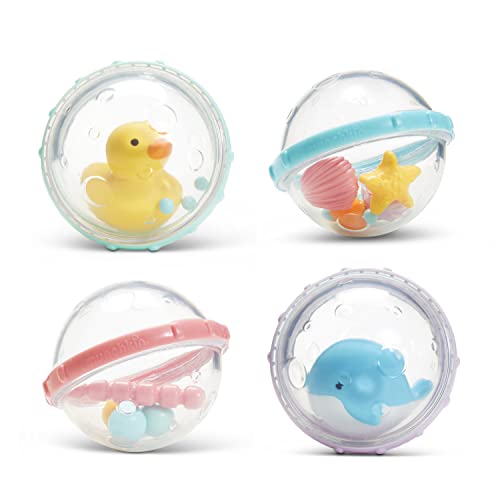
Munchkin seals these bath toys so water cannot get inside, which avoids the mould problem that ruins squirty bath toys within weeks. Each bubble has spinning parts and different colours inside, giving something to watch and turn while sitting in the water. They float and roll well and are easy to gather at the end of a bath.
Pros
- Sealed design avoids internal mould
- Spinning parts give visual interest in the bath
- Easy to collect and store after bathing
Cons
- Limited use outside the bath
- Small enough to disappear behind a bath panel
How to choose
Sensory does not mean loud Toys marketed as sensory often turn out to be a speaker and some flashing lights, which is stimulation rather than sensory exploration. What a developing child gets most from is resistance, texture, weight and predictable cause and effect, because those give the hands and body information. A silicone bubble that pops through under pressure teaches more about force than a button that plays a song. Quiet toys also last longer in a household, since nobody hides them in a cupboard after a fortnight.
Match the toy to the stage, not the age on the box Age labels are a safety guide rather than a developmental one. A baby who cannot yet grasp reliably needs something catchable from any angle, like an open cage design, while a child who has just learned to release objects wants things to drop, stack and knock over. Toddlers who can pinch and twist enjoy resistance and mechanisms. Watching what a child is currently practising is a far better guide to what will hold their attention than the printed age range.
Safety, materials and what can come off The practical safety checks are simple. Anything that fits through a toilet roll tube is a choking risk for children under three, so check small parts and whether any component could detach with sustained chewing. Look for toys made from food grade silicone or moulded plastic with no glued on eyes or ribbons for the youngest children. Liquid filled toys should be inspected periodically for cracks, and any toy with a battery compartment needs a screwed cover, particularly where button cells are involved.
Cleaning is what decides how long it stays in rotation Sensory toys go in mouths and onto floors, so a toy that cannot be cleaned easily quietly disappears from use. Solid silicone and moulded plastic items wipe or wash without fuss and some tolerate a dishwasher top rack. Fabric toys need to be machine washable to be practical. Textured surfaces trap grime in their grooves and need a brush occasionally. Bath toys should be sealed rather than squirty, because water drawn inside creates mould that cannot be removed.
How they compare
| # | Model | Age | Best for | Score | Price |
|---|---|---|---|---|---|
| 1 | Fat Brain Toys Dimpl | Suitable from around six months | Best overall | 9.4 | Check price |
| 2 | Manhattan Toy Winkel Rattle and Sensory Teether | From birth upward | Best for babies | 9.2 | Check price |
| 3 | Fat Brain Toys Tobbles Neo | Suitable from around six months | Best for stacking play | 9.0 | Check price |
| 4 | Infantino Textured Multi Ball Set | From around three months | Best for texture variety | 8.8 | Check price |
| 5 | Sassy Developmental Bumpy Ball | From around three months | Best budget | 8.6 | Check price |
| 6 | Learning Resources Sensory Fidget Tubes | Better suited to preschool and older | Best for calming | 8.3 | Check price |
| 7 | Munchkin Float and Play Bubbles Bath Toy | From around four months | Best for bath time | 8.0 | Check price |
Common questions
What counts as a sensory toy?
Anything that gives a child clear information through touch, sight, sound, movement or resistance, and responds predictably to what they do. That includes textured balls, silicone push toys, weighted stacking pieces and liquid tubes. Loud electronic toys are stimulating but often provide less genuine sensory feedback.
At what age can a baby use sensory toys?
From birth for high contrast visual toys and soft graspable items, from around three to six months for textured balls and push toys once grasping develops, and from a year for stacking and mechanism based play. Follow the safety age on the packaging for small parts.
Are sensory toys useful for autistic children?
Many families and therapists use them for regulation and focus, and quiet fidget style toys are common in that context. What works varies greatly between individuals, so it is worth trying a small selection. For specific needs, guidance from an occupational therapist is more useful than a general recommendation.
How do I clean sensory toys?
Solid silicone and plastic toys wash in warm soapy water and some tolerate a dishwasher top rack. Fabric toys should be machine washable. Use a soft brush for textured grooves. Avoid soaking anything with a battery compartment or an opening that lets water inside.
Do sensory toys need batteries?
The best ones usually do not. Mechanical resistance, texture and weight provide the feedback without power, which also makes them quieter and more durable. Battery toys have their place, but check that any battery compartment is secured with a screw, especially with button cells.
How many sensory toys does a child need?
Fewer than most households end up with. A small rotating selection covering different types of feedback, such as one resistance toy, one texture set and one stacking or balance toy, works better than a large box. Rotating toys in and out restores novelty without buying more.
Are wooden sensory toys better than plastic ones?
Neither is generally superior. Wood offers weight and a natural texture and lasts well, but it cannot be washed as thoroughly and can splinter if damaged. Food grade silicone and moulded plastic clean easily and tolerate mouthing. Choose based on how the toy will be used and cleaned.
What sensory toys work for travel?
Quiet, self contained ones with no loose parts, such as silicone push toys and sealed fidget items. Anything that rattles loudly or has pieces to drop becomes a problem in a car or on a plane. A toy that attaches to a bag or a seat with a clip saves a lot of retrieving.
Final word
The Fat Brain Toys Dimpl is the sensory toy worth buying first because the resistance of the silicone bubbles keeps small hands busy without noise, batteries or anything that can break off. For a baby who is still learning to grasp, the Manhattan Toy Winkel is easier to catch and doubles as a teether. If you want texture variety without much outlay, the Sassy Bumpy Ball covers that job and survives being thrown across a room.