Shoe Racks for Tight Hallways and Crowded Closets
The SONGMICS 10-Tier shoe rack holds the most pairs in a narrow footprint and adds a dust cover. The Seville Classics 3-Tier resin and wood rack is the sturdiest option for an entryway, and the Simple Houseware stackable rack is the flexible budget choice.
The SONGMICS 10-Tier rack is the most efficient way to store a lot of shoes in very little floor space, and the fabric cover keeps dust off the pairs you rarely wear. For a hallway where the rack doubles as a place to sit or set bags down, the Seville Classics 3-Tier resin and wood unit is far sturdier, and the Simple Houseware stackable rack is the practical budget answer.
Shoe racks are frustrating to compare because the advertised pair count almost always assumes flat trainers laid side by side, and a single pair of boots can occupy an entire tier. We compared stated capacity against tier spacing and depth, footprint, frame materials and stability, and whether units stack or expand, alongside what owners report about sagging fabric shelves, wobbling frames and racks that turn out to be too shallow for large sizes.
The top picks, ranked

SONGMICS 10-Tier Shoe Rack with Dust Cover
Going vertical is the only way to store a household’s worth of shoes in a narrow space, and this tower does exactly that with ten tiers on a small footprint. The zip up cover keeps dust off, which matters for seasonal shoes. Assembly uses connector fittings and plastic poles, so keep the heaviest shoes on the lower tiers.
Pros
- Very high capacity in minimal floor space
- Dust cover protects seasonal shoes
- Tier spacing adjustable during assembly
Cons
- Plastic connectors flex under heavy boots
- Tall units should be positioned against a wall

Seville Classics 3-Tier Resin Wood Shoe Rack
This rack uses a steel frame with resin wood slats, which is strong enough to sit on while putting boots on, something no fabric tower can manage. It handles wet shoes without warping and wipes clean. Capacity is modest compared with towers, so it suits a front door rather than a whole family’s collection.
Pros
- Strong enough to sit on
- Resists moisture from wet shoes
- Looks presentable in a hallway
Cons
- Lower capacity than tower racks
- Takes more floor width

Simple Houseware 3-Tier Stackable Shoe Rack
The appeal here is modularity, since each unit stacks on top of another so you can build the height that fits your space and add more later. The metal frame is light and assembles in minutes without tools. It is basic, but it solves the awkward closet corner problem cheaply and can be reconfigured when you move.
Pros
- Stack units to match your space
- Assembles in minutes without tools
- Low outlay per pair stored
Cons
- Light frame flexes with heavy shoes
- Stacked units need care to stay aligned

Simple Trending 5-Tier Stackable Metal Shoe Rack
Simple Trending’s rack combines five tiers with adjustable width, which is the feature that makes it work in an awkward closet where a fixed rack would not fit. The wire shelves let air circulate around damp shoes. Heavy boots are best kept on the bottom shelf, since the wire flexes under concentrated weight.
Pros
- Adjustable width fits awkward closets
- Open wire lets damp shoes dry
- Stackable with matching units
Cons
- Wire shelves flex under boots
- Heels can slip through the wires
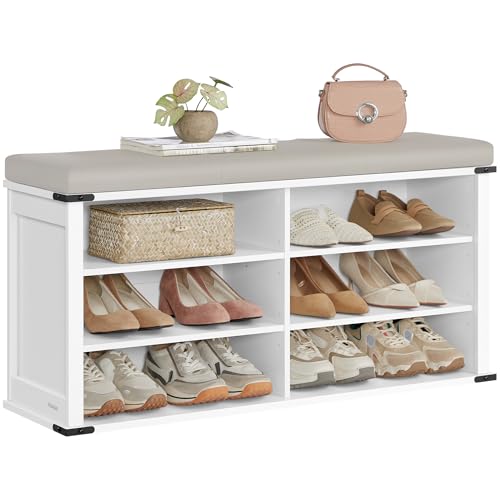
VASAGLE Shoe Rack Bench with Padded Seat
Combining a bench with shoe storage makes sense in a narrow hallway where floor space only allows one piece of furniture. The padded seat gives you somewhere to put boots on and the shelves below take everyday shoes. Capacity is limited, so treat it as the front of house rack rather than the main storage.
Pros
- Seat and storage in one footprint
- Comfortable place to put shoes on
- Tidy appearance for a hallway
Cons
- Low capacity for the space it takes
- Board shelves dislike wet shoes

Whitmor 4-Tier Shoe Rack
Whitmor’s four tier rack is the plain, inexpensive answer for a closet floor or a spare room, with a light metal frame and simple assembly. It holds everyday trainers and flats well. The narrow depth means larger sizes overhang slightly, and heavy boots are better stored elsewhere.
Pros
- Very low outlay
- Quick assembly with no tools
- Light enough to move easily
Cons
- Shallow depth for large sizes
- Thin frame is not made for boots

IRIS USA Wood and Metal Shoe Rack
IRIS spaces the tiers further apart than most racks, which is the specification that decides whether ankle boots and trainers with chunky soles actually fit. The wood and metal build is solid and looks appropriate in a bedroom or hallway. Fewer tiers for the same height means lower total capacity, which is the trade.
Pros
- Tier spacing takes boots and chunky soles
- Sturdy wood and metal construction
- Looks suitable in living spaces
Cons
- Fewer pairs than tight tiered racks
- Wood shelves need drying if shoes are wet
The lineup, side by side
| # | Model | Capacity | Best for | Score | Price |
|---|---|---|---|---|---|
| 1 | SONGMICS 10-Tier Shoe Rack with Dust Cover | Around 26 to 30 pairs | Best overall | 9.4 | Check price |
| 2 | Seville Classics 3-Tier Resin Wood Shoe Rack | Around 9 to 12 pairs | Best for entryways | 9.2 | Check price |
| 3 | Simple Houseware 3-Tier Stackable Shoe Rack | Around 9 pairs per unit | Best value | 9.0 | Check price |
| 4 | Simple Trending 5-Tier Stackable Metal Shoe Rack | Around 15 pairs | Best for closets | 8.8 | Check price |
| 5 | VASAGLE Shoe Rack Bench with Padded Seat | Around 6 to 8 pairs | Best for small hallways | 8.6 | Check price |
| 6 | Whitmor 4-Tier Shoe Rack | Around 12 pairs | Best budget | 8.3 | Check price |
| 7 | IRIS USA Wood and Metal Shoe Rack | Around 8 to 10 pairs | Best for boots | 8.0 | Check price |
How to pick the right one
Treat the pair count as an optimistic estimate Capacity claims are calculated with flat trainers positioned neatly side by side, which bears little relation to a real household. Boots take a whole tier, chunky trainers reduce a claimed three pairs per shelf to two, and children’s shoes let you fit more. Count the shoes you actually own, note how many are bulky, and then choose a rack rated for roughly a third more pairs than your count. Buying too small is the most common regret in this category.
Measure the footprint and the tier spacing Depth is the specification that catches people out, since a shallow rack leaves larger sizes overhanging into a hallway where they get kicked. Measure the length of your largest shoe and check the shelf depth against it. Tier spacing matters just as much, because a rack with ten tightly packed tiers holds a lot of flats and almost no boots. If boots are a significant part of your collection, prioritise spacing over tier count.
Match the material to the location Wet shoes at a front door will warp engineered wood shelves and eventually rust an uncoated metal frame. For entryways, resin, coated steel or open wire lets moisture escape and wipes clean. Fabric shelved towers are fine in a dry bedroom closet but sag under heavy shoes and hold damp. Solid shelving looks better in a living space and stops small items falling through, at the cost of airflow.
Stability, stacking and vertical space Tall shoe towers are inherently top heavy once loaded, so keep the heaviest footwear on the bottom tiers and position the unit against a wall, anchoring it if children are around. Stackable units are worth choosing if your storage needs are likely to change, since you can add a section rather than replace the rack. In a narrow hallway, going vertical or choosing an over door organiser is almost always more effective than adding another wide low rack.
Good to know
How many pairs does a shoe rack really hold?
Expect roughly two thirds of the advertised figure once boots and chunky trainers are included, since capacity claims assume flat shoes placed neatly. Counting your own collection first and adding a margin is the reliable approach.
What is the best shoe rack for boots?
Look for tier spacing of at least ten inches and a rack with sturdy shelves rather than thin wire. Racks that advertise many tiers in a short height are designed for flats and will not take ankle or knee boots.
Can shoe racks be used in a closet?
Yes, and adjustable width or stackable models fit awkward closet spaces best. Measure the internal width including any door frame lip, and check the height clearance under any hanging rail before ordering.
Are fabric shoe towers durable?
They are fine for light shoes in a dry room, but the shelves sag under heavy footwear and the plastic connectors flex over time. For boots or an entryway, a metal or resin framed rack lasts considerably longer.
How do I stop a tall shoe rack tipping over?
Load the heaviest shoes on the lowest tiers, stand the unit against a wall on level flooring, and anchor it if there are children or pets in the home. Avoid placing tall towers where a door swing can knock them.
Where should a shoe rack go?
By the door is the most useful spot for everyday shoes, provided the material tolerates moisture. Seasonal and rarely worn pairs are better stored in a bedroom closet, ideally on a covered rack that keeps dust off.
Do shoe racks help shoes last longer?
Keeping shoes off the floor and allowing air around them helps them dry and holds their shape better than a pile. Open wire and slatted racks let moisture escape, which matters for leather in particular.
Should I choose a bench or a plain rack?
A bench with storage is excellent in a hallway where you put shoes on and take them off, but it stores relatively few pairs for the floor space it uses. Most homes end up with a bench at the door and a taller rack elsewhere.
Final word
The SONGMICS 10-Tier rack is the pick when you need to store a lot of shoes without giving up floor space, and the dust cover is a genuine advantage for seasonal pairs. For an entryway that takes wet shoes and daily use, the sturdier Seville Classics resin and wood rack is the better buy, while Simple Houseware’s stackable units let you build capacity gradually.

