Which Ski Helmet Should a First-Time Skier Buy
Giro’s Ledge MIPS leads for pairing rotational-impact protection with a glove-friendly dial-fit system. Smith’s Holt 2 offers a tougher hybrid shell at a lower price for frequent beginner falls. OutdoorMaster’s Kelvin meets ASTM and CE certification at the lowest cost here.
Giro’s Ledge MIPS opens this list, built for beginners who fall often and need rotational-impact protection without fighting a fit dial in ski gloves. Smith’s Holt 2 and OutdoorMaster’s Kelvin follow close behind on durability and price, though neither pairs MIPS with a dial-fit system as smoothly as Giro’s helmet.
Falls happen more at the beginner stage, usually slow but at angles that twist the head unpredictably. We compared certification labels, shell construction, vent counts, and owner reports on fit to narrow this field to seven.
What we recommend

Giro Ledge MIPS
A low-friction liner inside Giro’s Ledge MIPS shifts slightly on impact, cutting rotational force during angled falls. Fourteen vents adjust for temperature swings between lift lines and runs. Its dial-fit tightens without removing a glove, a detail beginners fumbling with buckles will notice fast.
Pros
- MIPS liner reduces rotational force from angled falls
- Dial-fit tightens easily with gloves still on
- Size range fits most head shapes
Cons
- Vent count trails Giro’s premium helmets
- Liner dries slowly after a wet lift-line day

Smith Holt 2
Hybrid construction on Smith’s Holt 2 pairs a light in-mold shell with a tougher ABS panel near the base. Frequent beginner falls wear on that lower edge first, so the reinforcement matters. A washable liner cuts down on end-of-season cleanup.
Pros
- Costs less than most hybrid-shell helmets
- Reinforced lower shell handles repeated falls
- Washable liner simplifies seasonal cleaning
Cons
- Base model skips MIPS unless upgrading versions
- Vents stay fixed rather than adjustable

OutdoorMaster Kelvin Ski Helmet
ASTM and CE certification both apply to OutdoorMaster’s Kelvin despite its price sitting below brand-name rivals. Ear pads and the liner remove separately for washing after a season on the hill. Nine vents cover casual runs rather than aggressive high-output skiing.
Pros
- Meets ASTM and CE certification at a lower price
- Removable liner and ear pads wash separately
- Suits first-time buyers on a tighter budget
Cons
- No MIPS technology at this price point
- Fewer vents than mid-range competitors

POC Obex MIPS
Rounded shell geometry on POC’s Obex MIPS lowers snag risk during a fall, useful while a beginner is still learning to control speed. Warmer spring days get relief from adjustable vents. Matching goggles from POC close any gap at the helmet’s edge for a tighter seal.
Pros
- Rounded shell shape lowers snag risk in falls
- Pairs with POC goggles for a gap-free seal
- Dual ASTM and CE certification
Cons
- Costs more than Smith’s Holt 2 or OutdoorMaster’s Kelvin
- Fewer color choices than mainstream competitors

Retrospec Comstock Ski and Snowboard Helmet
Fewer vents on Retrospec’s Comstock trap more heat, a tradeoff that favors warmth over airflow on cold days. Long lift-line waits feel more comfortable under its plush liner. Ear pads accept audio inserts for skiers who like music between runs.
Pros
- Extra insulation suits cold, low-wind days
- Plush liner adds comfort during lift-line waits
- Ear pads accept audio headphone inserts
Cons
- Limited airflow can overheat on warmer days
- Heavier than in-mold shell competitors
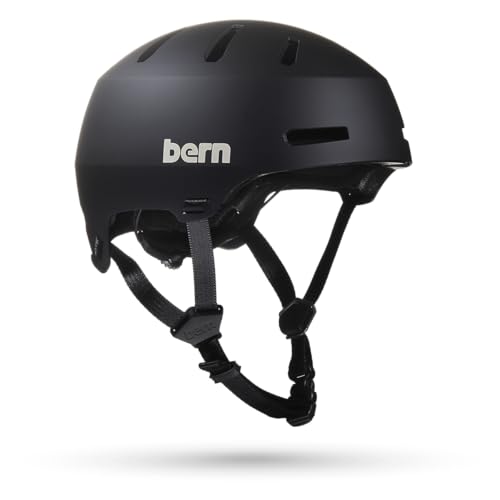
Bern Macon 2.0 MIPS
A removable winter liner lets Bern’s Macon 2.0 double as a bike or skate helmet once the snow melts. Occasional skiers get more mileage from one helmet across seasons this way. Zip Mold construction bonds shell and liner into a single lighter piece.
Pros
- Removable liner extends use past ski season
- Zip Mold build keeps overall weight down
- MIPS included at a mid-range price
Cons
- Winter liner adds bulk versus dedicated ski helmets
- Fewer adjustable vents than ski-specific models

Smith Method MIPS
An integrated goggle lock on Smith’s Method MIPS grips the strap without a separate clip. Twenty vents outpace every other helmet on this list, useful for beginners who run warm on easier runs. A women’s-specific fit version sells separately for a closer match.
Pros
- Integrated goggle lock secures goggles without a clip
- Twenty vents offer the most airflow control here
- Women’s-specific fit version sold separately
Cons
- High vent count trades away warmth on cold days
- Priced above most beginner-focused helmets
Before you buy
What to look for in a beginner ski helmet Certification comes first, and labels like ASTM F2040 or CE EN1077 mark helmets tested for ski-specific impacts. Shell type affects both weight and durability, since in-mold shells run lighter while hard ABS resists scuffs better. Vent count shapes comfort across a day of lift lines and short runs. Beginners crash more often than advanced skiers, so a helmet built for repeated low-speed impacts counts more than one built for racing.
How MIPS technology works MIPS stands for Multi-directional Impact Protection System, a low-friction layer letting the liner shift slightly during an angled hit. Angled falls happen often while learning to control edges, and that motion creates rotational force MIPS aims to reduce. Certification doesn’t require MIPS, yet several entry-level helmets now include it anyway. Giro’s Ledge MIPS and Smith’s Method MIPS both add the layer without a steep price jump over non-MIPS versions.
Getting the right fit as a first-time buyer Level positioning matters most, with the front edge sitting about an inch above the eyebrows rather than tilted back. Dial-fit systems, like the one on Giro’s Ledge MIPS, let a beginner tighten the fit without pulling off a glove. Trying a helmet with the goggles planned for the season catches gaps before a lift ride, not after. Head shape differs by brand, so a good fit from one maker doesn’t guarantee the same from another.
Choosing ventilation for different conditions Riders who run warm during moderate beginner runs benefit from higher vent counts, such as the 20 on Smith’s Method MIPS. Cold, low-wind days call for fewer vents instead, the approach Retrospec’s Comstock takes to trap heat. Adjustable vents split the difference across a season of mixed weather. Standing in lift lines longer than actually skiing tips the balance toward warmth over airflow for many beginners.
Side by side
| # | Model | Safety tech | Best for | Score | Price |
|---|---|---|---|---|---|
| 1 | Giro Ledge MIPS | MIPS brain protection system | Best overall | 9.4 | Check price |
| 2 | Smith Holt 2 | Optional MIPS version available | Best value | 9.2 | Check price |
| 3 | OutdoorMaster Kelvin Ski Helmet | ABS hard shell with EPS foam liner | Best budget | 9.0 | Check price |
| 4 | POC Obex MIPS | MIPS brain protection system | Best for visibility and fit | 8.7 | Check price |
| 5 | Retrospec Comstock Ski and Snowboard Helmet | ABS shell with EPS foam | Best for cold-weather insulation | 8.5 | Check price |
| 6 | Bern Macon 2.0 MIPS | MIPS brain protection system | Best convertible design | 8.2 | Check price |
| 7 | Smith Method MIPS | MIPS brain protection system | Best for goggle integration | 8.0 | Check price |
Questions worth asking
What certification should a ski helmet have?
Look for ASTM F2040 or CE EN1077 labeling, both signaling the helmet passed impact testing built around skiing and snowboarding falls.
Do beginners need a MIPS ski helmet?
Certification doesn’t require it, but MIPS cuts rotational force from angled falls, which beginners hit more often while learning.
How should a ski helmet fit?
It should sit level with the front edge about an inch above the eyebrows, snug enough that shaking your head doesn’t shift it.
Can a bike helmet work for skiing instead?
No, bike helmets skip the cold-weather and impact testing built into ski-specific certified helmets, so swapping one in isn’t safe.
How many vents does a beginner ski helmet need?
Colder days suit 8 to 10 vents, while riders who run warm do better with 14 to 20, like Smith’s Method MIPS offers.
What is the difference between in-mold and hard-shell ski helmets?
In-mold shells bond the outer layer to the foam liner for less weight, while hard ABS shells add toughness at extra weight.
How long does a ski helmet last before it needs replacing?
Manufacturers recommend replacement after any hard impact, or roughly every 5 years even without a major fall.
Do ski helmets fit with any goggles?
Not automatically; matched sets like POC’s helmet-and-goggle pairing close gaps that generic combinations sometimes leave open.
Which ski helmet is best for a first-timer on a budget?
OutdoorMaster’s Kelvin meets both ASTM and CE certification at the lowest price in this comparison, without MIPS technology.
The bottom line
Giro’s Ledge MIPS takes the top recommendation for pairing rotational-impact protection with a fit dial that works even in ski gloves. Skiers on a tighter budget should look at OutdoorMaster’s Kelvin instead, since it still clears ASTM and CE certification without MIPS. Anyone planning to reuse the helmet for biking or skating later gets more value from Bern’s convertible Macon 2.0.


