Small Animal Water Bottles That Do Not Drip or Clog
The Choco Nose H128 No Drip Water Bottle is our top pick because its narrow nozzle genuinely reduces dripping. The Lixit Wide Mouth Water Bottle is the value choice for easy refilling, and the Kaytee Chew Proof Water Bottle is the best option for cages with determined chewers.
The Choco Nose H128 leads our ranking, with the Lixit Wide Mouth and the Kaytee Chew Proof bottle following for refilling convenience and chew resistance. All seven bottles below are currently sold on Amazon and suit rabbits, guinea pigs, hamsters, rats, ferrets and chinchillas depending on size.
Water bottles look interchangeable but the valve design decides whether bedding stays dry and whether an animal can actually draw water. We compared nozzle types, capacities, mounting hardware and materials, along with what owners report about dripping, airlocks and how quickly each bottle needs cleaning.
Our top picks

Choco Nose H128 No Drip Water Bottle
The H128 uses a narrow patented nozzle that holds water back until an animal licks it, which is the main reason owners report far less puddling under it than under standard ball valves. It screws onto many standard bottle threads, so you are not tied to one container. The small nozzle suits hamsters, rats and smaller rabbits best.
Pros
- Noticeably less dripping than ball valve bottles
- Fits several standard bottle threads
- Easy to see the water level
Cons
- Narrow nozzle is slow for large thirsty rabbits
- Needs a bottle brush to clean the neck properly
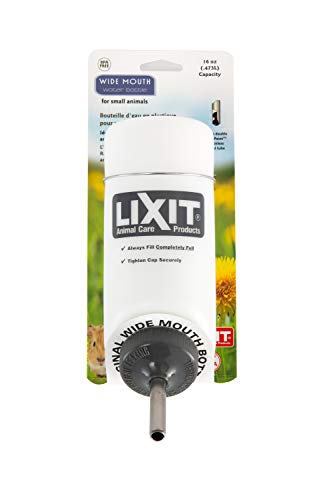
Lixit Wide Mouth Water Bottle
The wide opening is the point here: you can refill and get a brush inside without a funnel or a fight. The stainless steel tube with a ball valve is the traditional design, dependable but more prone to the occasional drip. Owners report it is the easiest bottle in this ranking to keep genuinely clean.
Pros
- Wide neck takes a bottle brush easily
- Available in several capacities
- Straightforward, well proven valve
Cons
- Ball valve drips more than narrow nozzle designs
- Wire hanger can be fiddly on some cage bar spacings

Kaytee Chew Proof Water Bottle
A glass body and a steel spout remove the two things a determined rabbit or chinchilla usually destroys. Glass also resists the cloudy staining that plastic picks up over months of use. The obvious trade off is weight and the risk of breakage if the mount fails.
Pros
- Survives animals that destroy plastic bottles
- Glass stays clear rather than clouding
- Easy to see remaining water
Cons
- Heavier, so mounting must be secure
- Can break if knocked onto a hard floor
Living World Eco Water Bottle
The Eco bottle pairs a generous capacity with a wider sipper tube that suits guinea pigs, which drink more than their size suggests. The mounting bracket holds it steady against a cage wall rather than swinging on wire. Owners report the graduated markings make it easy to check intake day to day.
Pros
- Volume markings help monitor drinking
- Wide tube suits heavier drinkers
- Stable bracket mounting
Cons
- Bracket suits wire cages better than glass tanks
- Larger sizes are bulky inside small enclosures

Ware Pet Products Critter Canteen Water Bottle
The Critter Canteen is a straightforward plastic bottle with a steel ball tube and a wire hanger, sold in several sizes. It does the job for hamsters, gerbils and rats without any special features. Buy two so one can be cleaned and dried while the other is in use.
Pros
- Inexpensive enough to keep a spare
- Multiple sizes for different species
- Simple design with little to fail
Cons
- Plastic clouds and stains over time
- Prone to the usual ball valve drips

Oasis Bell Bottle for Small Animals
The Bell Bottle uses a flat backed design that sits against a smooth surface, which makes it one of the few options that works well in a glass tank rather than a wire cage. Capacity is modest, so it suits hamsters, gerbils and mice. The valve is a conventional ball type.
Pros
- Works in glass tanks where hangers do not
- Compact in small enclosures
- Simple to remove for refilling
Cons
- Small capacity needs daily refilling
- Suction or clip mounting can loosen over time

Niteangel Glass Water Bottle for Small Pets
Niteangel’s glass bottle is scaled for hamsters, gerbils and mice, which matters because a large rabbit bottle mounted in a small cage takes up space and hangs too high. Glass keeps the interior clear and easy to inspect. Capacity is deliberately small, so it needs topping up often.
Pros
- Correctly sized for dwarf and Syrian hamsters
- Glass resists clouding and chewing
- Easy to check water level at a glance
Cons
- Needs refilling every day or two
- Glass demands a secure mount
What to look for
Valve design decides whether bedding stays dry Traditional ball valves work by letting the animal move a steel ball with its tongue, which is dependable but drips when the ball is knocked or the seal ages. Narrow nozzle designs such as the Choco Nose hold water back until licked and drip far less. If you constantly find a wet patch under the bottle, changing the valve type usually fixes it faster than changing the mounting.
Match capacity to the species, not the cage Rabbits and guinea pigs drink far more than hamsters, and an undersized bottle means refilling twice a day or risking an empty bottle. A larger bottle also lasts longer between refills if you are away for a day. The counterpoint is that stale water needs changing daily regardless of how much is left, so a huge bottle for a mouse just means throwing water away.
Mount it securely at the right height The nozzle should sit at a height the animal can reach comfortably without stretching upward, roughly at head level when standing normally. Wire hangers suit bar cages, brackets suit solid walls, and flat backed designs are the option for glass tanks. A bottle that swings when nudged will drip, so a firm mount is part of the drip solution.
Clean weekly and watch for airlocks Biofilm builds up inside the tube and on the ball within days, especially in warm rooms. Wash the bottle weekly with a bottle brush and a narrow tube brush, rinse thoroughly and refill with fresh water daily. Check the nozzle by touching it to release a drop each time you refill, since an airlock or a stuck ball can leave an apparently full bottle delivering nothing at all.
How they compare
| # | Model | Valve type | Best for | Score | Price |
|---|---|---|---|---|---|
| 1 | Choco Nose H128 No Drip Water Bottle | Narrow no drip nozzle | Best overall | 9.4 | Check price |
| 2 | Lixit Wide Mouth Water Bottle | Stainless steel tube with ball | Best value | 9.2 | Check price |
| 3 | Kaytee Chew Proof Water Bottle | Glass | Best for chewers | 9.0 | Check price |
| 4 | Living World Eco Water Bottle | Up to about 32 ounces | Best for guinea pigs | 8.8 | Check price |
| 5 | Ware Pet Products Critter Canteen Water Bottle | Plastic | Best budget | 8.6 | Check price |
| 6 | Oasis Bell Bottle for Small Animals | Flat back for tanks and smooth walls | Best for tanks and aquariums | 8.3 | Check price |
| 7 | Niteangel Glass Water Bottle for Small Pets | Glass | Best for hamsters | 8.0 | Check price |
Good to know
Why does my small animal water bottle leak?
The usual causes are a ball valve that has been knocked, a bottle mounted so it swings, a worn seal, or the bottle being filled completely to the top so temperature changes push water out. Try a narrow nozzle design, mount it rigidly, and leave a small air gap when filling.
Bottle or bowl for small pets?
Bottles keep water clean of bedding and droppings, while bowls are more natural to drink from and deliver water faster. Many rabbit and guinea pig owners offer both, so the animal has a backup if a bottle airlocks. If you use a bowl, choose a heavy ceramic one that cannot be tipped.
How often should I clean a water bottle?
Change the water daily and wash the bottle properly at least once a week with a bottle brush and a thin tube brush. Warm rooms and sugary treats speed up biofilm growth. Avoid strong detergents, and rinse very thoroughly whatever you use.
What size bottle does a rabbit need?
A rabbit drinks a surprising amount, so a bottle around 32 ounces is sensible for a single rabbit, and many owners supplement with a heavy bowl. Guinea pigs do well with 16 to 32 ounces. Hamsters, gerbils and mice need far less, and a small bottle refilled daily is better than a large one left standing.
How do I know if the bottle is working?
Touch the nozzle with a fingertip each time you pass and check that a drop releases. An airlock, a stuck ball or a blocked tube can leave a full bottle delivering nothing, and animals cannot tell you. Watching for a normal water level drop each day is the other simple check.
Are glass bottles better than plastic?
Glass resists chewing and does not cloud or stain, which makes it easier to inspect and longer lasting. Plastic is lighter, cheaper and cannot shatter. Choose glass for rabbits and chinchillas that destroy plastic, and plastic where weight or breakage is a concern.
Can I use a water bottle in a glass tank?
Yes, with a flat backed or bracket mounted design such as the Oasis Bell Bottle, since a wire hanger has nothing to hook onto. Some owners use a tank specific holder that clips over the rim. Check the mount regularly, as suction fittings loosen over time.
Should I add anything to the water?
No. Plain fresh water is what small animals need, and vitamin drops or flavourings encourage bacterial growth in the bottle and can put animals off drinking. If you are worried about intake, speak to a vet rather than changing what is in the bottle.
Our pick
The Choco Nose H128 is the bottle to buy if wet bedding is your main complaint, since the nozzle design addresses the cause rather than the symptom. The Lixit Wide Mouth is the easiest to keep clean and refill, which matters more than it sounds when you are doing it every day. Rabbits and chinchillas that destroy plastic should go straight to the Kaytee Chew Proof glass bottle, mounted securely.