Smart Litter Boxes That Scoop So You Do Not Have To
The Litter-Robot 4 is our overall pick for its interior size, safety sensing and weight tracking per cat. The PetSafe ScoopFree Smart is a simpler crystal litter alternative, while Casa Leo Leo’s Loo Too offers most of the globe design features for less outlay.
For a multi cat home, the Litter-Robot 4 is the automatic box worth the money, with Casa Leo Leo’s Loo Too the closest alternative and the PetSafe ScoopFree Smart the simpler choice for a single cat that already uses crystal litter.
Smart litter boxes are difficult to compare because the marketed capacity is the litter chamber, not the space a large cat needs to turn around in, and the waste drawer size decides how often you are still doing the job manually. We compared interior dimensions, sensor systems, drawer capacity and what owners report about long term reliability to rank the seven below.
The top picks, ranked

Litter-Robot 4
A rotating globe design with a wide entry, multiple safety sensors and onboard weighing that logs each cat’s visits and weight through the app. The larger interior suits big cats that outgrow other automatic boxes. Owners report the litter level and drawer sensors are what make it genuinely low maintenance rather than merely automatic.
Pros
- Large enough for big cats to turn around
- Weight and visit logs flag health changes early
- Quieter cycle than earlier generations
Cons
- Substantial outlay compared with manual boxes
- Waste drawer liners are an ongoing cost

PetSafe ScoopFree Smart Self-Cleaning Litter Box
A rake design that sweeps waste into a covered compartment in a disposable tray, so you handle no litter at all between tray changes. Crystal litter absorbs liquid and controls odour without clumping. Owners report it is the easiest system here to live with, provided the cat accepts crystal litter underfoot.
Pros
- No contact with litter between tray changes
- Crystal litter controls odour well
- Low, open entry suits older cats
Cons
- Disposable trays are a recurring cost
- Some cats dislike crystal litter texture

Casa Leo Leo’s Loo Too
A rotating globe box with anti pinch sensors, an included odour control system and app control, at a lower outlay than the category leader. It takes standard clumping clay litter. Owners report the sifting works well and the interior suits average sized cats better than very large ones.
Pros
- Globe convenience at a lower outlay
- Uses ordinary clumping litter
- Odour control included rather than extra
Cons
- Interior is tight for very large cats
- Cycle is more audible than the top pick
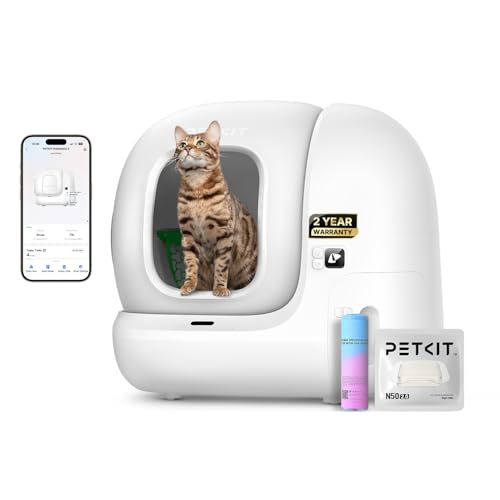
PETKIT PuraMax Self-Cleaning Cat Litter Box
A large capacity rotating box with a spacious waste bin, aimed at households where several cats share one appliance. The app records usage per cat by weight and flags irregular visits. Owners report the big waste bin is the practical advantage, since drawer emptying is the remaining manual task in every automatic box.
Pros
- Large waste bin reduces emptying frequency
- Roomy entry suits several cats
- Detailed usage logging in the app
Cons
- Large footprint needs planning
- Assembly is more involved than rivals

Neakasa M1 Open-Top Self-Cleaning Litter Box
An open topped automatic box, which removes the enclosed chamber that many cats refuse to enter. It uses a tilting mechanism to sift rather than a rotating globe. Owners report it is the option worth trying when a cat has rejected a conventional enclosed automatic box.
Pros
- Open design accepted by cats that refuse enclosures
- Stainless basin is easy to wipe clean
- Handles tofu as well as clay litter
Cons
- Open top means less odour containment
- More litter tracking outside the box
Litter-Robot 3 Connect
The previous generation globe box, still sold and still supported, with app notifications and the same sifting principle as its successor. It has a smaller entry and a simpler sensor set. Owners report a long service life and good parts availability, which matters for an appliance that runs several times a day.
Pros
- Proven mechanism with parts available
- Lower outlay than the current generation
- Reliable app notifications
Cons
- Smaller entry than the newer model
- Noisier cycle and fewer sensors
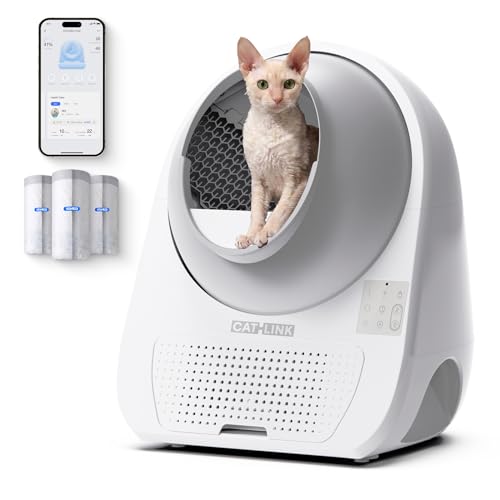
CatLink Scooper Pro Self-Cleaning Litter Box
A rotating box with a sealed waste compartment and a deodorising system aimed at apartments where the box shares a room with people. It includes a safety delay before each cycle. Based on specifications it targets odour control more directly than most rivals in this group.
Pros
- Strong odour containment for small homes
- Safety delay before each cycle
- App control and usage records
Cons
- Tall design needs headroom
- Fewer service outlets than the major brands
Before you buy
Measure your cat, not just the box The dimension that matters is the usable interior, and it is rarely the number on the box. A cat should be able to enter, turn around fully and squat without touching the sides. Large breeds routinely outgrow automatic boxes designed around an average cat, and a cat that feels cramped will simply go elsewhere. If your cat is over about fifteen pounds, check interior measurements specifically rather than relying on the marketed capacity.
Safety sensors are not a marketing feature Any box with a moving mechanism needs multiple ways of knowing a cat is present, since a single sensor can be fooled by a cat sitting on the rim or a kitten too light to trigger a weight plate. Look for a combination of weight sensing and infrared detection, plus a delay timer before each cycle. Kittens under a certain weight should generally not use an automatic box at all until they are big enough to register.
The waste drawer decides the real workload Automatic boxes do not eliminate the job, they batch it. A small waste drawer in a multi cat home still needs emptying every few days, which is not the transformation people expect. Look at drawer capacity relative to the number of cats, and check whether the manufacturer expects you to buy proprietary liners, since that is an ongoing cost that varies a lot between brands.
Litter type locks you in more than you think Globe and drum boxes generally require clumping clay litter and will not sift lightweight, crystal or tofu litters correctly. Rake designs with disposable trays are usually built around crystal litter. If your cat has a strong preference, or you have a reason to avoid clay dust, filter by litter compatibility before anything else, because a cat that dislikes the litter will not use the appliance at any price.
Side by side
| # | Model | Design | Best for | Score | Price |
|---|---|---|---|---|---|
| 1 | Litter-Robot 4 | Rotating globe with sifting screen | Best overall | 9.4 | Check price |
| 2 | PetSafe ScoopFree Smart Self-Cleaning Litter Box | Raking arm with covered waste compartment | Best for low maintenance | 9.2 | Check price |
| 3 | Casa Leo Leo’s Loo Too | Rotating globe with sifting | Best value globe design | 9.0 | Check price |
| 4 | PETKIT PuraMax Self-Cleaning Cat Litter Box | Rotating drum with sifting | Best for multiple cats | 8.8 | Check price |
| 5 | Neakasa M1 Open-Top Self-Cleaning Litter Box | Open top with tilting sift mechanism | Best for nervous cats | 8.6 | Check price |
| 6 | Litter-Robot 3 Connect | Rotating globe with sifting screen | Best proven design | 8.3 | Check price |
| 7 | CatLink Scooper Pro Self-Cleaning Litter Box | Rotating drum with sealed waste bin | Best for odour containment | 8.0 | Check price |
Common questions
Are automatic litter boxes safe for cats?
Modern designs use weight sensing plus infrared detection and a delay before cycling, which makes them safe for adult cats in normal use. Very small kittens may not be heavy enough to trigger weight sensors reliably, so most manufacturers set a minimum weight. Keep the sensors clean, since litter dust on a sensor is the usual cause of a missed detection.
How often do I still need to empty the waste drawer?
For one cat, typically once or twice a week. For three or four cats, every few days regardless of the marketing. The drawer capacity is the real determinant, so compare that number rather than the litter chamber size if you have multiple cats.
Can I use any litter in a smart litter box?
No, and this is the most common source of disappointment. Globe and drum boxes need clumping clay litter to sift properly. Rake based systems are usually designed around crystal litter in disposable trays. Lightweight and tofu litters work in only some models, so check the manual before switching.
Will my cat actually use an automatic litter box?
Most adapt within a week or two if you introduce it gradually, leave the old box available at first, and let them investigate it switched off. Nervous cats and those that dislike enclosed spaces do better with an open top design. Never force the transition by removing the familiar box immediately.
Do smart litter boxes control odour better?
Generally yes, because waste is removed within minutes rather than sitting until the next scoop, and most seal it in a covered drawer. Carbon filters and deodorising systems help further. An open top design containing less odour is the trade you make for cats that refuse enclosures.
What do the app features actually tell you?
Visit frequency, duration and, on boxes with a scale, each cat’s weight over time. Those are genuinely useful health signals, since changes in litter box frequency or a gradual weight loss are early indicators worth discussing with a vet. It is monitoring rather than diagnosis.
How many automatic boxes do I need for multiple cats?
The usual guidance of one box per cat plus one still applies, though an automatic box being cleaned after every visit eases the pressure. In practice many multi cat homes run one automatic box plus at least one conventional box, which also gives a fallback if the appliance needs servicing.
How do I clean the box itself?
Most globe designs come apart for washing with mild soap and water, and the interior benefits from a full clean every month or so. Avoid strong scented cleaners, since cats are put off by citrus and ammonia smells. Wipe sensors carefully with a dry cloth rather than soaking them.
Our pick
The Litter-Robot 4 is the smart litter box to buy if you want the job genuinely handled, since the interior fits larger cats and the weight logging is a real health monitoring benefit. Casa Leo Leo’s Loo Too delivers most of that experience for a smaller outlay if your cat is average sized. Cats that refuse enclosed boxes are the case for the open top Neakasa M1, and any household should keep one conventional box as a fallback.
