Solar Chargers for Camping, Hiking and Power Cuts
The Anker 625 Solar Panel is the most reliable folding panel for phones and small devices, thanks to its steady output and adjustable stand. BigBlue’s 28W SolarPowa is the lighter, cheaper hiking option. For power station owners, Jackery SolarSaga 100 is the straightforward match.
The Anker 625 Solar Panel is the best all round pick for keeping phones, headlamps and power banks topped up off grid, with output that holds up when the sun is not directly overhead. BigBlue’s 28W SolarPowa is the lighter choice for hiking, and Jackery SolarSaga 100 is the panel to pair with a portable power station.
Solar charger listings are full of wattage numbers that describe laboratory conditions rather than a cloudy afternoon in a field. What actually matters is cell efficiency, how the panel holds a charge session when light dips, and whether the output connector suits your gear. We compared rated wattage, published efficiency figures, folded size and weight, port layouts and stated compatibility, then split the picks between small device charging and power station input.
How to choose
What the wattage number really tells you Rated wattage is measured under standard test conditions: bright, direct, perpendicular sunlight at a set temperature. Real world output is routinely well below that figure, and the gap widens with haze, low sun angle, dust on the panel and high heat. A useful rule is to plan around roughly half to two thirds of the rated figure for a good day in the field, and less in winter or at high latitude. Efficiency claims for monocrystalline cells are more informative than the headline wattage alone.
Angle and shade matter more than you expect A panel lying flat on the ground can lose a large share of its output compared with the same panel angled toward the sun, which is why kickstands and adjustable cases are worth having. Partial shade is worse still: a single shaded section can drag down the whole panel because the cells are wired in series. When you set up, aim the panel square to the sun, move it every couple of hours, and keep pack straps, tent guy lines and branches off the surface.
Direct charging against charging a battery Charging a phone straight from a panel works, but passing clouds interrupt the session and some phones stop and restart charging repeatedly, which wastes time. The more reliable approach is to charge a power bank or power station from the panel, then charge devices from that battery. Look for panels with a DC output if you own a power station, and check which connector it uses, since brands are not always interchangeable without an adapter.
Weight, folded size and where you will use it Be realistic about the trip. Backpacking rewards panels in the 20 to 30W range that weigh little and strap to a pack. Car camping, van life and home backup favour 100W class panels that would be miserable to carry any distance but recharge a power station in a useful time. Check folded dimensions rather than just weight, because a stiff panel that will not fit in your pack is no use regardless of how light it is.
The best picks, ranked

Anker 625 Solar Panel
Anker’s 100W folding panel uses monocrystalline cells with an adjustable kickstand so you can angle it at the sun instead of laying it flat and losing output. It offers both USB outputs and a DC connector, which means it charges phones directly or feeds a power station. It folds down neatly but is still too heavy to want on a long backpacking trip.
Pros
- Adjustable angle makes a real output difference
- Charges devices directly or feeds a power station
- Weather resistant fabric backing
Cons
- Too heavy for backpacking
- Needs a fair amount of open ground to set up

BigBlue 28W SolarPowa Charger
This is the classic folding hiker’s panel: three panels, a fabric backing with attachment loops, and enough output to keep a phone alive on a multi day trip. It is light enough to strap to a pack lid and keep charging while you walk, though output drops sharply when the panel is not facing the sun. There is no built in battery, so it charges only while the sun is out.
Pros
- Light enough to carry on a pack
- Attachment loops for strapping down
- Reliable output in direct sun
Cons
- No internal battery to store charge
- Output falls off quickly at poor angles
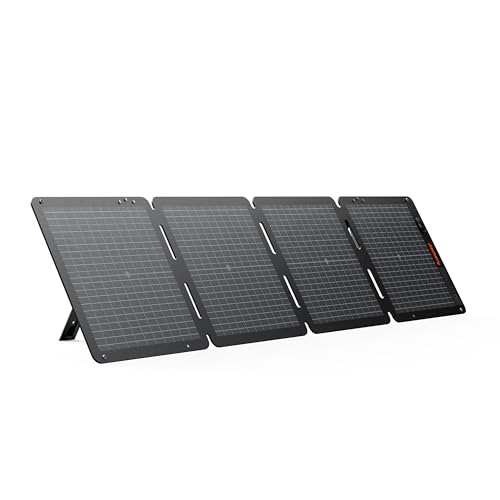
Jackery SolarSaga 100 Portable Solar Panel
SolarSaga is designed to plug straight into a Jackery power station, and that simplicity is the reason to buy it if you already own one. It also carries USB ports for direct device charging when the station is elsewhere. The connector is proprietary in feel, so cross brand use may need an adapter.
Pros
- Plug and play with matching power stations
- Built in kickstands and carry handle
- USB ports for direct charging
Cons
- Best value only if you own the matching station
- Cross brand use may need an adapter

EcoFlow 110W Portable Solar Panel
EcoFlow’s panel pairs high monocrystalline efficiency with a protective case that doubles as an angled stand, which is a genuinely good design touch. Rated at 110W, it recharges a power station noticeably faster than 60W class panels in the same conditions. The case adds bulk, and the whole package is a vehicle based item rather than something you carry far.
Pros
- High output for faster station recharges
- Case works as a proper angled stand
- Sealed panel construction
Cons
- Bulky with the case included
- Vehicle based rather than portable on foot

Goal Zero Nomad 20 Solar Panel
Goal Zero builds the Nomad for repeated abuse in the field, with a tough frame, a kickstand and a chainable connector for linking panels. Output is modest at 20W, which suits phones, headlamps and small battery packs rather than laptops. It costs more per watt than most rivals, and you are paying for durability rather than raw power.
Pros
- Built to survive rough handling
- Panels can be chained together
- Integrated kickstand for angling
Cons
- Costly per watt of output
- Not enough output for laptops
Nekteck 21W Solar Charger
Nekteck delivers the basic folding solar panel formula at a low price: monocrystalline cells, two USB ports and a nylon shell with loops. It has no battery and no clever features, and that is precisely the point. Output tracks the light closely, so it works well clipped to a pack in open sun and poorly under tree cover.
Pros
- Low cost for monocrystalline cells
- Light and easy to hang
- No fragile electronics to fail
Cons
- No storage battery included
- Charging pauses if light drops suddenly
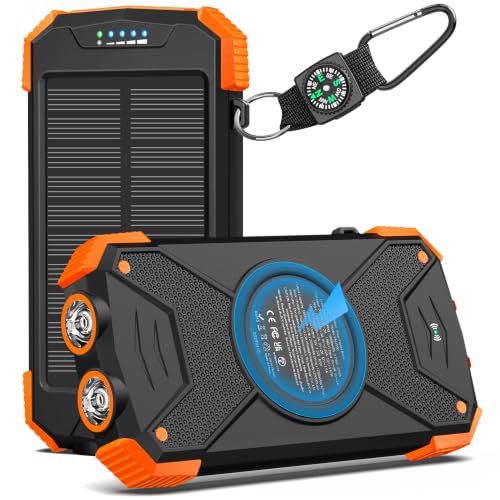
BLAVOR Solar Power Bank
This is a power bank with a small solar cell on the back rather than a solar charger in any serious sense, and it is important to understand the difference. The battery is the useful part, charged from mains before you leave, with solar as a slow trickle top up in an emergency. Extras like a torch and compass make it a reasonable item for a go bag.
Pros
- Battery plus panel in one pocket sized unit
- Useful extras for an emergency kit
- Very low cost
Cons
- Solar panel charges the bank extremely slowly
- Not a substitute for a real folding panel
Side by side
| # | Model | Rated output | Best for | Score | Price |
|---|---|---|---|---|---|
| 1 | Anker 625 Solar Panel | 100W | Best overall | 9.4 | Check price |
| 2 | BigBlue 28W SolarPowa Charger | 28W | Best for hiking | 9.2 | Check price |
| 3 | Jackery SolarSaga 100 Portable Solar Panel | 100W | Best for power stations | 9.0 | Check price |
| 4 | EcoFlow 110W Portable Solar Panel | 110W | Best for high output | 8.8 | Check price |
| 5 | Goal Zero Nomad 20 Solar Panel | 20W | Best build quality | 8.6 | Check price |
| 6 | Nekteck 21W Solar Charger | 21W | Best value | 8.3 | Check price |
| 7 | BLAVOR Solar Power Bank | Power bank with solar panel | Best budget backup | 8.0 | Check price |
Common questions
How long does a solar charger take to charge a phone?
In good direct sun, a 20 to 28W panel typically charges a phone in a few hours, similar to a slow mains charger. Cloud, low sun angle and heat all extend that considerably. Charging a power bank during the day and using it at night is more dependable than charging the phone directly.
Do solar chargers work on cloudy days?
They produce some power, but output falls dramatically under heavy cloud, often to a small fraction of the rated figure. Light overcast is workable if you are patient. Plan for the worst case by carrying a charged power bank as well.
What wattage solar panel do I need?
For phones and headlamps, 20 to 30W is enough. For tablets and fast top ups, 40 to 60W helps. For recharging a portable power station in a reasonable time, look at 100W or more, and consider chaining panels if the station supports it.
Are solar power banks any good?
As power banks, yes. As solar chargers, the small cell on the back charges the internal battery very slowly, often taking many days of full sun. Treat solar on a power bank as an emergency trickle rather than your main charging method.
Can I leave a solar panel out in the rain?
Check the rating. Many panels have water resistant fabric and sealed cells, but the USB port housings are usually the weak point and should be covered or kept dry. Panels rated IP67 or IP68 handle wet conditions better, though the devices connected to them still need protection.
Will a solar charger work through a window?
Poorly. Glass filters a meaningful share of the useful spectrum and reflects more, so output drops noticeably compared with the same panel outside. If you must charge indoors, put the panel as close to the glass as possible and expect slow results.
Can I connect a panel to any power station?
Not always. Check the input voltage and current range of your station and the panel’s output, and confirm the connector type. Many brands use their own plug, and adapters exist but you need to match the electrical specification, not just the physical fit.
How long do solar panels last?
Portable folding panels typically hold most of their output for years of seasonal use, with the fabric hinges and port housings usually failing before the cells do. Store them dry, avoid folding along cell faces, and keep the surface clean to maintain output.
Our pick
The Anker 625 is the panel most people should buy because it charges devices directly, feeds a power station and angles properly at the sun. Hikers counting grams should take the BigBlue 28W instead, and anyone who already owns a Jackery power station gets the least hassle from the matching SolarSaga 100. Treat rated wattage as a ceiling, not a promise.


