Squat Racks That Actually Fit a Small Home Gym
Titan Fitness’s T-3 Series Power Rack leads for tight rooms, since its 24-inch depth option still holds an 1,100 lb rated load. Mikolo’s Power Cage adds built-in cable pulleys in a similar footprint. PRx Performance Profile ONE folds flat to 6.75 inches for rooms with no floor space to spare.
Three racks stand out for cramped rooms. Titan Fitness’s T-3 Series Power Rack tops the list because its 24-inch depth option still carries an 1,100 lb rackable rating, rare at this size. Mikolo’s Power Cage folds cable pulleys into a similar 61 by 53-inch footprint, and PRx Performance Profile ONE collapses to 6.75 inches once a workout ends.
Squat racks scale down awkwardly, since a shallow frame often trades away weight capacity or safety arm reach. Wall studs, ceiling height and floor space all cap what fits before a single spec sheet gets checked. We compared footprint, folded depth, steel gauge and rated capacity, then weighed owner reports of wobble under load, hole alignment and how much floor space each design gives back after a workout.
The top picks, ranked

Titan Fitness T-3 Series Power Rack
This 24-inch depth configuration fits against a wall while leaving room to walk around a squat stance. Numbered 2×3-inch 11 gauge uprights rated for 1,100 lbs support heavy pulling and pressing. Owners report the laser-cut holes line up cleanly for fast pin adjustments.
Pros
- Numbered holes speed up bar height changes
- Whole rack rated to 4,400 lbs for band and chain work
- 24-inch depth option leaves floor space for a bench
Cons
- Needs roughly 5 feet of wall length
- J-hooks and safeties often sold as separate add-ons

Mikolo Power Cage HR05
A built-in dual pulley system pairs with the squat cage here, so cable work replaces a separate functional trainer. Frame footprint runs 61 by 53.4 inches, tighter than most rigs with an attached cable station. Reviewers note the 1:1 pulley ratio keeps loaded weight matching the stack you load.
Pros
- Cable pulleys remove the need for a separate lat tower
- Landmine and T-bar row add pressing and rowing variety
- 205 lb frame stays planted during heavy pulls
Cons
- Wider footprint than a bare squat stand
- Pulley cables need periodic tension checks

PRx Performance Profile ONE Folding Squat Rack
Gas shock hinges let this rack fold flat against a wall, shrinking to about 6.75 inches deep when not in use. Extended for a lift, the 2×3-inch 11 gauge frame opens to roughly 27.5 inches and holds 1,000 lbs on the J-cups. Installation bolts into wall studs on 16 or 24-inch centers.
Pros
- Folds away in seconds, freeing the floor for other uses
- Gas shocks make raising and lowering a one-person job
- Frees up wall space a freestanding rack would otherwise block
Cons
- Needs exposed studs and a permanent wall mount
- Not portable once installed
Bells of Steel Utility Power Rack
A 32.5 by 51-inch footprint keeps this freestanding cage compact while it still stands 88.5 inches tall. 12 gauge steel uprights measure 28.6 inches deep, shallow enough for a spare bedroom corner. It ships with triple-padded J-cups, pin pipe safeties and concrete anchors for permanent mounting.
Pros
- 28.6-inch depth suits rooms too shallow for a full rack
- Concrete anchor holes allow a bolt-down for extra stability
- Single bare pull-up bar avoids obstructing the ceiling
Cons
- 12 gauge steel is lighter duty than 11 gauge competitors
- No lat pulldown or cable option on this frame

Rep Fitness PR-1100 Power Rack
This half rack trims down to a 58 by 47.5-inch footprint with a 24 by 44-inch gap between uprights for the lifter. 2×2-inch tubing with 1-inch holes on 3-inch spacing holds up to 700 lbs. A multi-grip pull-up arch adds four hand positions without extending the frame’s width.
Pros
- Multi-grip arch adds pull-up variety in the same footprint
- Numbered uprights simplify matching J-hook and safety height
- Extended safeties double as a rack pull platform
Cons
- 700 lb rating trails heavier duty full cages
- 47.5-inch depth still needs a dedicated corner

Fitness Reality 810XLT Super Max Power Cage
An optional lat pulldown and low row attachment bolts onto this 2×2-inch tubular steel cage for accessory work. Assembled footprint runs 68 by 46.5 inches, and the cage plus safety bars carry an 800 lb rating. The pulley attachment itself is rated to 270 lbs, enough for most accessory lifts.
Pros
- Lat pulldown and low row cover pulling work without a separate machine
- 800 lb rated safety bars handle heavier squat and bench sessions
- Chrome guide rail keeps the pulley cable tracking smoothly
Cons
- Lat pulldown attachment sold separately from the base cage
- 68-inch depth runs longer than several rivals here
Yaheetech Adjustable Squat Rack Pair
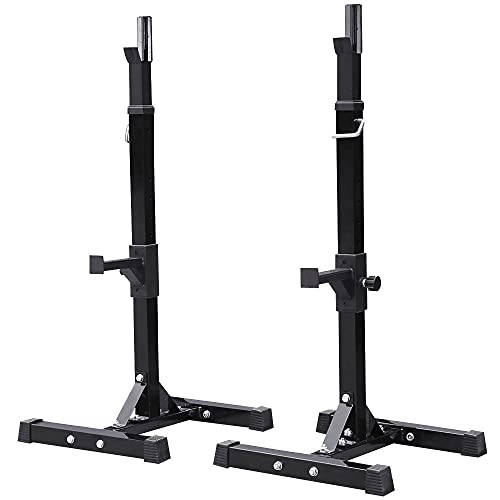
Two independent stands replace a connected cage here, so owners can angle or store them separately in tight rooms. Each stand adjusts from 40.4 to 66 inches across 14 height settings and holds 550 lbs combined. 2×2-inch tubing at 1/16-inch thickness keeps the pair light enough to reposition solo.
Pros
- Two separate stands store flush against a wall when not in use
- Lightweight frame is easy for one person to reposition
- Lowest cost entry point among racks compared here
Cons
- No connected safety arms between the two stands
- 550 lb rating limits heavier powerlifting loads
What to look for
How Much Space Does a Squat Rack Actually Need? Start with a tape measure, not a spec sheet. Note ceiling height, the depth from wall to nearest obstruction, and whether a stud wall exists nearby for mounting. A rack rated at 24 inches deep still needs clearance behind it for a full squat descent and bar loading. Most compact racks in this roundup need at least 6 to 7 feet of total depth once a lifter and loaded barbell factor in.
Folding and Wall-Mounted Racks for the Tightest Rooms A garage shared with a car or a spare bedroom often can’t spare permanent floor space. PRx Performance Profile ONE addresses that by folding to under 7 inches deep against studs. Bells of Steel Utility Power Rack stays freestanding but keeps its uprights under 29 inches deep, a middle ground for rooms that can spare a fixed corner. Either route trades some rigidity for reclaimed square footage.
Power Cage With Cables or a Bare Squat Stand? Mikolo’s Power Cage and the Fitness Reality 810XLT both build cable pulleys into the frame, replacing a separate functional trainer in the same room. That convenience adds width, since pulley towers extend past the squat footprint on one or both sides. Yaheetech’s two-stand pair skips cables entirely, favoring a lighter, cheaper setup that stores flush against a wall. Budget and available width should decide between these approaches before rated capacity does.
Matching Rack Depth to the Lifts You Actually Do Deadlifts and rack pulls need less depth than a full squat rack, so a shallow half rack like the Rep Fitness PR-1100 covers most home programming. Powerlifters loading heavy bench and squat work benefit more from the deeper, higher capacity Titan T-3. Bodyweight and band work suits a folding wall mount well, since it never needs standing squat clearance once stored.
How they compare
| # | Model | Footprint | Best for | Score | Price |
|---|---|---|---|---|---|
| 1 | Titan Fitness T-3 Series Power Rack | 54 in x 32.75 in | Best overall | 9.4 | Check price |
| 2 | Mikolo Power Cage HR05 | 61 in x 53.4 in | Best value | 9.1 | Check price |
| 3 | PRx Performance Profile ONE Folding Squat Rack | 6.75 in | Best folding wall-mounted rack for tight spaces | 8.9 | Check price |
| 4 | Bells of Steel Utility Power Rack | 32.5 in x 51 in | Best compact freestanding power rack | 8.7 | Check price |
| 5 | Rep Fitness PR-1100 Power Rack | 58 in x 47.5 in | Best half rack for small footprint | 8.5 | Check price |
| 6 | Fitness Reality 810XLT Super Max Power Cage | 68 in x 46.5 in | Best with lat pulldown and cable attachment included | 8.3 | Check price |
| 7 | Yaheetech Adjustable Squat Rack Pair | 40.4 in to 66 in | Best budget | 8.0 | Check price |
Common questions
What’s the smallest footprint squat rack for a home gym?
PRx Performance Profile ONE folds to about 6.75 inches deep against a wall, the shallowest option compared here when not in use.
Can a squat rack fit in a room with 8-foot ceilings?
Most compact racks top out between 82 and 91 inches tall, leaving clearance under an 8-foot ceiling; measure from floor to any light fixtures or ductwork first.
Do folding wall-mounted racks need a garage wall?
They need exposed studs rated to hold the mounting hardware, whether that’s a garage, basement or spare bedroom wall on 16 or 24-inch centers.
Half rack vs full cage, which fits small spaces better?
A half rack like the Rep Fitness PR-1100 saves depth since it’s open on one side, while a full cage like the Titan T-3 adds safety arms on all sides but needs more clearance.
Is a squat rack with a lat pulldown worth the extra footprint?
If it replaces a separate cable machine, yes, the Fitness Reality 810XLT covers pulling work in the same room; skip it if floor space is the tighter constraint.
What’s the best budget squat rack for small spaces?
Yaheetech’s Adjustable Squat Rack Pair costs less than a connected cage and stores as two separate stands, though it carries a lower 550 lb combined rating.
How much wall space does a folding squat rack need?
PRx Performance Profile ONE needs roughly 49 inches of wall width and correctly spaced studs, based on the listed dimensions for its Fold-In model.
Can two people share one compact squat rack for different lifts?
Numbered uprights on racks like the Titan T-3 and Rep PR-1100 let lifters log their own J-hook and safety heights, so resetting between users takes seconds.
How deep should a squat rack be for a home gym?
Plan for at least 24 inches of rack depth plus 3 to 4 feet of walking and loading space in front. Shallower racks like PRx’s folding model reclaim that space only after the workout ends.
Our pick
Titan Fitness’s T-3 Series Power Rack rewards roughly 5 feet of wall space with a 1,100 lb rating that outperforms most compact cages. PRx Performance Profile ONE suits rooms with no permanent floor space, folding flat between sessions. Tightest budgets should start with the Yaheetech pair and add safety arms later.