Which SSD Enclosure Gives You Full Drive Speed?
The Sabrent USB 3.2 Type-C Tool-Free NVMe Enclosure is our top pick for its easy access design and dependable ten gigabit bridge. The ACASIS TBU401 unlocks full forty gigabit speeds for Thunderbolt users, and the UGREEN M.2 NVMe Enclosure is the value option.
The Sabrent USB 3.2 Type-C Tool-Free NVMe Enclosure is the best SSD enclosure for most people, with the ACASIS TBU401 the choice for Thunderbolt speed and the UGREEN M.2 NVMe Enclosure the sensible budget option.
An enclosure is really just a bridge chip in a metal case, and that chip decides whether your NVMe drive runs at a thousand megabytes a second or four thousand. We compared published interface generations, bridge chipsets, heatsink and thermal pad provision, supported drive keying and owner reports of drives disconnecting under sustained load or throttling once the case got hot.
The shortlist, ranked
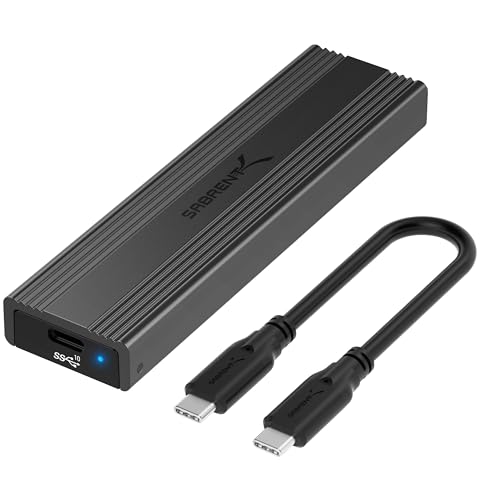
Sabrent USB 3.2 Type-C Tool-Free NVMe Enclosure EC-SNVE
Sabrent’s tool free design lets you slide the tray out and clip a drive in without hunting for a tiny screw, which matters more than it sounds if you swap drives. The ten gigabit interface delivers around a gigabyte a second in practice, which saturates any SATA drive and gets most of the way with a mid range NVMe. The aluminium shell and included thermal pad keep sustained transfers from throttling.
Pros
- Drive swaps take under a minute
- Metal body manages heat well
- Includes both USB-C and USB-A cables
Cons
- Ten gigabit ceiling limits fast Gen 4 drives
- Does not accept SATA M.2 drives

ACASIS 40Gbps Thunderbolt NVMe Enclosure TBU401
This is the enclosure to buy if you have a Thunderbolt port and a fast drive to put in it, since the forty gigabit interface removes the bottleneck entirely and lets a good NVMe run at internal drive speeds. It runs warm, which is why the body is a large finned aluminium block with an integrated pad. Owners editing video directly off the enclosure report it holds speed through long timelines.
Pros
- No practical speed bottleneck for NVMe drives
- Substantial heatsink for sustained work
- Fast enough to edit video directly from
Cons
- Falls back to slower speeds on plain USB ports
- Runs noticeably hot to the touch

OWC Express 1M2 Thunderbolt Enclosure
OWC builds the Express 1M2 to a standard closer to professional storage hardware than a generic caddy, with a machined body, an internal fan on some configurations and firmware that behaves predictably on macOS. It is the choice when reliability matters more than saving money, particularly for people working off external drives daily. It is also available preconfigured with a drive if you would rather not build it.
Pros
- Excellent stability on macOS and Windows
- Strong thermal design for long sessions
- Available prebuilt if you prefer
Cons
- The most expensive option here
- Overkill unless you have Thunderbolt
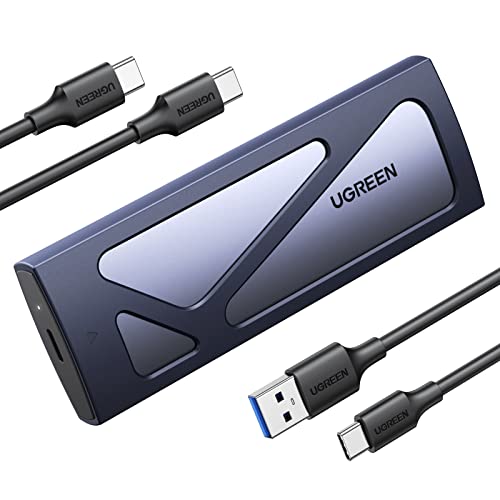
UGREEN M.2 NVMe SSD Enclosure
UGREEN’s enclosure covers the same ten gigabit ground as the Sabrent at a lower price, using a screw fixing rather than a tool free tray. Build is aluminium with a silicone thermal pad included, and the supplied cables are better than the usual bundled offcuts. If you are installing a drive once and leaving it, the screw is not a real inconvenience.
Pros
- Strong price for a genuine ten gigabit bridge
- Supports short 2230 drives as well as 2280
- Decent quality cables in the box
Cons
- Screwdriver needed for drive changes
- Body is smaller so it warms up faster

ORICO M.2 NVMe Enclosure M2PV-C3
ORICO’s snap fit design is the fastest way to change drives of anything here, using a clip rather than a screw or a tray. That suits anyone testing multiple drives or using the enclosure as a docking point for pulled laptop SSDs. Thermal performance is adequate rather than excellent, so it is better for file transfers than for running an operating system off it all day.
Pros
- Fastest drive swapping mechanism compared
- Compact and light for a metal enclosure
- Good choice for testing pulled drives
Cons
- Clip feels less secure than a screw
- Thermal headroom is limited under sustained load

SSK Aluminum M.2 NVMe Enclosure
SSK sells one of the cheapest enclosures that still uses an aluminium body and a real ten gigabit bridge rather than an old five gigabit chip. It is a plain screw together design with a thermal pad, and it does the job for backups and portable file storage. Owners note the supplied cable is short, so budget for a longer one if it will sit on a desk.
Pros
- Metal housing at a plastic enclosure price
- Genuine ten gigabit controller
- Simple, few things to go wrong
Cons
- Very short supplied cable
- No tool free access

Plugable USB-C NVMe Enclosure
Plugable’s strength is that its products tend to work with awkward hosts, from older laptops to tablets and single board computers, and its support documentation is unusually thorough. Performance is standard ten gigabit rather than exceptional. Pick this one if you have had compatibility trouble with generic enclosures or you need something that behaves predictably across a mixed fleet of machines.
Pros
- Reliable across unusual host devices
- Clear documentation and firmware notes
- Predictable behaviour on Linux
Cons
- No speed advantage over cheaper rivals
- Plainer build than premium metal enclosures
What to look for
Match the interface to your port, not your drive A forty gigabit Thunderbolt enclosure plugged into an ordinary USB port runs at ordinary USB speed. Check what your laptop actually has: a plain USB-C port is often only five or ten gigabit. If your machine has no Thunderbolt or USB4 port, a good ten gigabit enclosure gives you the same real world result for far less money.
NVMe and SATA M.2 drives are different M.2 is a physical format, not an interface. NVMe drives use PCIe lanes, SATA M.2 drives use the SATA protocol, and the notches on the connector differ. Most enclosures here take NVMe only. Check your drive’s key and protocol before ordering, or choose one of the dual protocol enclosures that accept both.
Heat is the hidden performance limit NVMe controllers throttle when hot, and an enclosure is a sealed box with no airflow. Aluminium bodies with a thermal pad pressed against the drive make a measurable difference on long transfers. If you plan to run an operating system or edit video from the enclosure, prioritise the thermal design over a marginally faster bridge chip.
The cable is part of the product A ten gigabit enclosure connected with a charging only or USB 2.0 rated cable will crawl, and this is a very common cause of disappointing speed tests. Use the cable supplied, and if you replace it, check the cable is rated for the data speed you need rather than just the power delivery figure.
Side by side
| # | Model | Interface | Best for | Score | Price |
|---|---|---|---|---|---|
| 1 | Sabrent USB 3.2 Type-C Tool-Free NVMe Enclosure EC-SNVE | USB 3.2 Gen 2, 10Gbps | Best overall | 9.4 | Check price |
| 2 | ACASIS 40Gbps Thunderbolt NVMe Enclosure TBU401 | Thunderbolt 3 and 4, 40Gbps | Best for maximum speed | 9.2 | Check price |
| 3 | OWC Express 1M2 Thunderbolt Enclosure | Thunderbolt, 40Gbps | Best build quality | 9.0 | Check price |
| 4 | UGREEN M.2 NVMe SSD Enclosure | USB 3.2 Gen 2, 10Gbps | Best value | 8.8 | Check price |
| 5 | ORICO M.2 NVMe Enclosure M2PV-C3 | USB 3.1 Gen 2, 10Gbps | Best for frequent drive swaps | 8.6 | Check price |
| 6 | SSK Aluminum M.2 NVMe Enclosure | USB 3.2 Gen 2, 10Gbps | Best budget | 8.3 | Check price |
| 7 | Plugable USB-C NVMe Enclosure | USB 3.2 Gen 2, 10Gbps | Best for compatibility | 8.0 | Check price |
Frequently asked questions
Will any M.2 SSD fit in these enclosures?
Not necessarily. Most take M.2 NVMe drives in the 2280 length, with some also supporting shorter 2230 and 2242 drives. SATA based M.2 drives need an enclosure that explicitly supports them. Check both the length and the protocol before buying.
Do I need to format the drive first?
Yes, a new bare drive will not appear until it is initialised and formatted. Use exFAT if you need the drive to work on both Windows and macOS, or the native filesystem of your platform if you only use one.
Why is my enclosure slower than the drive’s rated speed?
The usual causes are a bridge chip slower than the drive, a host port that is only five gigabit, or a cable not rated for the speed. Thermal throttling shows up as speed that starts high and falls partway through a large transfer.
Can I boot an operating system from an SSD enclosure?
Often yes, though it depends on your machine’s firmware and whether it will boot from USB. Thunderbolt enclosures are generally the more reliable route for this, and thermal performance matters more when the drive is in constant use.
Is Thunderbolt worth it over USB 3.2?
Only if your computer has a Thunderbolt or USB4 port and you use a drive fast enough to exceed ten gigabits. For backups, photo libraries and general file storage, a ten gigabit enclosure is already faster than most people’s workflow requires.
Do enclosures support TRIM?
Support depends on the bridge chipset and the host operating system. Enclosures using well supported chipsets generally pass TRIM through on modern systems, but it is not universal, so do not assume it if long term write performance matters to you.
Is it safe to unplug an external SSD without ejecting?
Eject it properly. Pulling a drive mid write risks losing data or corrupting the filesystem, and NVMe drives may still be flushing cache even when the activity light looks idle.
Why does my enclosure get so hot?
That is the aluminium body doing its job, drawing heat away from the drive controller. Warm is expected under sustained transfer. Uncomfortably hot combined with dropping speeds suggests the thermal pad is not making proper contact with the drive.
Final word
The Sabrent USB 3.2 Type-C Tool-Free NVMe Enclosure is the right pick for most people, since ten gigabits covers real world use and the tool free tray makes drive changes painless. Anyone with a Thunderbolt port and a fast drive should step up to the ACASIS TBU401, and the UGREEN enclosure covers the same ground as the Sabrent for less if you only install a drive once.