Step Drill Bits That Cut Clean Holes in Sheet Metal
The Irwin Unibit 10502 leads on cutting geometry and edge life in sheet steel. The Neiko 10184A set covers the widest size range for one purchase. The DEWALT DWA1786 fits an impact driver, which matters if that is the only tool on hand.
Sheet metal work separates these bits fast. The Irwin Unibit 10502 cuts cleanly without grabbing and keeps its size markings legible for years. The Neiko 10184A set answers when a wide size range matters more than one premium bit, and the DEWALT DWA1786 locks into an impact driver for anyone already carrying that tool.
Step bits look interchangeable in listings, yet differences surface the first time one goes through eighteen gauge steel. Coating decides how long the edge survives heat, flute count decides whether the bit grabs on breakthrough, and shank type decides which tools can drive it. We compared coatings, shank styles and stated thickness limits, then checked owner reports on edge life and how fast cheap bits dull past aluminum.
The shortlist, ranked

Irwin Unibit 10502 Step Drill Bit
Two cutting flutes share the load instead of one edge doing all the work, which cuts down on grabbing at breakthrough. Size markings are laser etched into the steps rather than stamped shallow, so they stay readable after months of use. Irwin built the original step bit design, and this version still sets the pace for clean holes in thin material.
Pros
- Two flutes reduce grabbing at breakthrough
- Step markings stay readable with use
- Long edge life in sheet steel
Cons
- Costs more than multi bit budget sets
- Single bit covers one size range only
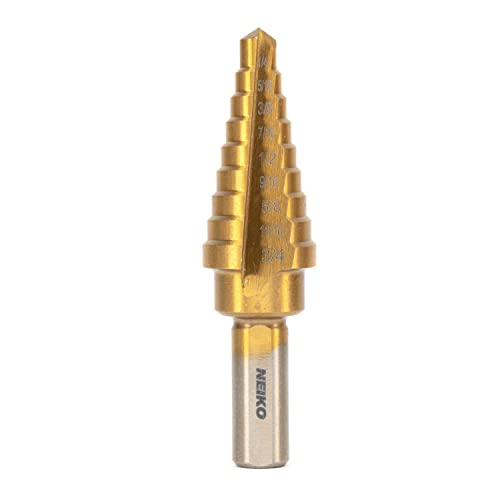
Neiko 10184A Step Drill Bit Set
Three bits span most hole sizes a home shop needs, from small grommet holes to large conduit knockouts. Titanium coating helps the edges survive occasional steel work, though sustained metal drilling wears them faster than industrial equivalents. An aluminum case keeps the set together in a van or toolbox.
Pros
- Covers a very wide size range in one purchase
- Titanium coating helps with occasional steel
- Case keeps the set together in a van
Cons
- Edge life is shorter than premium bits in steel
- Larger bit needs a powerful drill to spin properly

DEWALT DWA1786 Impact Ready Step Drill Bit
A quarter inch hex shank snaps straight into an impact driver, so electricians can carry one tool instead of two. That shank shape also resists slipping under load, a common frustration with round shanks in a keyless chuck. Impact drivers spin fast, so let the bit cut rather than leaning on it.
Pros
- Locks into an impact driver without slipping
- Saves carrying a separate drill on site
- Sturdy shank resists rounding
Cons
- Impact driver speed can overheat the edge
- Fewer size options than a full set

Milwaukee 48-89-9221 Step Drill Bit
Steps land on common knockout and connector diameters instead of an even spread, so sizing matches the holes electricians actually cut. A black oxide finish and heavy flute grind hold up against enclosure steel. General purpose work suits a different bit, since this one specializes.
Pros
- Step sizes match electrical connector diameters
- Robust build for panel and enclosure work
- Three flat shank grips well in a keyless chuck
Cons
- Step sizes are less useful outside electrical work
- Premium outlay for a single bit

Klein Tools KTSB03 Step Drill Bit
A short overall length matters when drilling inside a junction box or against a stud with little room to swing a drill. Double fluted geometry starts cleanly in thin material without needing a pilot hole. Its size range runs narrower than the multi-bit sets, so it pairs well alongside a broader set rather than replacing one.
Pros
- Short body fits confined work areas
- Starts cleanly without a pilot hole in thin stock
- Solid grip in standard chucks
Cons
- Narrow size range compared with sets
- Not suited to thick plate

COMOWARE Step Drill Bit Set
A titanium coated three piece set covers the sizes most DIY jobs need without a big outlay. Occasional workshop use suits it fine, but repeated steel drilling wears the coating faster than premium bits handle. Plastic, aluminum and light gauge steel are where it performs best.
Pros
- Low outlay for three usable sizes
- Fine for plastic, aluminum and light steel
- Case included for storage
Cons
- Coating wears quickly in sustained steel work
- Step markings can rub off over time

TACKLIFE Step Drill Bit Set
Five bits give more size overlap than most budget sets, useful when a bulkhead fitting or cable gland needs one specific diameter. Cutting stays acceptable in thin sheet and plastic if speed stays low. Owners report heat as the main enemy, so cutting fluid and patience extend the life considerably.
Pros
- Five sizes give useful overlap
- Works well in plastic and thin sheet
- Inexpensive way to cover many diameters
Cons
- Heat sensitive, needs slow speeds and lubricant
- Not built for repeated production drilling
Compared at a glance
| # | Model | Steps | Best for | Score | Price |
|---|---|---|---|---|---|
| 1 | Irwin Unibit 10502 Step Drill Bit | Multiple stepped diameters in one bit | Best overall | 9.4 | Check price |
| 2 | Neiko 10184A Step Drill Bit Set | Three bits covering a wide size range | Best value | 9.2 | Check price |
| 3 | DEWALT DWA1786 Impact Ready Step Drill Bit | Quarter inch hex, impact rated | Best for impact drivers | 9.0 | Check price |
| 4 | Milwaukee 48-89-9221 Step Drill Bit | Sized around common electrical diameters | Best for electrical work | 8.8 | Check price |
| 5 | Klein Tools KTSB03 Step Drill Bit | Short overall length | Best for tight spaces | 8.6 | Check price |
| 6 | COMOWARE Step Drill Bit Set | Three bits | Best budget set | 8.3 | Check price |
| 7 | TACKLIFE Step Drill Bit Set | Five bits | Best for occasional DIY | 8.0 | Check price |
How to pick the right one
What material thickness can a step bit handle? A step bit cuts no deeper than the height of a single step, usually a few millimeters. That makes them ideal for sheet metal, electrical enclosures, plastic panels and thin aluminum, and useless for plate steel or timber beams. Thicker material calls for a twist bit or a hole saw instead.
How do coating and flute count affect edge life? Titanium nitride coatings help the cutting edge survive the heat of metal drilling, where uncoated bits fail first. Flute count matters just as much. A single flute cuts aggressively and can grab on breakthrough, while two flutes share the load for a cleaner hole with less chatter.
Does slow speed and cutting fluid really extend life? Heat kills more step bits than anything else, and heat comes from spinning too fast. Run the drill at a low speed, apply steady pressure instead of leaning in, and add cutting fluid for steel work. A tip that turns blue has already lost its temper and will not cut properly again.
Which shank type matches which tool? Three flat shanks grip well in a keyless chuck without spinning loose. Hex shanks are needed to run a bit from an impact driver, and impact-rated bits are built to survive that hammering action. A standard round shank in an impact driver slips and chews up fast.
Good to know
What thickness of metal can a step drill bit handle?
Only up to the height of one step, typically around three millimeters or an eighth of an inch depending on the bit. Thicker material stops the next step from clearing, which binds the bit and can snap it.
Do I need a pilot hole with a step drill bit?
Usually not in thin sheet, since the pointed tip starts the hole itself. A small pilot hole helps on curved surfaces or slippery material where the tip would wander, and it reduces load on the first steps.
Why is my step bit leaving burrs?
The bit may be dull, the speed too high, or the final breakthrough pushed too hard. Ease off pressure just before the step clears the far side, and run the next step size briefly to deburr the edge.
Can I use step drill bits on stainless steel?
Yes, with the right technique, though stainless work hardens quickly. Run slow, keep constant pressure so the edge keeps cutting rather than rubbing, and use plenty of cutting fluid. Cheap uncoated bits will not last long in stainless.
Are step bits good for wood and plastic?
They work well in plastic and thin plywood and leave cleaner holes than spade bits in acrylic, which cracks easily. Thick timber still calls for a standard twist bit or forstner bit.
What drill speed works best for step bits?
Low speed for steel and stainless, moderate for aluminum, and moderate to fast for plastic while watching for melting. Bigger steps need slower speeds because the outer edge travels further per revolution.
Can step drill bits be sharpened?
They can be touched up on the flute face with a fine file or small stone, though it is fiddly and easy to change the geometry. Most people replace rather than resharpen, another reason to buy a bit built to last.
Single flute or double flute, which should I buy?
Double flute for most work, since it cuts more smoothly and grabs less on breakthrough. Single flute clears chips well in soft materials like plastic and thin aluminum and often costs less, but it can bite hard exiting steel.
Step drill bit vs twist bit, what is the difference?
A step bit cuts several diameters from one tapered tool and suits thin sheet stock. A twist bit cuts a single fixed diameter and handles thick material a step bit cannot clear.
The bottom line
The Irwin Unibit 10502 is worth the extra cost for anyone cutting metal regularly, since two flute geometry and durable markings keep it working long after budget bits dull. The Neiko 10184A set covers more sizes for less if range matters more than longevity. Anyone drilling from an impact driver should go straight to the DEWALT DWA1786 and its hex shank.

