Which String Trimmer Is Right for Your Yard?
The EGO Power+ ST1521S is our top string trimmer for its strong 56V power, carbon fiber shaft and quick POWERLOAD line feeding. The Greenworks Pro 80V suits large lawns, while the Milwaukee M18 Fuel is a durable choice for professionals and demanding weekend jobs.
If you want the short version, the EGO Power+ ST1521S is the string trimmer most homeowners should choose, combining strong cordless power, a light carbon fiber shaft and a bump-free POWERLOAD head that reloads line automatically.
String trimmers are tricky to compare because cutting performance depends on motor power, line thickness and head design, not voltage alone, and comfort matters as much as raw output over a long session. To rank these, we compared published specifications, manufacturer run-time claims and recurring themes in verified owner feedback, weighting real cutting power, balance and ease of reloading line over headline numbers.
The best picks, ranked

EGO Power+ ST1521S
The ST1521S combines a 56V brushless motor with a light carbon fiber shaft and EGO’s POWERLOAD head, which winds new line at the push of a button. Owners report it cuts thick grass and light weeds with ease, and the included battery keeps it ready for typical suburban lawns.
Pros
- Strong 56V brushless cutting power
- POWERLOAD auto line feed
- Light, durable carbon fiber shaft
Cons
- Premium position in the lineup
- POWERLOAD needs correct line loading
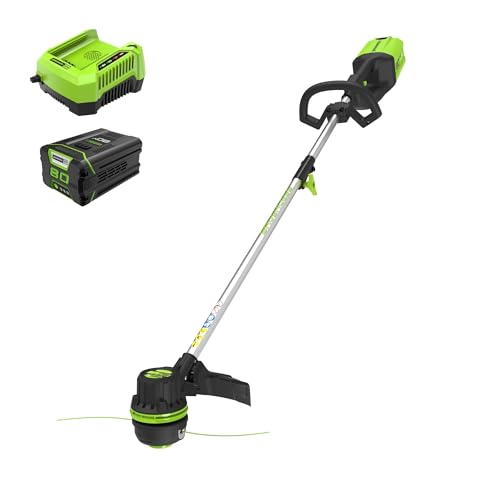
Greenworks Pro 80V String Trimmer
Running on the 80V platform, this Greenworks trimmer offers a wide cutting swath and sustained power well suited to bigger properties. Based on specifications it favors steady output, and owners note the brushless motor and attachment capability add long-term flexibility.
Pros
- Wide 16-inch cutting swath
- High-voltage sustained power
- Accepts attachment heads
Cons
- Battery ecosystem costs more to expand
- Heavier than lower-voltage models

Milwaukee M18 Fuel String Trimmer
Built for daily use, the M18 Fuel trimmer pairs a brushless motor with a rugged build and fits Milwaukee’s professional battery platform. Owners value its consistent power and quick-load head, making it a strong pick for contractors and homeowners with demanding weekly cutting.
Pros
- Rugged, jobsite-ready build
- Consistent brushless power
- Fits the M18 tool platform
Cons
- Often sold as a bare tool
- Premium price for homeowners

DeWalt DCST920P1 20V MAX
The DCST920P1 is a well-rounded 20V MAX trimmer with a variable-speed trigger and an adjustable cutting width, and it ships with a 5.0Ah battery. Owners like the balance and the option to trade run time for power, though it suits small to mid-size yards best.
Pros
- Includes a 5.0Ah battery
- Variable speed for power or run time
- Adjustable cutting width
Cons
- Best for small to mid-size yards
- Bump feed rather than auto load

Husqvarna 128LD
The 128LD is a gas trimmer with a 28cc two-cycle engine and a detachable shaft that accepts a range of Husqvarna attachments. Owners choose it for uninterrupted run time and the ability to convert it into an edger or pole saw, accepting the fuel mixing and upkeep gas requires.
Pros
- No battery limits on run time
- Accepts multiple attachments
- Wide 17-inch cutting swath
Cons
- Requires fuel mixing and upkeep
- Louder and heavier than cordless

Worx WG184 40V
The WG184 runs two 20V batteries for 40V output and includes a command feed spool system that advances line at the push of a button. Owners like the two-in-one trimmer and edger design and the included batteries, making it a practical value pick for small yards.
Pros
- Two batteries and charger included
- Push-button command feed
- Converts to a wheeled edger
Cons
- Uses two battery slots at once
- Narrower cutting width

Ryobi ONE+ 18V String Trimmer
The Ryobi ONE+ 18V trimmer is an accessible entry into cordless yard care and shares batteries with a huge ONE+ tool range. Owners find it capable for touch-ups and small lawns, and the light weight makes it easy for most people to handle comfortably.
Pros
- Affordable entry point
- Shares the large ONE+ battery range
- Light and easy to handle
Cons
- Limited power for thick weeds
- Shorter run time on small batteries
How they compare
| # | Model | Cutting width | Best for | Score | Price |
|---|---|---|---|---|---|
| 1 | EGO Power+ ST1521S | 15 in | Best overall | 9.4 | Check price |
| 2 | Greenworks Pro 80V String Trimmer | 16 in | Best for large lawns | 9.1 | Check price |
| 3 | Milwaukee M18 Fuel String Trimmer | 16 in | Best for professionals | 8.9 | Check price |
| 4 | DeWalt DCST920P1 20V MAX | 13-15 in | Best for DeWalt users | 8.6 | Check price |
| 5 | Husqvarna 128LD | 17 in | Best gas trimmer | 8.4 | Check price |
| 6 | Worx WG184 40V | 13 in | Best value | 8.2 | Check price |
| 7 | Ryobi ONE+ 18V String Trimmer | 13 in | Best budget pick | 8.0 | Check price |
How to choose
Cordless, gas or corded? Cordless trimmers dominate for most yards because they are quiet, low-maintenance and powerful enough for typical grass and weeds. Gas still leads for very large or overgrown properties thanks to unlimited run time, at the cost of noise, fumes and fuel mixing. Corded models are cheap and light but tether you to an outlet.
Cutting width, line and power A wider cutting swath, often 13 to 17 inches, clears more ground per pass, while thicker line handles tougher weeds. Higher voltage and brushless motors sustain speed under load, but comfort and control matter too. For thick brush, look for a trimmer that accepts 0.080 inch line or larger and offers a variable-speed trigger.
Line feed systems How a trimmer reloads line affects daily frustration. Bump feed advances line when you tap the head on the ground and is simple but can jam. Automatic systems feed line as it wears, while push-button systems like EGO’s POWERLOAD and Worx’s command feed rewind a fresh spool without manual winding, which many owners prefer.
Weight, balance and attachments Weight and balance decide how a trimmer feels after 20 minutes, so test the reach and consider a shoulder strap for larger jobs. Straight shafts extend reach under shrubs, while curved shafts feel nimble on small lawns. Attachment-capable models let one powerhead run an edger, pole saw or cultivator, saving money and storage.
Frequently asked questions
Are cordless string trimmers powerful enough?
For most lawns, yes. Modern 40V, 56V and 80V brushless trimmers cut grass and light weeds comfortably. For very large properties or thick, woody brush, a gas trimmer still offers more sustained power and unlimited run time.
What cutting width should I choose?
Match it to your yard. A 13-inch swath suits small lawns and tight spaces, while 15 to 17 inches clears larger areas faster with fewer passes. Wider heads use more power, so pair them with a higher-capacity battery or gas engine.
What is the difference between bump feed and automatic line feed?
Bump feed advances line when you tap the spinning head on the ground. Automatic feed releases line as it wears without tapping, and push-button systems rewind a full spool for you. Automatic and push-button systems reduce interruptions but can cost more.
Is a straight or curved shaft better?
Straight shafts offer more reach and are better for tall people and getting under shrubs, and they usually accept attachments. Curved shafts are lighter and feel more maneuverable on small, flat lawns. Choose based on your yard and comfort.
Can I use a string trimmer as an edger?
Many trimmers rotate or convert to an edging position, and some accept a dedicated edger attachment. Turning the head vertical along a walkway gives clean edges, though a purpose-built edger attachment produces the neatest results.
What line thickness do I need?
Thinner line around 0.065 inch suits light grass and small trimmers, while 0.080 inch and thicker handles tougher weeds and brush. Always use the line diameter your trimmer specifies, since oversized line can strain the motor.
How long do cordless trimmer batteries last?
Run time depends on battery size and cutting load, typically 30 to 60 minutes of light trimming per charge. Thick grass and higher speeds shorten this, so a spare battery is useful for larger yards.
Do string trimmers need much maintenance?
Cordless models need very little beyond replacing line and keeping the head clean. Gas trimmers require fuel mixing, air-filter cleaning, spark-plug checks and occasional carburetor care, which is the main trade-off for their run time.
Which brands share batteries across tools?
Systems like Ryobi ONE+, DeWalt 20V MAX, EGO 56V, Greenworks and Milwaukee M18 share batteries across many tools. Staying in one system lets you reuse batteries and chargers, which lowers the cost of adding more tools later.
The verdict
The EGO Power+ ST1521S is the string trimmer we would recommend to most homeowners, combining strong power, light handling and hassle-free line feeding. Choose the Greenworks Pro 80V for large lawns, the Milwaukee M18 Fuel for professional durability, or the gas Husqvarna 128LD when you need unlimited run time.