Survival Knives Built for Bushcraft and Backpacking
The Morakniv Garberg is our overall pick, combining a full tang with a scandi grind that sharpens easily in the field. The ESEE 6P is the tougher choice for heavy chopping and batoning, while the Morakniv Companion Heavy Duty is the sensible budget blade that punches far above its weight.
The Morakniv Garberg leads this list because a full tang, a stainless spine suited to striking a ferro rod and a scandi grind that anyone can resharpen make it the most complete all-rounder here. The ESEE 6P is the knife to carry when batoning and heavy camp chores are the priority, and the Morakniv Companion Heavy Duty covers the essentials for very little.
Survival knife shopping goes wrong when buyers chase blade length and serrations instead of the things that decide whether a knife survives real use: tang construction, steel choice and grind geometry. A hollow-handled blade with a saw back looks the part and fails at the first prying task. We compared steel composition and hardness, full versus partial tang designs, grind shape, sheath retention and what owners report about edge retention and corrosion to build the seven below.
Our top picks

Morakniv Garberg Full Tang Fixed Blade
The Garberg took Morakniv’s famous scandi grind and put it on a genuine full tang blade with a squared spine that throws sparks from a ferro rod. Sandvik 14C28N stainless resists rust in damp conditions and sharpens back to shaving sharp with basic field tools. Owners report it is the knife that finally removed the excuse for carrying something heavier.
Pros
- Full tang construction handles batoning without worry
- Scandi grind is the easiest geometry to resharpen in the field
- Squared spine strikes a ferro rod cleanly
Cons
- Scandi edge is less suited to fine slicing tasks
- Standard polymer sheath is functional rather than premium

ESEE 6P Fixed Blade Knife
ESEE builds the 6P from 1095 carbon steel at a thickness and hardness aimed squarely at abuse, and the company’s no questions warranty reflects that intent. The longer blade gives real leverage for splitting wood and chopping. Owners report the flat grind slices better than most survival blades while still taking a beating, though the carbon steel needs oiling.
Pros
- Built for batoning, prying and hard camp work
- Flat grind slices better than typical thick survival blades
- Backed by an unconditional replacement warranty
Cons
- Carbon steel rusts quickly without maintenance
- Heavier than most backpackers want to carry

KA-BAR Becker BK2 Campanion
At a quarter of an inch thick, the BK2 sits closer to a small hatchet than a knife, which is exactly why it splits kindling and processes firewood so effectively. The Grivory handle fills the hand well and stays grippy when wet. Owners report the weight is the trade-off, but for a base camp or truck knife the durability is hard to argue with.
Pros
- Extremely thick spine takes serious batoning
- Comfortable handle even in wet conditions
- Doubles as a light chopping tool
Cons
- Heavy for its blade length
- Thick grind makes fine cutting awkward
Benchmade Bushcrafter 162
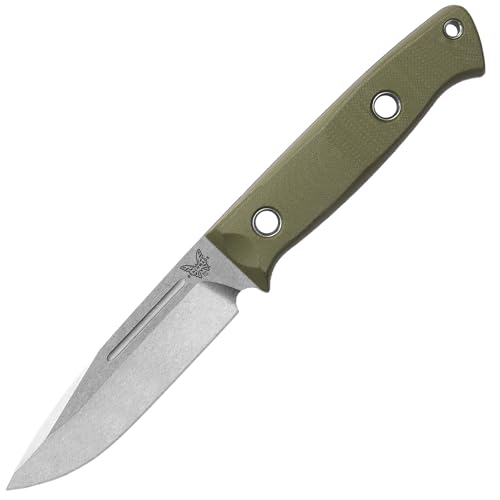
Benchmade uses CPM-S30V stainless with a high flat grind, which gives the Bushcrafter noticeably better edge retention and slicing ability than tool steel rivals. The contoured G10 handle and leather sheath are finished to a level the rest of this list does not attempt. Based on specifications it is aimed at woodcraft precision rather than pure abuse.
Pros
- Excellent edge retention from premium stainless
- Comfortable contoured handle for long carving sessions
- Quality leather sheath included
Cons
- S30V is harder to resharpen without proper stones
- A serious investment compared with the rest of the group
Gerber StrongArm Fixed Blade Knife
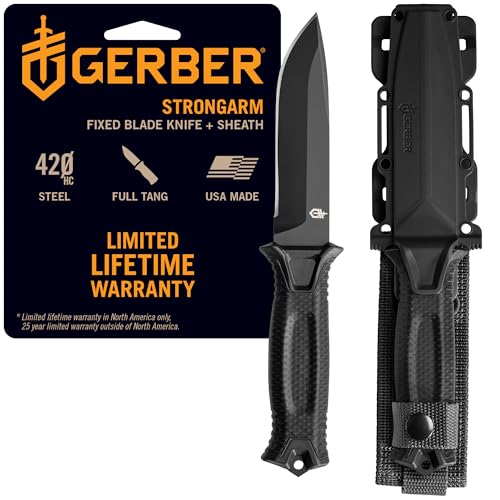
The StrongArm’s modular sheath is its real advantage, mounting horizontally, vertically or to MOLLE webbing without extra parts, which matters if the knife rides on a pack rather than a belt. The rubberised diamond texture handle grips well with gloves on. Owners report the striking pommel gets more use than expected for breaking glass and driving stakes.
Pros
- Genuinely versatile mounting options on the sheath
- Textured grip works well with wet or gloved hands
- Striking pommel adds practical utility
Cons
- 420HC steel dulls faster than premium alternatives
- Partial serration limits some carving tasks

Schrade SCHF9 Extreme Survival Knife
The SCHF9 is a large, heavy slab of 1095 with a thick spine and a nearly seven inch blade, giving it the reach and mass to chop rather than just cut. It is the least refined knife here and the sheath is the weak point, but the blade itself takes remarkable punishment. Owners report it as the knife they are happy to leave in a truck or bug-out bag.
Pros
- Mass and reach for genuine chopping
- Very robust full tang construction
- Strong value for the size of blade
Cons
- Included sheath retention is mediocre
- Heavy and unwieldy for detail work

Morakniv Companion Heavy Duty
A thicker spine than the standard Companion gives this version enough backbone for light batoning while keeping the scandi grind that makes Moras so easy to keep sharp. The rubber handle grips reliably in cold and wet conditions. Owners report buying several so one can live in a pack, one in a car and one in a workshop.
Pros
- Outstanding cutting performance for a simple knife
- Scandi grind resharpens easily on a basic stone
- Grippy handle performs in cold and wet weather
Cons
- Not a full tang, so hard prying is off limits
- Basic plastic sheath lacks refinement
Side by side
| # | Model | Blade steel | Best for | Score | Price |
|---|---|---|---|---|---|
| 1 | Morakniv Garberg Full Tang Fixed Blade | Sandvik 14C28N stainless | Best overall | 9.4 | Check price |
| 2 | ESEE 6P Fixed Blade Knife | 1095 carbon steel | Best for heavy use | 9.2 | Check price |
| 3 | KA-BAR Becker BK2 Campanion | 1095 Cro-Van carbon | Best for camp chores | 9.0 | Check price |
| 4 | Benchmade Bushcrafter 162 | CPM-S30V stainless | Best for bushcraft detail work | 8.8 | Check price |
| 5 | Gerber StrongArm Fixed Blade Knife | 420HC stainless | Best sheath system | 8.6 | Check price |
| 6 | Schrade SCHF9 Extreme Survival Knife | 1095 high carbon | Best for chopping reach | 8.3 | Check price |
| 7 | Morakniv Companion Heavy Duty | Carbon or stainless options | Best budget | 8.0 | Check price |
What to look for
Full tang is the specification that matters most A full tang means the steel of the blade continues in one piece all the way through the handle, with the scales bolted or riveted to it. That single detail determines whether a knife survives batoning and hard lateral loads. Partial tang and rat tail designs can be perfectly good for cutting, but they are the first thing to fail under leverage. Hollow-handled knives with storage compartments concentrate stress at exactly the wrong point and are best avoided.
Carbon steel or stainless is a maintenance choice Carbon steels like 1095 are tough, easy to sharpen and throw sparks from a ferro rod, but they will show rust within days if left damp. Stainless options such as 14C28N and S30V shrug off moisture and hold an edge longer, though harder stainless takes more effort to bring back. If your knife lives in a humid climate or a coastal environment, stainless removes a maintenance chore. If you are willing to oil a blade, carbon steel is forgiving in other ways.
Grind geometry decides what the knife is good at A scandi grind has a single wide bevel that bites into wood and is easy to resharpen freehand, which is why it dominates bushcraft. A flat grind slices better and handles food prep and general cutting more gracefully. Convex grinds are the toughest at the edge and best for chopping. There is no universal best, so pick the geometry that matches whether you will mostly carve, mostly slice or mostly chop.
Do not overlook the sheath A knife that falls out of its sheath on a trail is gone, and one that cannot be secured to a pack ends up left at home. Look for positive retention, a drainage point so water does not sit against the blade, and a mounting system that suits how you carry. Owners report that sheath quality is the single most common reason for replacing an otherwise good knife, and aftermarket kydex is a common upgrade.
Questions worth asking
What blade length is best for a survival knife?
Four to six inches suits most people. Shorter blades handle carving and detail work better and weigh less, while longer blades give leverage for batoning and chopping. Anything beyond seven inches starts trading away the fine control that makes a knife useful for everyday camp tasks.
Should a survival knife have serrations?
Generally no. Serrations help with rope and fibrous material but make the blade far harder to sharpen in the field and reduce the usable straight edge for carving. Most experienced users prefer a plain edge and carry a small saw if cutting cordage or wood is a frequent need.
Is a full tang really necessary?
For batoning and any task involving leverage, yes. For cutting, carving and general camp use, a well made three quarter tang knife like the Morakniv Companion performs excellently. Buy full tang if you expect to split wood with the blade, and be honest about whether you will.
How do I keep a carbon steel blade from rusting?
Wipe it dry after use, particularly after cutting anything acidic, and apply a thin film of mineral oil or a purpose made blade oil before storage. Never store a carbon blade in a wet leather sheath. A stable grey patina that forms over time actually offers some protection against deeper rust.
What steel holds an edge the longest?
Among the knives here, CPM-S30V in the Benchmade Bushcrafter holds an edge longest, followed by the Sandvik stainless in the Garberg. Tougher tool steels like 1095 dull faster but are easier to bring back with a simple stone, which is a genuine advantage far from home.
Can I baton wood with any of these knives?
The full tang models here, the Garberg, ESEE 6P, BK2, Bushcrafter, StrongArm and SCHF9, are all built for it. The Companion Heavy Duty handles light batoning on small rounds but is not the right tool for repeatedly splitting large sections.
How often should I sharpen a survival knife?
Touch up the edge whenever it stops biting into a fingernail or slicing paper cleanly, which for regular camp use might be every few outings. Frequent light stropping keeps a working edge with far less effort than letting a blade go fully dull and grinding it back.
Are there legal restrictions on carrying fixed blade knives?
Rules vary widely by country, state and even city, and they often distinguish between transport for a lawful outdoor purpose and everyday carry. Check the specific regulations for where you live and anywhere you plan to travel before carrying a fixed blade in public.
Final word
The Morakniv Garberg is the knife most people should buy, since a full tang, corrosion resistant steel and an easily maintained edge cover almost everything a survival blade is asked to do. Step up to the ESEE 6P if batoning and heavy camp work dominate your use, or to the Benchmade Bushcrafter 162 if you want premium steel for fine woodcraft. The Morakniv Companion Heavy Duty proves you do not need to spend much to carry something genuinely capable.