Table Tennis Paddles for Spin, Speed and Control
The STIGA Pro Carbon is our top table tennis paddle for attacking players who want speed with usable spin. The STIGA Evolution is the best value for club level control, and the Palio Expert 3.0 is the paddle to learn proper technique on as a beginner.
The STIGA Pro Carbon is the table tennis paddle we would put in an attacking player’s hand, with the STIGA Evolution as the balanced club level choice and the Palio Expert 3.0 as the paddle beginners actually improve on.
The confusing part of this category is the star rating printed on the packaging, which is a manufacturer’s own marketing scale rather than any recognised standard, so a five star paddle from one brand may play nothing like a five star from another. We compared blade layer construction, rubber grade, sponge thickness and handle shapes, alongside what owners and coaches report about how each paddle rewards or punishes developing technique, then ranked them by playing style rather than by star count.
What we recommend

STIGA Pro Carbon Performance Ping Pong Paddle
Two carbon layers inside a seven ply blade give this paddle a noticeably larger sweet spot and a faster response than an all wood construction, which is what attacking players are looking for. The S5 rubber with a thick sponge generates real topspin rather than just pace. It is fast enough that beginners will struggle to keep the ball on the table, so this is a paddle for someone with a developed stroke.
Pros
- Carbon layers widen the sweet spot noticeably
- Generates genuine topspin, not just speed
- ITTF approved rubber for tournament play
Cons
- Too fast for developing players to control
- Blocking requires an adjusted, softer touch

STIGA Evolution Performance Ping Pong Paddle
The Evolution sits one step below the Pro Carbon and is the better paddle for most people, because a six ply all wood blade with a slightly thinner sponge is far easier to control while still allowing an attacking shot. The crystal technology in the blade stiffens the surface for a cleaner strike. Club players consistently report this as the paddle they settled on after finding faster ones unmanageable.
Pros
- Balanced speed and control for club play
- Easier to keep on the table than carbon paddles
- Comfortable flared handle with shock damping
Cons
- Less outright speed than carbon blades
- Rubber wears faster than premium grades
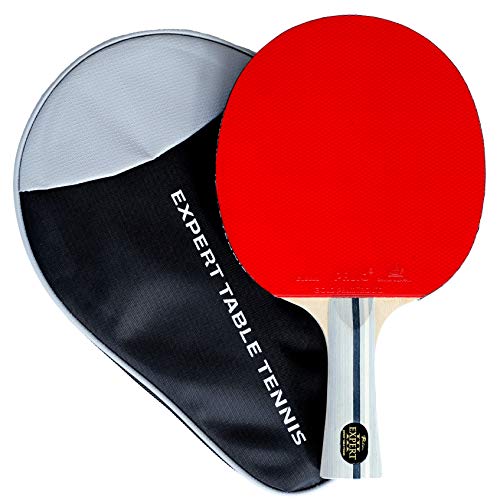
Palio Expert 3.0 Table Tennis Racket
Coaches keep recommending the Expert 3.0 because it does the one thing a beginner paddle should: it rewards a correct stroke and does not paper over a bad one. The blade is controlled rather than fast, the rubber grips enough to teach spin, and both are ITTF approved so nothing needs replacing when a player enters a first competition. It comes with a case, which most competing paddles do not.
Pros
- Rewards correct technique as it develops
- ITTF approved rubber suits early competition
- Case included in the box
Cons
- Not fast enough for developed attacking players
- Plain appearance compared with branded rivals
Killerspin JET800 Speed N1
The JET800 is built around five wood plies plus two carbon layers, producing the fastest paddle in this group and one aimed squarely at aggressive loopers who finish points early. Nitrx rubber on both faces provides the grip needed to keep that speed on the table. It is unforgiving of a late or lazy stroke, and it costs more than most players new to the sport should spend.
Pros
- Fastest paddle in this comparison
- Excellent grip for aggressive looping
- Premium finish and presentation
Cons
- Very unforgiving of imprecise technique
- Among the most expensive options here

JOOLA Infinity Overdrive
JOOLA balances the Infinity Overdrive between offence and control, using a carbon reinforced blade that adds speed without the harshness of a full carbon setup. The result is a paddle that suits an improving player who is starting to attack but still needs the ball to stay on the table when the stroke is not perfect. Handle comfort is a strong point over long sessions.
Pros
- Adds speed without becoming uncontrollable
- Comfortable handle over long sessions
- Suits players transitioning to attacking play
Cons
- Neither the fastest nor the most controlled option
- Rubber is less grippy than premium tournament sheets

Butterfly 401 Table Tennis Racket
Butterfly is the most respected name in the sport, and the 401 brings that engineering to a controlled, all round paddle rather than a speed weapon. Yuki rubber with a thinner sponge keeps the ball predictable, which suits defensive and blocking players and anyone playing on a smaller home table. It is not the paddle to buy if you want to hit through opponents.
Pros
- Very predictable ball response
- Suits blocking and defensive play
- Trusted brand engineering throughout
Cons
- Limited speed for attacking players
- Thinner sponge reduces spin generation

DHS Hurricane-II Table Tennis Racket
DHS rubbers are known for a tacky surface that grips the ball long enough to impart heavy spin, which is the defining characteristic of the Chinese playing style. The Hurricane-II brings that to a ready assembled paddle rather than a custom build. Tacky rubber needs cleaning regularly to keep working, and it feels quite different from the springier European rubbers on the other paddles here.
Pros
- Tacky surface generates heavy spin
- Ready assembled version of a respected setup
- Distinctive feel worth trying for spin players
Cons
- Tacky rubber needs frequent cleaning to stay effective
- Feels unfamiliar to players used to European rubbers
Compared at a glance
| # | Model | Blade | Best for | Score | Price |
|---|---|---|---|---|---|
| 1 | STIGA Pro Carbon Performance Ping Pong Paddle | Seven ply with two carbon layers | Best overall | 9.4 | Check price |
| 2 | STIGA Evolution Performance Ping Pong Paddle | Six ply light wood with crystal technology | Best value | 9.2 | Check price |
| 3 | Palio Expert 3.0 Table Tennis Racket | Five ply wood, control oriented | Best for beginners | 9.0 | Check price |
| 4 | Killerspin JET800 Speed N1 | Seven layer with two carbon plies | Best for speed | 8.8 | Check price |
| 5 | JOOLA Infinity Overdrive | Carbon reinforced multi ply | Best all round performance | 8.6 | Check price |
| 6 | Butterfly 401 Table Tennis Racket | Five ply all wood | Best for control | 8.3 | Check price |
| 7 | DHS Hurricane-II Table Tennis Racket | Multi ply wood | Best for spin | 8.0 | Check price |
What to look for
Ignore the star ratings on the packaging Star ratings are each manufacturer’s internal marketing scale, not an industry standard, so a five star paddle from one brand can be slower than a four star from another. What actually determines how a paddle plays is the blade construction, the rubber grade and the sponge thickness. Read those three specifications and treat the stars as decoration on the box.
Match speed to your current technique, not your ambition The most common purchasing mistake is buying a carbon blade because it is the most advanced option available. A fast paddle sends balls long when your stroke is not yet consistent, which means you stop attacking to keep the ball on the table, and your technique goes backwards. Buy something controlled, develop the stroke, then step up. Coaches are unanimous on this and players routinely ignore them.
Sponge thickness changes the game more than most people realise A thicker sponge, around two millimetres, stores more energy and produces more speed and spin, but it dulls the feel of the ball and makes touch shots harder. A thinner sponge, around one and a half millimetres, gives a much more direct connection and better control at the cost of power. Attacking players want thick sponge. Blockers, defenders and beginners are usually better served by thinner.
Check ITTF approval if competition is a possibility Rubbers used in sanctioned competition must appear on the ITTF approved list, and paddles sold for recreational use often use rubber that is not. If there is any chance of entering a league or a club tournament, buy an approved paddle now rather than replacing it later. The approval marking is printed on the rubber near the edge of the blade.
Frequently asked questions
What do the star ratings on paddles mean?
They are each brand’s own marketing scale with no shared standard behind them. Compare blade construction, rubber grade and sponge thickness instead, since those determine how the paddle actually plays.
Should a beginner buy an expensive paddle?
No. A fast carbon paddle sends balls long before technique is consistent, which discourages proper stroke development. A controlled paddle such as the Palio Expert 3.0 builds better habits and costs far less.
What sponge thickness should I choose?
Around two millimetres for attacking play with more speed and spin, and about one and a half millimetres for control, blocking and touch shots. Thicker sponge reduces the feel of the ball on soft shots.
What is the difference between flared and straight handles?
A flared handle widens toward the base and locks into the hand, which suits most players and forehand dominant styles. Straight handles allow easier grip rotation, which some players prefer for switching between forehand and backhand.
How long does paddle rubber last?
Owners report roughly six months to a year of regular play before grip noticeably declines. Rubber that has lost its tack no longer generates spin, which is usually the first thing a player notices.
How should I clean a table tennis paddle?
Wipe the rubber with a damp sponge or a dedicated cleaner after each session and let it air dry. Store the paddle in a case with rubber protection sheets, since dust and light are what degrade the surface.
Does the paddle need to be ITTF approved?
Only for sanctioned competition, where the rubber must be on the ITTF list. For home and casual club play it makes no difference, but buying approved rubber keeps the option open.
Can I replace the rubber rather than the whole paddle?
On better paddles, yes, and it is what serious players do. Rubber sheets are glued to the blade and can be replaced when worn. Cheaper pre assembled paddles are generally not worth recovering.
The verdict
The STIGA Pro Carbon is the table tennis paddle we would pick for a developed attacking player, because the carbon layers widen the sweet spot without killing the spin the rubber can generate. Most club players will actually enjoy the STIGA Evolution more, since it keeps the ball on the table while still allowing an attacking shot, and anyone learning the sport should start with the Palio Expert 3.0.


