Telescopes for Kids That Make Stargazing Fun
The Celestron Inspire 80AZ is our top pick for kids. It offers a solid balance of aperture, ease of use, and durability. Young astronomers appreciate its simple altazimuth mount and clear views of the Moon and planets. Its main limitation is the need for adult help during initial assembly.
Choosing a first telescope for a child can be tricky. You want something that sparks curiosity without overwhelming them. A good kids telescope should be easy to set up, simple to use, and durable enough to handle a few bumps.
We compared seven popular models based on specs, user feedback, and reputation. Whether your child wants to see the Moon’s craters or Saturn’s rings, there’s a telescope here for every budding astronomer.
The shortlist, ranked

Celestron Inspire 80AZ
The Celestron Inspire 80AZ is a refractor telescope with an 80mm aperture, offering bright and clear views. It includes two eyepieces, a StarPointer finderscope, and a smartphone adapter. The altazimuth mount is smooth and easy to point, making it great for kids. Owners report that setup takes about 10 minutes with adult help.
Pros
- Easy to use and adjust
- Sharp views of the Moon and planets
- Sturdy tripod with accessory tray
Cons
- Tripod legs are a bit wobbly at full extension
- Finder scope is low magnification
Orion StarBlast II 4.5 Equatorial
This tabletop reflector has a 4.5-inch aperture that collects plenty of light, allowing views of the Moon, planets, and even brighter deep-sky objects like the Orion Nebula. It features an equatorial mount, which can be challenging for young kids but offers a great learning opportunity. Comes with a red dot finder and two eyepieces.
Pros
- Excellent light gathering for the price
- Compact and portable tabletop design
- Teaches celestial tracking with EQ mount
Cons
- EQ mount has a learning curve
- Needs a stable table or surface

Celestron PowerSeeker 70AZ
The Celestron PowerSeeker 70AZ is an affordable refractor with a 70mm aperture, making it a good entry-level telescope. It includes a 3x Barlow lens and two eyepieces, providing up to 120x magnification. The altazimuth mount is simple, and the tripod is adjustable. Parents appreciate the low price for a first telescope.
Pros
- Very affordable for starters
- Lightweight and portable
- Good views of the Moon and bright planets
Cons
- Tripod is somewhat flimsy
- Finder scope is difficult to align

Gskyer 600x90mm Telescope
The Gskyer 600x90mm is a refractor with a 90mm aperture, offering great light gathering for kids interested in deep space. It comes with three eyepieces and a Barlow lens, achieving magnifications up to 600x (though practically, 200x is more realistic). The adjustable aluminum tripod is sturdy for the price.
Pros
- Large aperture for bright views
- Multiple eyepieces for varied magnification
- Sturdy tripod with carry bag
Cons
- High magnification claims are misleading
- Finder scope is basic
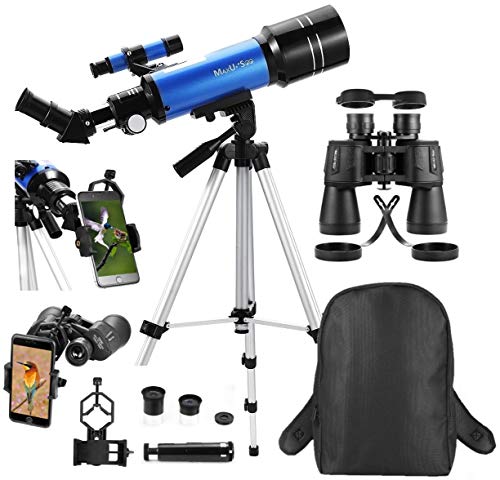
MaxUSee 50mm Telescope
This compact 50mm refractor is perfect for very young kids. It features a simple altazimuth mount, easy-to-use controls, and a lightweight design. The tripod is adjustable, and it includes a finder scope and two eyepieces. Parents report that their children can set it up with minimal help.
Pros
- Very easy for kids to operate
- Lightweight and portable
- Durable construction
Cons
- Limited light gathering
- Only basic views of the Moon
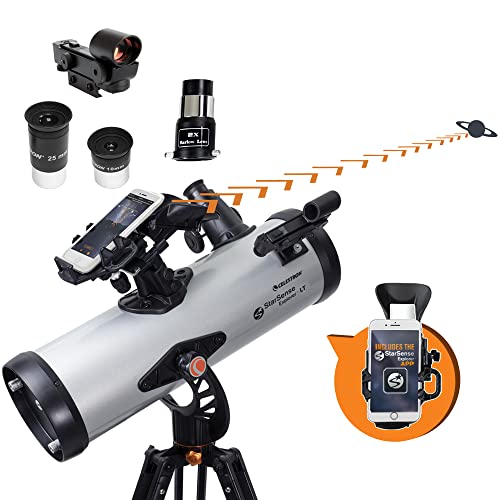
Orion SkyScanner 100mm
The Orion SkyScanner 100mm is a tabletop reflector that offers a large 100mm aperture at a low price. It provides bright, clear views of the Moon, planets, and some deep-sky objects. The simple Dobsonian mount makes it easy for kids to point and track. It comes with a 20mm eyepiece and a red dot finder.
Pros
- Large aperture for the price
- Simple Dobsonian mount
- Compact tabletop design
Cons
- Requires a stable table
- Only one eyepiece included
Meade Instruments Infinity 60mm AZ
The Meade Infinity 60mm is a classic refractor with a 60mm aperture, ideal for beginners. It includes a full-height tripod, two eyepieces, and a finder scope. The altazimuth mount is smooth and easy to use. While it won’t show faint galaxies, it provides nice views of the Moon and Jupiter’s moons.
Pros
- Stable tripod included
- Good for terrestrial viewing
- Simple setup
Cons
- Small aperture limits deep-sky views
- Finder scope is basic
How they stack up
| # | Model | Aperture | Best for | Score | Price |
|---|---|---|---|---|---|
| 1 | Celestron Inspire 80AZ | 80mm (3.1 in) | Overall best for kids | 9.4 | Check price |
| 2 | Orion StarBlast II 4.5 Equatorial | 114mm (4.5 in) | Older kids who want to learn astronomy | 9.1 | Check price |
| 3 | Celestron PowerSeeker 70AZ | 70mm (2.8 in) | Budget-friendly choice | 8.7 | Check price |
| 4 | Gskyer 600x90mm Telescope | 90mm (3.5 in) | Kids who want high magnification | 8.4 | Check price |
| 5 | MaxUSee 50mm Telescope | 50mm (2 in) | Younger kids (ages 6-8) | 8.2 | Check price |
| 6 | Orion SkyScanner 100mm | 100mm (4 in) | Families on a budget wanting large aperture | 8.9 | Check price |
| 7 | Meade Instruments Infinity 60mm AZ | 60mm (2.4 in) | Beginners who want a classic refractor | 8.0 | Check price |
What to look for
Good to know
What is the best telescope for a 5 year old?
For a 5 year old, choose a simple and sturdy telescope like the MaxUSee 50mm. It is lightweight, easy to operate, and has low magnification, which is perfect for young kids. Adult supervision is recommended.
How much should I spend on a kids telescope?
You can get a decent kids telescope for under 100 dollars. Budget models like the Celestron PowerSeeker 70AZ offer good value. More advanced telescopes with larger apertures will cost more, but they provide better views and can grow with the child.
What can kids see with a beginner telescope?
With a beginner telescope, kids can see the Moon’s craters, Jupiter’s moons, Saturn’s rings, and bright star clusters. Some telescopes can reveal the Orion Nebula as a faint smudge. Deep-sky objects like galaxies are harder to see with small apertures.
Are reflector telescopes better for kids?
Reflectors often offer more aperture per dollar, but they require more maintenance (collimation) and are generally bulkier. For very young kids, a refractor is easier to handle. For older kids, a tabletop reflector like the Orion SkyScanner is a good choice.
Do kids need a computerized telescope?
No. Computerized telescopes can be expensive and complex for kids. Manual telescopes are simpler and teach children how to navigate the night sky. A simple altazimuth or Dobsonian mount is ideal.
What is the best magnification for a kids telescope?
A magnification of 30x to 100x is practical for most kids telescopes. Higher magnifications often result in dimmer, blurrier images unless the telescope is on a very stable mount. Start with low power and gradually increase.
How do I align the finder scope?
Align the finder scope during the day. Aim the telescope at a distant object like a tree or a telephone pole. Center it in the main eyepiece, then adjust the finder scope’s screws until the crosshairs are on the same object. This ensures the finder points where the telescope points.
Can kids use a telescope to look at the Sun?
Never look at the Sun through a telescope without a proper solar filter. It can cause permanent eye damage. Only use telescopes with certified solar filters designed for that purpose. For kids, it’s safer to observe the Moon and planets at night.
Our pick
For most families, the Celestron Inspire 80AZ is the best choice because it combines ease of use, good optics, and durability. If your child shows a strong interest in astronomy and is ready to learn, consider the Orion StarBlast II 4.5 for its superior views. For a budget pick, the Celestron PowerSeeker 70AZ is reliable and affordable.


