Which Thermal Camera Actually Finds Hidden Leaks?
The FLIR C3-X is our overall pick for a standalone pocket camera with usable resolution and a clear touchscreen. The TOPDON TC001 gives phone users detector performance for far less, and the HIKMICRO Pocket2 is the higher resolution choice for trades doing survey work.
The FLIR C3-X is the pick for most buyers because it is a self contained camera with a screen, a usable detector and a workflow that does not depend on a phone staying charged. The TOPDON TC001 is the value route for anyone happy to plug into a phone, offering resolution that used to sit in a much higher bracket. For trades producing survey reports, the HIKMICRO Pocket2 gives noticeably more detector pixels and the on device tools to annotate what it finds.
Thermal imaging is easy to buy badly because the marketing number is usually the screen resolution, not the detector resolution, and those can differ by a factor of ten. A camera with a small detector interpolates a smooth image that looks convincing and hides the small temperature differences you were trying to find. Thermal sensitivity, quoted in millikelvin, decides whether a draught around a window frame shows at all. We compared detector resolution, stated sensitivity figures, temperature ranges, refresh rates, standalone versus phone attached designs and reporting features, then weighed those against what owners report about real world use on damp, insulation gaps and electrical inspection.
Before you buy
Detector resolution is the number that matters Listings often lead with the display resolution, which tells you nothing about what the camera can see. The figure to find is the detector or sensor resolution, written as something like 160 by 120 or 256 by 192. Everything above that is interpolation, which smooths the image without adding information. As a rule, more detector pixels means you can stand further back and still resolve a small hot spot rather than averaging it away.
Thermal sensitivity decides what shows at all Sensitivity is quoted in millikelvin, and lower is better. A camera rated below fifty millikelvin can separate the small differences that reveal a draught at a window seal or a slightly damp patch of plaster. A less sensitive detector will show a radiator and a hot pipe clearly and miss the subtle work entirely. If your reason for buying is insulation and damp rather than electrical faults, weigh sensitivity above almost everything else.
Standalone or phone attached changes how you work Phone attachments give you a large screen, plenty of storage and a familiar interface for a lower outlay, and they stop working when the phone is cold, wet or flat. Standalone cameras cost more and simply work, which counts in a loft, a crawl space or on a ladder. Trades who image daily generally end up with a standalone unit, while homeowners diagnosing one or two problems a year are well served by an attachment.
Emissivity and reflection will mislead you Thermal cameras read emitted infrared, and shiny surfaces such as bare metal, foil and glass emit poorly while reflecting the temperature of whatever is nearby, including you. A polished pipe can read far cooler than it is. Cameras with adjustable emissivity settings let you compensate, and a strip of matt tape on a shiny target gives a far more honest reading. Treat absolute temperature numbers as approximate unless you have controlled for this.
The shortlist, ranked
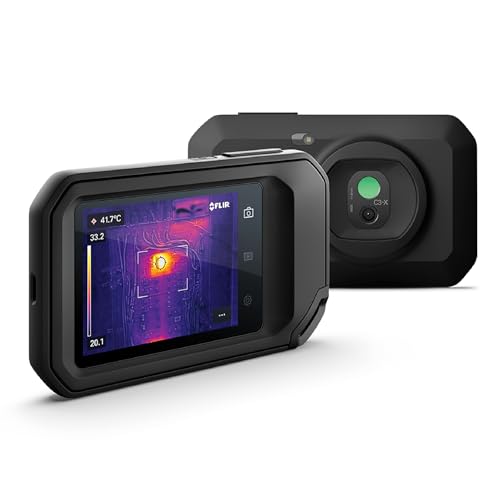
FLIR C3-X Compact Thermal Camera
This is a complete pocket camera rather than a phone accessory, so it powers up, images and stores without anything else in the loop, which matters on a ladder or in a loft. FLIR’s image blending overlays visible edges onto the thermal picture, and that alone turns a warm smudge into an identifiable pipe run or stud line. The detector is modest by professional standards, so it is better at finding problems than measuring them precisely at distance.
Pros
- Works standalone with no phone required
- Visible edge blending makes images readable
- Pocket sized with a usable touchscreen
Cons
- Detector resolution is modest for survey work
- Costs more than phone attached rivals

TOPDON TC001 Thermal Imaging Camera
Plugging directly into a phone gives you a large bright screen and processing power without paying for either, and the detector inside is far better than the outlay suggests. It suits finding underfloor heating runs, missing insulation and overheating connections around the home. There is no battery to charge and no screen to break, though it drains the phone it is attached to and the exposed connector needs care in a tool bag.
Pros
- Strong detector resolution for the outlay
- No separate battery to keep charged
- Uses your phone screen and storage
Cons
- Depends on a compatible charged phone
- Exposed connector needs protecting in a bag

HIKMICRO Pocket2 Thermal Camera
The Pocket2 pairs a higher pixel count detector with a visible camera and a proper touchscreen, which is the combination that makes reportable images rather than suggestive ones. On device annotation and image fusion mean a surveyor can capture, mark and export without going back to a laptop first. It is chunkier than a phone attachment, and getting real value from the extra resolution means learning how emissivity settings change the readings.
Pros
- Reportable image quality for professional use
- Annotation and fusion handled on the device
- Self contained with internal storage
Cons
- Bulkier than a phone attachment
- Emissivity settings take learning to use well
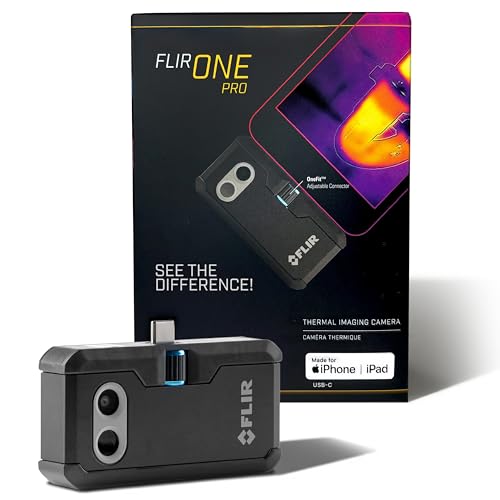
FLIR ONE Pro
The ONE Pro is the established phone attached option with versions for both Lightning and USB C, and its own internal battery so it does not flatten the phone it plugs into. Image quality benefits from FLIR’s visible blending, which remains the clearest way to identify what you are looking at. The adjustable connector accommodates thicker cases, though owners report the small battery needs charging separately and the plastic housing is not built for site abuse.
Pros
- Available for both iPhone and Android
- Own battery so the phone is not drained
- Visible blending aids identification
Cons
- Small battery needs its own charging routine
- Housing is not built for rough site use

InfiRay P2 Pro Thermal Camera
The included macro lens is the reason to choose this one, because it lets you image individual components on a circuit board rather than a whole appliance, which is the difference between finding a fault and confirming something is warm. It is tiny enough to live in a pocket permanently. The narrow default field of view means stepping further back for room scale work, and the software is less polished than the established brands.
Pros
- Macro lens enables board level inspection
- Very small and easy to carry always
- Good detector count for the size
Cons
- Narrow field of view for whole room scans
- App experience trails larger brands

Seek Thermal CompactPRO
Seek packs an unusually high pixel count into a phone attachment, which pays off when the target is far away, such as a roof line or an overhead cable run where every pixel covers more area. Manual focus lets you sharpen on the subject rather than accepting a fixed setting. The trade offs are a slower refresh rate that lags when you pan quickly, and an app that owners report as functional rather than pleasant.
Pros
- Highest pixel count in this comparison
- Manual focus sharpens distant targets
- Pocket sized with protective case
Cons
- Low refresh rate lags when panning
- App is dated compared with rivals
HIKMICRO B20 Thermal Imaging Camera
This is shaped like a tool rather than a gadget, with a pistol grip, a robust body and a screen sized to be read at arm’s length in poor light, which suits electrical and mechanical inspection rounds. A built in torch and laser pointer help when identifying which of several similar components you have highlighted. It is the bulkiest option here by a distance, and that grip form makes it awkward to carry casually.
Pros
- Built for repeated site handling
- Large screen readable at arm’s length
- Torch and laser aid identification
Cons
- Far too bulky for pocket carry
- Overspecified for occasional home use
How they compare
| # | Model | Detector | Best for | Score | Price |
|---|---|---|---|---|---|
| 1 | FLIR C3-X Compact Thermal Camera | 128 by 96 thermal resolution | Best overall | 9.4 | Check price |
| 2 | TOPDON TC001 Thermal Imaging Camera | 256 by 192 thermal resolution | Best value | 9.2 | Check price |
| 3 | HIKMICRO Pocket2 Thermal Camera | 256 by 192 thermal resolution | Best for trade survey work | 9.0 | Check price |
| 4 | FLIR ONE Pro | 160 by 120 thermal resolution | Best for iPhone users | 8.7 | Check price |
| 5 | InfiRay P2 Pro Thermal Camera | 256 by 192 thermal resolution | Best for close inspection | 8.5 | Check price |
| 6 | Seek Thermal CompactPRO | 320 by 240 thermal resolution | Best for detail at distance | 8.2 | Check price |
| 7 | HIKMICRO B20 Thermal Imaging Camera | 256 by 192 thermal resolution | Best for site durability | 8.0 | Check price |
Frequently asked questions
Can a thermal camera see through walls?
No. It reads surface temperature only. What it does show is the effect of what is behind the surface, so a cold stripe on a ceiling can reveal a joist with missing insulation beside it, and a warm line on a floor can trace a heating pipe. That is often just as useful.
Will a thermal camera find damp?
It finds temperature differences caused by evaporation, so damp areas usually appear cooler than dry surroundings. It cannot confirm moisture on its own, which is why surveyors follow up with a moisture meter. Used together, the camera finds where to test and the meter confirms it.
What resolution do I need for home use?
For finding draughts, insulation gaps and heating runs at close range, a detector around 160 by 120 is workable and 256 by 192 is comfortable. Go higher only if you need to identify small targets from a distance, such as connections in a live panel or components on a roof.
Why does my thermal camera click while imaging?
That is the shutter performing a non uniformity correction, which recalibrates the detector against a known reference. The image briefly freezes during it. It is normal and necessary, and cameras that do it less often tend to drift more between corrections.
Are phone attached thermal cameras accurate enough?
For relative comparison, which is what most inspection work involves, yes. For absolute temperature measurement to report a specific figure, a standalone camera with adjustable emissivity and a documented accuracy specification is the more defensible choice.
What does the refresh rate affect?
It controls how smoothly the image updates as you move. Cameras limited to around nine frames per second smear when you pan quickly, which is fine for static inspection and frustrating for scanning a large area. Export restrictions are the reason many consumer models sit at that limit.
Can I use one to check my electrical panel?
You can look for connections running hotter than their neighbours, which is a common early sign of a loose termination. Opening a live panel is work for a qualified electrician, so leave the cover removal and any remedial work to them and use the camera only where you are competent and safe to be.
Does outdoor temperature affect the results?
Considerably. Insulation and draught surveys work best when there is a meaningful difference between inside and outside, ideally around ten degrees or more, which is why heat loss surveys are done in cold weather. On a mild day, the contrast that reveals the problem simply is not there.
Our pick
For a camera that works on its own and produces images you can actually interpret, the FLIR C3-X is the sensible default. Anyone comfortable working through a phone will get more detector resolution for far less outlay from the TOPDON TC001, which covers most household diagnostics. Trades who need reportable images and on device annotation should step up to the HIKMICRO Pocket2.