Tow and Recovery Straps Rated by Strength and Stretch
The Rhino USA Recovery Tow Strap is the best all round choice thanks to a high rated capacity, reinforced loops and clear labelling. The ARB snatch strap is the specialist for stuck vehicles, and the Bubba Rope Renegade adds kinetic stretch for deep mud recoveries.
The Rhino USA Recovery Tow Strap is the strap most drivers should keep in the vehicle, because it has the rated strength for typical trucks and SUVs, reinforced loops that resist the abrasion that kills cheap straps, and honest labelling of its working limits. The ARB snatch strap is what you want when a vehicle is genuinely stuck rather than merely being towed, and the Bubba Rope Renegade takes the kinetic principle further for deep mud and sand.
This category is dangerous when misunderstood, since a stretchy recovery strap used as a tow strap surges unpredictably, and a rigid tow strap used for a snatch recovery transmits a shock load that can tear a mounting point off a vehicle and send metal flying. Straps with hooks sewn on are a separate hazard again. We compared rated strength, stretch behaviour, loop construction, hardware and abrasion resistance, then weighed those against what owners report about wear after repeated real recoveries.
The top picks, ranked

Rhino USA Recovery Tow Strap
Rhino publishes a clear break strength and stitches heavy protective sleeves over both loop eyes, which is where straps normally fail after being dragged across rock and gravel. The polyester webbing has modest stretch, making it suitable for straight towing as well as gentle recovery. It comes with a storage bag, and Rhino’s warranty handling is a common reason owners choose it again.
Pros
- Clearly stated break strength
- Heavy sleeve protection over the loop eyes
- Loop ends rather than dangerous sewn on hooks
Cons
- Low stretch limits snatch recovery use
- Shackles are not included
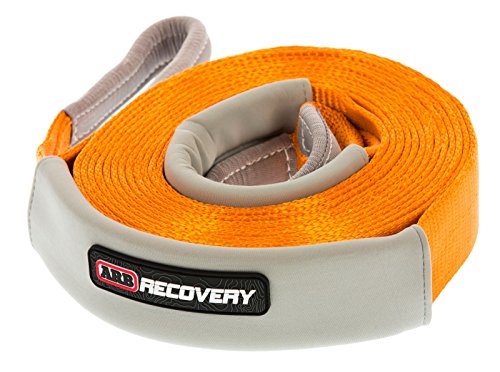
ARB ARB705 Snatch Strap
ARB is the reference in off road recovery gear and this nylon snatch strap is built to stretch by a designed percentage, storing energy and then releasing it to pull a bogged vehicle free without the shock loading a rigid strap produces. Loop eyes are heavily reinforced. It is a specialist item, and using it for ordinary towing is both unsafe and a waste of the strap.
Pros
- Engineered stretch reduces shock loading
- Extremely well made loop reinforcement
- Trusted name in off road recovery
Cons
- Not suitable for towing on a road
- Nylon needs drying before storage

Bubba Rope Renegade Kinetic Recovery Rope
A kinetic rope stretches considerably more than webbing and returns that energy smoothly, which is why it frees vehicles that a flat strap cannot budge. Bubba Rope coats its ropes to resist abrasion and moisture, and the double braided nylon handles repeated recoveries well. It costs several times what a basic strap does and demands correct technique to be used safely.
Pros
- Frees vehicles that flat straps cannot
- Coating resists abrasion and water
- Smooth energy release is easier on vehicles
Cons
- Much more expensive than webbing straps
- High stored energy demands correct technique

Smittybilt CC330 Recovery Strap
Smittybilt has sold this strap to off roaders for years and it remains a sensible middle ground, with a high rated capacity, protected loop eyes and enough stretch for recovery work. The webbing is thick and takes rough handling. Labelling is less detailed than Rhino’s and the strap comes without a bag, which are minor complaints at the price.
Pros
- Long standing reputation among off roaders
- Thick webbing resists abrasion
- Strong value for the rated capacity
Cons
- No storage bag supplied
- Labelling less detailed than some rivals

GearAmerica Recovery Tow Strap
GearAmerica aims at trucks and larger SUVs with a high rated break strength and triple reinforced loop eyes, and the webbing is wide enough to spread load across a shackle properly. A storage bag is included. As with any high capacity strap, the limiting factor becomes the recovery points on the vehicle rather than the strap itself, so check those before relying on the number.
Pros
- High rated capacity for full size trucks
- Triple reinforced eyes resist wear
- Bag included for tidy storage
Cons
- Bulky to store in a smaller vehicle
- Capacity exceeds many factory recovery points

Keeper 02932 Vehicle Recovery Strap
Keeper is a mainstream strap that suits a car or light SUV owner who wants something in the boot for the one time a year it is needed, rather than a dedicated off road setup. It is loop ended, adequately rated for lighter vehicles and inexpensive. Check the rating against your vehicle weight carefully, since it is not intended for full size trucks.
Pros
- Sensible choice for a car or light SUV
- Loop ends rather than hooks
- Low cost for occasional need
Cons
- Not rated for heavy trucks
- Basic loop protection compared with premium straps
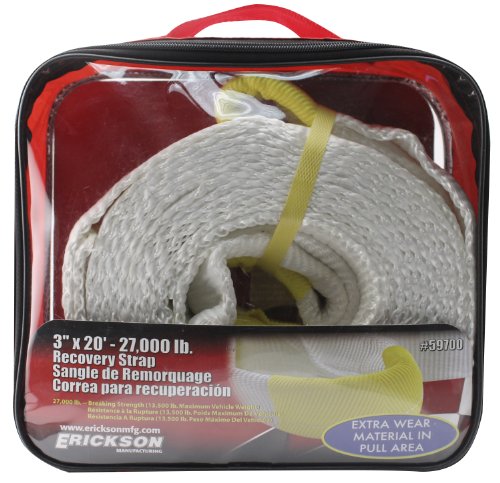
Erickson 59700 Heavy Duty Tow Strap
Erickson supplies a straightforward polyester tow strap that does the flat towing job at the lowest cost here. Polyester means very little stretch, which is correct for towing and wrong for snatch recovery. Some configurations ship with hooks, and if yours does, treat those as a hazard and consider using rated shackles through the loops instead.
Pros
- Lowest cost option here
- Low stretch is correct for towing
- Compact to store
Cons
- Hook versions are a serious hazard
- Wrong choice for any snatch recovery
How they compare
| # | Model | Type | Best for | Score | Price |
|---|---|---|---|---|---|
| 1 | Rhino USA Recovery Tow Strap | Polyester tow and light recovery strap | Best overall | 9.4 | Check price |
| 2 | ARB ARB705 Snatch Strap | Nylon snatch recovery strap | Best snatch strap | 9.2 | Check price |
| 3 | Bubba Rope Renegade Kinetic Recovery Rope | Double braided nylon kinetic rope | Best kinetic rope | 9.0 | Check price |
| 4 | Smittybilt CC330 Recovery Strap | Nylon recovery strap | Best value recovery strap | 8.8 | Check price |
| 5 | GearAmerica Recovery Tow Strap | Polyester recovery tow strap | Best for heavy vehicles | 8.6 | Check price |
| 6 | Keeper 02932 Vehicle Recovery Strap | Webbing recovery strap | Best for occasional use | 8.3 | Check price |
| 7 | Erickson 59700 Heavy Duty Tow Strap | Polyester tow strap | Best budget | 8.0 | Check price |
How to pick the right one
Tow straps and recovery straps do different jobs A tow strap is made from low stretch material, usually polyester, and is designed to pull a rolling vehicle in a straight line at low speed. A recovery or snatch strap is nylon, designed to stretch under load, store energy and release it to free a stuck vehicle. Using a tow strap for a snatch recovery transmits the full shock load into both vehicles, and using a snatch strap for towing produces a surging, unpredictable pull. Buy the one that matches what you will actually be doing, and label it.
Rating the strap against your vehicle The usual guidance is a break strength of roughly two to three times the gross weight of the vehicle being recovered, since a stuck vehicle in mud takes far more force to move than its weight suggests. Never use working load and break strength interchangeably. Just as important, the strap is only as strong as what it attaches to, and factory tie down points are not recovery points. Use rated recovery points or a properly rated hitch receiver shackle mount.
Hooks are the most common danger Straps sold with metal hooks sewn onto the ends are widely available and widely criticised, because a hook that slips off under load becomes a projectile travelling at high speed. Loop ended straps connected with rated soft shackles or bow shackles are the safer arrangement. Never attach to a tow ball, a bumper or a suspension component, and never join two straps with a metal shackle in the middle, since that becomes a missile if either strap fails.
Technique, inspection and storage Keep everyone well clear of the strap line during a recovery, since the danger zone extends a long way in both directions, and lay a heavy blanket or recovery damper over the middle to absorb energy if it breaks. Inspect webbing before each use for cuts, fraying, chemical staining and heat glazing, and retire the strap if any of those appear. Wash mud off, dry nylon fully before storing since damp nylon degrades, and keep straps out of direct sunlight which weakens the fibres over time.
Questions worth asking
What is the difference between a tow strap and a recovery strap?
A tow strap has minimal stretch and pulls a rolling vehicle at low speed. A recovery or snatch strap stretches under load to free a stuck vehicle, using stored energy rather than a hard pull. They are not interchangeable, and using the wrong type is a common cause of damage and injury.
What strength strap do I need?
A common guideline is a break strength of two to three times the gross vehicle weight of the vehicle being recovered. Check the strap’s rated break strength rather than any vague capacity claim, and remember the recovery points on the vehicle must be rated for that load too.
Are straps with hooks safe?
They are widely considered the least safe arrangement, because a hook that comes loose under tension travels at dangerous speed. Loop ended straps used with rated soft shackles or bow shackles are the recommended alternative, and all the top picks here use loop ends.
Where should I attach a recovery strap on my vehicle?
Only to a rated recovery point or a rated shackle mount in a hitch receiver. Never to a tow ball, bumper, axle, suspension arm or a factory tie down loop used for transport. If you are unsure what your vehicle has, the owner manual usually identifies proper recovery points.
Can I join two straps together?
Straps can be joined by looping them through each other, but never with a metal shackle in the middle, since that shackle becomes a projectile if either strap fails. Where possible use a single strap of the correct length instead of joining.
How do I store a strap so it lasts?
Rinse off mud and grit, dry it completely, especially nylon, and store it in a bag out of direct sunlight. Ultraviolet light and prolonged damp both weaken fibres. A strap kept loose in a truck bed under the sun will be noticeably weaker after a couple of seasons than one kept in its bag.
When should I retire a strap?
As soon as you find cuts, significant fraying, chemical staining, melted or glazed patches from heat, or damaged stitching at the eyes. Straps that have been shock loaded severely should also be retired. They are inexpensive relative to the consequences of a failure.
Is a kinetic rope better than a snatch strap?
A kinetic rope such as the Bubba Rope Renegade stretches more and releases energy more smoothly, which frees vehicles that a strap cannot and is gentler on mounting points. It costs considerably more. For occasional recovery a good snatch strap is sufficient, and for regular deep mud work the rope earns its price.
The verdict
The Rhino USA Recovery Tow Strap is the sensible single purchase for most drivers, since it covers towing and light recovery with rated strength and properly protected loop eyes. Anyone regularly pulling vehicles out of mud should add the ARB snatch strap and use it only for that job, or step up to the Bubba Rope Renegade. Whatever you buy, pair it with rated shackles and proper recovery points, because the strap is rarely the weakest part of the setup.
You might also need
How Many Microfiber Towels Do You Need to Detail a Car?
How to Wash Microfiber Towels for Car Detailing
