Toy Cash Registers That Teach Counting Through Play
The Learning Resources Pretend and Play Calculator Cash Register is the best all round choice because the working calculator turns play into real arithmetic. The Melissa and Doug Wooden Cash Register is the most durable, and the VTech Ring and Learn is the best pick for toddlers.
For a child who is starting to handle numbers, the Learning Resources Pretend and Play Calculator Cash Register is the strongest choice, with the Melissa and Doug Wooden Cash Register the one most likely to survive years of play and the VTech Ring and Learn the right level for a toddler.
Toy tills look similar in photos but they split into three quite different things, electronic talking toys aimed at toddlers, working calculator registers aimed at early maths, and wooden play tills that last but do very little on their own. We compared included coins and notes, whether the calculator actually computes, scanner and card features, materials and battery requirements across currently sold listings, then weighed those against what owners report about noise, lost coins and how long each one holds attention.
The top picks, ranked

Learning Resources Pretend and Play Calculator Cash Register
The reason this one keeps being recommended by teachers is the solar powered calculator built into the top, which genuinely adds and subtracts rather than making noises. That turns shop play into practice with money handling, change and simple sums. It ships with plastic coins and paper notes, and the drawer opens with a satisfying action that children keep repeating.
Pros
- Calculator does real arithmetic, not sound effects
- Solar power means no batteries to replace
- Generous set of play money included
Cons
- Small coins need supervision with under threes
- Plastic body is lighter than wooden rivals

Melissa and Doug Wooden Toy Cash Register
Melissa and Doug build this from wood with a hand crank drawer, a working scanner shape and a card slot for pretend payments. It is the option most likely to be passed down to a second child because there is very little on it to break. Owners report the quiet operation is a genuine relief compared with electronic tills that chirp constantly.
Pros
- Wooden construction survives heavy play
- Completely silent, no electronic noise
- No batteries to run out mid game
Cons
- No calculator or counting feedback
- Heavier for a small child to move

VTech Ring and Learn Cash Register
VTech aims this squarely at the youngest shoppers, with light up buttons, spoken numbers and colour recognition play built around chunky pieces too big to swallow. The scanner beeps when a card is passed over it, which is the single feature toddlers repeat most. Expect songs, and expect to want a volume switch, which it does have.
Pros
- Chunky pieces suit the youngest age group
- Spoken numbers reinforce early counting
- Volume control included
Cons
- Repetitive songs wear on adults
- Outgrown sooner than a plain play till
LeapFrog Count Along Cash Register
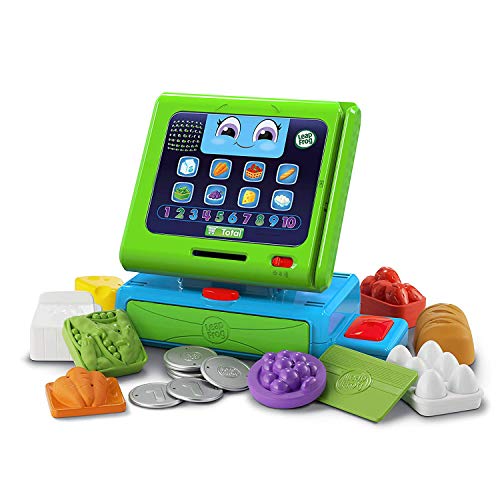
LeapFrog’s version counts coins aloud as they are dropped into the slot, which links the physical action to the number in a way flat play money does not. There are several play modes covering counting, addition and simple shopping. It sits between the toddler VTech and the school age Learning Resources unit in difficulty.
Pros
- Counts coins aloud as they are inserted
- Several modes as the child progresses
- Coins are large and easy to grip
Cons
- Coin slot jams if two are pushed at once
- Needs batteries that are not always included

Casdon Electronic Cash Register Toy
Casdon specialises in toys modelled closely on real household items, and this till has the layout, receipt roll and beeping scanner of a shop counter rather than a nursery toy. That realism is exactly what appeals to four and five year olds who want to copy adults. The trade off is more small parts than the toddler options.
Pros
- Most convincing shop counter look here
- Receipt roll adds to the role play
- Scanner beep is satisfying without being loud
Cons
- More small parts to lose
- Receipt roll refills are an extra purchase
Theo Klein Cash Register Toy Till
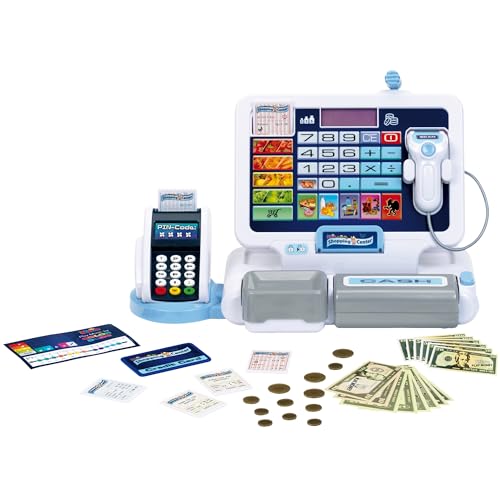
Theo Klein tills are a fixture of European playrooms and pair naturally with the brand’s play shop and supermarket sets, so this is a sensible pick if you already own or plan to buy one. The drawer, scanner and conveyor style layout is designed to be handled roughly. Some versions include a working scale, which adds another counting concept.
Pros
- Pairs with a wide play shop range
- Built to take rough handling
- Scale versions add weighing to the play
Cons
- Bulkier than a standalone toy till
- Feature set varies between versions

Battat Toy Cash Register Play Set
Battat keeps the price down by stripping the concept back to the essentials, a drawer, buttons, a card and a set of play money. There is no calculator and no speech, which some parents will consider a feature rather than a limitation. It is the sensible option for a child who wants a shop corner rather than a maths tool.
Pros
- Lowest cost way into shop role play
- No batteries or noise to manage
- Play money included in the box
Cons
- No counting or calculator support
- Lighter plastic than the premium options
The lineup, side by side
| # | Model | Calculator | Best for | Score | Price |
|---|---|---|---|---|---|
| 1 | Learning Resources Pretend and Play Calculator Cash Register | Working, solar powered | Best overall | 9.4 | Check price |
| 2 | Melissa and Doug Wooden Toy Cash Register | Wood | Best build quality | 9.2 | Check price |
| 3 | VTech Ring and Learn Cash Register | Electronic talking register | Best for toddlers | 9.0 | Check price |
| 4 | LeapFrog Count Along Cash Register | Electronic counting register | Best for early maths | 8.8 | Check price |
| 5 | Casdon Electronic Cash Register Toy | Realistic shop till | Best realistic play | 8.6 | Check price |
| 6 | Theo Klein Cash Register Toy Till | Robust moulded plastic | Best for shop role play | 8.3 | Check price |
| 7 | Battat Toy Cash Register Play Set | Basic play till | Best budget | 8.0 | Check price |
Before you buy
Match the type to the age, not the price The three categories here suit quite different children. Talking electronic registers work for roughly two to four year olds who are learning to recognise numbers and colours. Working calculator registers suit four to seven year olds who can already count and are ready for change and simple sums. Plain wooden tills have no ceiling because the learning comes from whatever game the child invents around them, which is why they last the longest.
Check what money is actually in the box A till with no play money is half a toy, and replacement coin sets add cost. Look for listings that state the number of coins and notes included. Larger chunky coins are safer for toddlers and easier for small hands, while realistic smaller coins suit older children practising with values but need supervision with younger siblings around.
Sound, batteries and your own patience Electronic tills sing, beep and repeat phrases, sometimes for years. A volume control is close to essential, and a genuine off switch more so. Check the battery type and count, since some units need several AA cells that are not supplied. Wooden and mechanical tills sidestep the whole issue, at the cost of doing less on their own.
Durability comes from fewer moving parts The parts that fail on toy tills are the same ones every time, the drawer spring, the coin slot mechanism and the scanner cable. Wooden and simple mechanical designs have fewer of these, which is why they survive to a second child. If you want electronics and durability, favour models where the scanner is attached by a short sturdy lead rather than a long thin one.
Common questions
What age is a toy cash register suitable for?
Chunky talking registers generally start around two, while calculator based tills suit four and up. Most listings state a minimum age based on small parts, which is the figure to follow if a younger sibling shares the playroom.
Do toy cash registers actually help with maths?
The ones with working calculators or spoken counting do the most, because they connect a physical action to a number. Even a plain till helps, since sorting coins and making change is early number practice. Teachers commonly use shop role play for exactly this reason.
Wooden or plastic, which is better?
Wooden tills last longer and stay quiet, which matters in a shared living space. Plastic electronic tills offer counting feedback and speech that a wooden one cannot. If the toy is for a toddler, the electronic feedback is genuinely useful, and if it is for a play corner that will be used for years, wood wins.
Does the play money get lost?
Almost inevitably, which is why the tills that include a generous set are better value. Keeping a small tub next to the till helps, and replacement play money sets are widely available if the original coins disappear under the sofa.
Are the small coins a choking hazard?
Realistic sized play coins can be, which is why those sets carry an age warning. Registers aimed at toddlers use oversized coins for this reason. If there is a child under three in the house, choose the chunky coin versions regardless of the older child’s age.
Do these need batteries?
Electronic models generally do, often two or three AA cells that are not included. The Learning Resources calculator register runs on solar power for the calculator, and wooden tills need none at all.
How long do children keep playing with them?
Toddler electronic models tend to be outgrown within a year or two once the songs become familiar. Plain and wooden tills last much longer because the child supplies the game. Calculator models sit in between and often get a second life as a homework aid.
Can a toy till work with a play kitchen or shop?
Yes, and pairing them is what extends the play. Brands that sell a matching shop or supermarket set make this easiest, but any till works alongside a play kitchen since the game is really about handing things over and paying for them.
Our pick
The Learning Resources Pretend and Play Calculator Cash Register is the pick for most families because the working calculator turns shop play into genuine number practice and the solar panel removes battery hassle. For a toy that will still be in the playroom in five years, the Melissa and Doug Wooden Cash Register is the more sensible buy. Toddlers get the most from the VTech Ring and Learn, provided you are comfortable with the songs.