Trail Cameras That Catch Every Deer, Day or Night
The Browning Strike Force Pro DCL leads for detection speed and night clarity. The SPYPOINT FLEX-M is the easiest cellular option for remote properties, and the Campark T85 covers basic scouting on a small budget without cellular fees or complicated setup.
For most hunters and property owners the Browning Strike Force Pro DCL is the trail camera to buy, with the SPYPOINT FLEX-M taking over when you need photos sent to your phone instead of driving out to swap cards.
Trail cameras are tricky because the numbers printed on the box rarely describe field behaviour. A camera can advertise 4K video and still miss a walking buck if trigger speed is slow or the detection cone is narrow. We compared published trigger speeds, flash type, detection range, battery ratings and owner feedback on false triggers to rank these seven.
How to pick the right one
Trigger speed matters more than megapixels A trail camera with a slow trigger photographs the empty trail an animal just left. Anything at or under 0.3 seconds will catch most walking game on a trail crossing, while 0.5 seconds and slower works best on a feeder or water source where animals pause. Recovery time, meaning how quickly the camera arms again, matters just as much for sequences of animals moving through together.
Cellular versus SD card Cellular cameras send images to your phone and let you leave a property undisturbed for months, which is a real advantage on pressured ground. The trade is a monthly image plan and slightly slower triggers in most models. If you can check cards without spooking the area, a non cellular camera gives you faster performance and better images for the same outlay.
Flash type and night image quality Low glow infrared produces brighter, cleaner night photos but shows a faint red dot that some animals and most people notice. No glow, sometimes called black flash, is invisible but delivers a darker image at the same distance. Dual lens designs, like the Browning model here, sidestep the compromise by using separate optics for day and night.
Power, cards and placement Lithium AA cells outlast alkaline by a wide margin in cold weather and leak far less, which protects the battery bay. Use a Class 10 SD card sized to your check interval, and format it in the camera rather than a computer. Mount roughly waist height, angle slightly down, and face north where possible so sunrise and sunset do not wash out the sensor or cause false triggers.
What we recommend

Browning Strike Force Pro DCL
Browning built the Strike Force Pro DCL around a very fast trigger and a dual lens system that switches optics between day and night rather than compromising on one. Owners report clean, sharp night images at distance where cheaper cameras produce a bright blur. Battery life on lithium cells is long enough that a season on one set is realistic in moderate traffic.
Pros
- Very fast trigger with short recovery
- Dual lens keeps night images sharp
- Long battery life on lithium cells
Cons
- No cellular option in this model
- Menu takes some learning

SPYPOINT FLEX-M
The FLEX-M connects to whichever cellular network is strongest at the location, which removes the guesswork of picking a carrier before you buy. Setup runs through the SPYPOINT app and owners consistently describe it as the simplest cellular activation available. A free image plan covers light scouting, with paid tiers for heavier traffic.
Pros
- Simple app activation and network selection
- Free image tier for light use
- Good detection range for a cellular unit
Cons
- Data plan needed for heavy traffic
- Trigger slower than top non cellular models

Bushnell CelluCORE 20
Bushnell keeps the CelluCORE 20 deliberately simple, with a small screen, a short menu and dependable image transmission. It is a good choice for a property you visit rarely, since owners report fewer dropped uploads than with budget cellular brands. Image quality is good rather than exceptional, which is the trade for that consistency.
Pros
- Consistent image uploads
- Straightforward menu system
- Compact housing sits close to the tree
Cons
- Carrier locked at purchase
- Video quality trails rivals

Stealth Cam DS4K Ultimate
If you care more about watching behaviour than counting animals, the DS4K Ultimate records genuinely detailed 4K video with sound. The larger housing takes eight batteries, which helps because video draws far more power than stills. Based on specifications it also offers one of the wider burst and time lapse feature sets in this group.
Pros
- Excellent video detail and audio
- Deep feature set for burst and time lapse
- Large battery bay extends runtime
Cons
- Bulkier than most rivals
- Video mode drains batteries quickly
Moultrie Mobile Edge 2
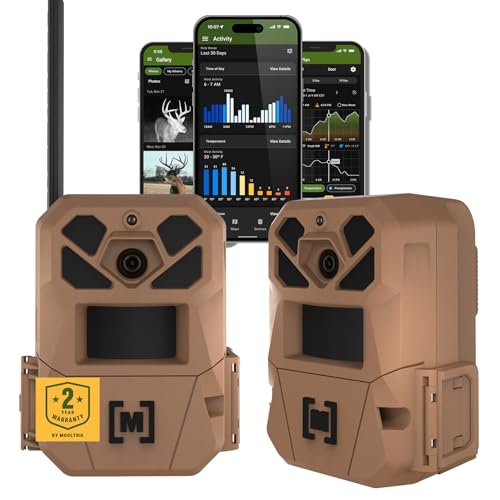
The Edge 2 pairs a compact camera with what owners describe as the most polished app in the category, including species tagging and weather overlays. Activation happens automatically out of the box, so there is no SIM card handling. It suits anyone running several cameras who wants one clean dashboard for all of them.
Pros
- Best in class app and tagging tools
- No SIM setup required
- Scales well across multiple cameras
Cons
- Subscription required beyond trial images
- Night stills soften at long range

Reconyx HyperFire 2
Reconyx cameras are the ones biologists and land managers leave out for a year at a time. The HyperFire 2 has a very fast trigger, almost no recovery delay and a reputation for surviving weather that kills consumer units. Image resolution is modest by current standards, but reliability is the reason people choose it.
Pros
- Outstanding durability and weather sealing
- Extremely long battery life
- Almost no missed sequences
Cons
- Lower resolution than newer rivals
- Plain image output with few extras
Campark T85
The T85 covers the basics well for backyard wildlife, driveways and light scouting. WiFi and Bluetooth let you review images on a phone at the camera rather than pulling the card, which is a genuinely useful feature at this level. Trigger speed and night range are the compromises, so place it close to a trail rather than across a field.
Pros
- Phone review without pulling the SD card
- Low cost entry into trail cameras
- Simple menu for first time users
Cons
- Slower trigger misses fast movement
- Shorter night illumination range
How they compare
| # | Model | Trigger speed | Best for | Score | Price |
|---|---|---|---|---|---|
| 1 | Browning Strike Force Pro DCL | 0.15 seconds | Best overall | 9.4 | Check price |
| 2 | SPYPOINT FLEX-M | Dual carrier LTE | Best cellular camera | 9.2 | Check price |
| 3 | Bushnell CelluCORE 20 | 20 megapixel stills | Best for reliable connectivity | 9.0 | Check price |
| 4 | Stealth Cam DS4K Ultimate | 4K at 30 frames per second | Best for video quality | 8.8 | Check price |
| 5 | Moultrie Mobile Edge 2 | Built in LTE, auto activation | Best app experience | 8.6 | Check price |
| 6 | Reconyx HyperFire 2 | 0.2 seconds | Best for research and long deployments | 8.3 | Check price |
| 7 | Campark T85 | Up to 32 megapixel interpolated | Best budget pick | 8.0 | Check price |
Frequently asked questions
What trigger speed do I actually need?
For trails where animals move steadily, look for 0.3 seconds or faster. Over bait, water or a food plot where animals stop, 0.5 seconds is fine and lets you consider slower cameras that are stronger elsewhere.
Do cellular trail cameras need a subscription?
Yes, beyond a small free tier on some brands. Plans are priced per camera and by monthly image count, so running several cameras adds up. Choose the plan after a month of real image volume rather than guessing.
Can animals see the infrared flash?
Low glow emitters produce a faint red glow that some animals notice, though most ignore it after a few visits. No glow emitters are invisible to game and to people, which also reduces theft risk on public ground.
How long do batteries last?
Expect two to six months on lithium AA cells for still images in moderate traffic. Heavy video use can drain the same set in a few weeks, and cold weather shortens alkaline life dramatically.
What SD card should I use?
A Class 10 card between 32GB and 128GB suits most cameras. Check the manual for the maximum supported size, and format the card inside the camera before the first deployment to avoid file errors.
Why does my camera fire with nothing in frame?
False triggers usually come from sun on moving vegetation or heat shimmer off open ground. Clear branches from the detection zone, face the camera north, and lower sensitivity in hot weather.
Are trail cameras waterproof?
Most are weather resistant rather than fully waterproof, rated to shrug off rain and snow. Close the latch fully, keep the gasket clean, and add a small silica pack inside if you deploy in humid areas.
Do I need a security box or lock?
On private land a cable lock is usually enough. On public or shared ground a steel security box plus a no glow camera meaningfully reduces the chance of a camera walking off.
Our pick
The Browning Strike Force Pro DCL is the strongest all round trail camera here, combining a fast trigger with night images that stay usable at distance. Choose the SPYPOINT FLEX-M if you need images delivered to your phone from a property you rarely visit, or the Reconyx HyperFire 2 if the camera has to survive a full year untouched. The Campark T85 remains a sensible first camera for driveways and backyard wildlife.