Transfer Pumps for Water Tanks, Fuel Drums and Job Sites
Wayne PC4 offers the broadest household coverage, self priming through a standard garden hose. Job sites without power favor the cordless Milwaukee 2771-20. Farm and fleet fuel duty belongs to the Fill-Rite FR1210G, built with seals rated for diesel and gasoline rather than water.
Matching pump to liquid decides most transfer pump purchases. Water jobs favor the self priming Wayne PC4, cordless flexibility goes to the Milwaukee 2771-20, and fuel transfer calls for the Fill-Rite FR1210G. Raw flow numbers matter less than fitting type and fluid compatibility.
Transfer pump listings blend water utility pumps, fuel transfer units and small drum siphons under one search term, which confuses buyers fast. We compared published flow rates, priming behavior, fitting sizes, seal materials and power source, then weighed owner feedback on real world output once hose length and lift enter the picture.
Our top picks

Wayne PC4 Portable Transfer Water Pump
Garden hose threads on both ports mean this self priming pump connects in seconds. Owners report reliable priming even with several feet of lift, a spot where cheaper units stall out. Draining aquariums, water beds and flooded window wells all fall within its range.
Pros
- Self priming with no manual fill step
- Garden hose fittings on both inlet and outlet
- Compact enough to store in a closet
Cons
- Limited to water and non corrosive liquids
- Requires a nearby electrical outlet

Milwaukee 2771-20 M18 Cordless Transfer Pump
M18 batteries power this pump, so it travels to crawl spaces, boats and job sites without a cord. Buying it only makes sense for households already holding M18 tools, since the pump ships bare. Flow trails corded models, but going anywhere without an outlet often outweighs that gap.
Pros
- Works anywhere without mains power
- Shares batteries with existing M18 tools
- Built to job site durability standards
Cons
- Battery and charger sold separately
- Runtime caps how long a drain can run
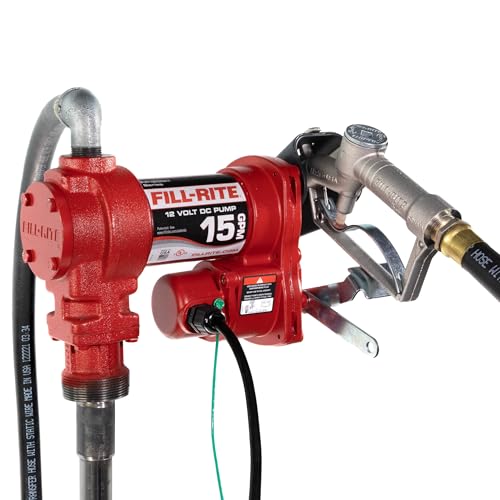
Fill-Rite FR1210G 12V Fuel Transfer Pump
Seals and motor housing on this pump are built for diesel, gasoline and kerosene, not water. A vehicle or tractor battery runs it, and most listings include a nozzle and hose. Owners report years of service when the inline filter gets regular cleaning.
Pros
- Seals and motor rated for fuel duty
- High flow speeds tank to tank transfers
- Replacement filters and parts stay available
Cons
- Needs a 12V supply wired correctly
- Not rated for water transfer

GPI EZ-8 12V Fuel Transfer Pump
Alligator clamps let this pump draw straight from a portable tank without permanent wiring. Pickup bed tanks and smaller diesel setups suit it better than a full cabinet pump. Flow sits below the Fill-Rite, which fits smaller equipment refueling jobs.
Pros
- Clamps on for quick temporary setup
- Sized right for pickup bed tanks
- Manual shutoff nozzle included in the kit
Cons
- Slower flow than full size fuel pumps
- Power leads run short on some kits

Superior Pump 91250 Thermoplastic Utility Pump
Submersible design lets this pump drop straight into a stock tank or flooded pit. A garden hose adapter ships in the box, and a suction screen keeps grit away from the impeller. Moving a large volume of clean water rarely costs less than this.
Pros
- High flow output for its price class
- Submersible operation needs no priming
- Housing resists corrosion in wet storage
Cons
- Leaves a thin layer of residual water
- Limited to clean water duty

TRUPOW 1/10 HP Mini Electric Transfer Pump
Short jobs like draining a water heater, hot tub or fish tank suit this small inline pump. Both hose adapters and a light suction hose ship in the box, so nothing extra is needed. Duty cycle stays limited, so long drains need scheduled breaks.
Pros
- Light weight simplifies storage and transport
- Complete hose kit included in the box
- Reaches awkward small drain spots easily
Cons
- Not designed for continuous long running
- Priming sometimes needs a manual fill

TERAPUMP TRFA01 Battery Fuel Transfer Pump
Four D cell batteries run this siphon, which screws onto standard drums and jerry cans. No mains outlet or vehicle battery is needed to top off a generator or mower. Owners report clean, spill free dispensing, though flow stays low for bulk transfers.
Pros
- Runs without cords or a vehicle battery
- Dispenses fuel without spills
- Stores easily in a small kit
Cons
- Flow too slow for large volumes
- Battery life drops under heavy use
How they compare
| # | Model | Motor | Best for | Score | Price |
|---|---|---|---|---|---|
| 1 | Wayne PC4 Portable Transfer Water Pump | 1/2 HP electric | Best overall | 9.4 | Check price |
| 2 | Milwaukee 2771-20 M18 Cordless Transfer Pump | M18 battery, tool only | Best cordless | 9.2 | Check price |
| 3 | Fill-Rite FR1210G 12V Fuel Transfer Pump | 12V DC | Best for fuel transfer | 9.0 | Check price |
| 4 | GPI EZ-8 12V Fuel Transfer Pump | 12V DC with battery clips | Best for pickup bed and portable fuel tanks | 8.7 | Check price |
| 5 | Superior Pump 91250 Thermoplastic Utility Pump | 1/4 HP submersible | Best value for clean water | 8.5 | Check price |
| 6 | TRUPOW 1/10 HP Mini Electric Transfer Pump | 1/10 HP electric | Best compact pump for small drains | 8.2 | Check price |
| 7 | TERAPUMP TRFA01 Battery Fuel Transfer Pump | Four D cell batteries | Best budget fuel siphon | 8.0 | Check price |
What to look for
What matters most when choosing a transfer pump Fluid type decides which pump family to shop first, since water and fuel pumps use different seals and impeller materials. Flow rate, measured in gallons per hour or per minute, comes next and tracks with motor size. Power source narrows the field further among corded electric, battery and vehicle powered 12V units. Fittings decide whether existing garden hose works or a fuel rated hose ships in the box.
Water pumps and fuel pumps are not interchangeable Rubber seals in a water pump swell or crack once gasoline or diesel touches them. Running fuel through an unrated motor also raises fire risk near open contacts. Fill-Rite and GPI style pumps use different materials and sealed housings built for petroleum. Owners who need both jobs typically buy two separate pumps rather than compromise on one.
Picking a power source for job sites and remote spots Corded electric pumps like the Wayne PC4 need a nearby outlet and deliver steady flow. Battery pumps such as the Milwaukee 2771-20 trade some flow for total portability, useful in crawl spaces or on boats. Vehicle battery powered fuel pumps run from a truck or tractor, skipping generators entirely. Battery operated siphons cover the lightest duty, moving small volumes from drums without any wiring.
Priming, lift and hose fittings that avoid mid job surprises Self priming surface pumps pull their own prime from several feet below without manual filling. Submersible pumps skip priming altogether by sitting directly in the liquid. Maximum lift and hose length both cut into the flow rate printed on the box. Suction side hose needs a rigid or reinforced wall, since standard garden hose collapses under vacuum.
Good to know
What is the difference between a transfer pump and a utility pump?
Terminology overlaps a lot in this category. Utility pump usually means a submersible unit for standing water, while transfer pump often describes a surface or inline unit moving liquid between containers. Several models in this guide handle both jobs.
Can a water transfer pump handle diesel or gasoline?
No. Seals, hoses and motor housings built for water are not rated for fuel vapor or fuel chemistry. Choose a fuel rated pump instead, such as the Fill-Rite FR1210G or GPI EZ-8.
How high can a transfer pump lift water?
Surface pumps typically manage 20 to 25 feet of suction lift, less with long hose runs. Total head, combining suction and discharge, is the number worth checking on the spec sheet.
Do transfer pumps need to be primed before use?
Self priming models pull their own prime once the suction hose sits in liquid. Non priming surface pumps need the housing filled manually first. Submersible pumps skip priming entirely since they sit below the water line.
Will a transfer pump move dirty or muddy water?
Only if the listing states a solids handling rating. Grit wears through an impeller fast on pumps built for clean water. Muddy conditions call for a trash pump rated for a specific solids size instead.
Can a transfer pump run dry without damage?
Briefly, but not for long. Liquid cools the seals and impeller while the pump runs, so dry operation overheats both quickly. Owners report a few seconds is usually fine, while a few minutes often is not.
Is a cordless transfer pump strong enough for real jobs?
For a water heater, bilge or flooded pit, yes. The Milwaukee 2771-20 moves useful volume, though battery runtime limits long drains more than raw flow does. Keeping a spare pack charged solves most of that.
How do I stop a pump from losing prime mid job?
Keep the suction hose fully submerged at all times. Use a rigid or reinforced hose on the suction side, since standard garden hose collapses under vacuum. Check every fitting for air leaks, since a small leak at the inlet is the most common cause of lost prime.
Is a battery powered fuel siphon worth it over a full transfer pump?
For topping off a generator or mower from a drum, yes, since no wiring or mains power is needed. Flow stays far lower than a 12V fuel pump like the Fill-Rite, so bulk fuel transfer still needs the larger unit. Convenience is the trade, not raw output.
Our pick
Wayne PC4 covers the widest range of household and yard water jobs with the least setup fuss. Superior Pump 91250 answers the same question at a lower cost when volume matters more than finesse. Fuel transfer belongs with a purpose built unit like the Fill-Rite FR1210G, and job sites without an outlet still favor the cordless Milwaukee 2771-20.