Travel Pillows That Actually Support Your Neck
The Cabeau Evolution S3 is the strongest all round travel pillow, using dense memory foam and raised side walls to stop the head rolling. The Trtl Pillow Plus suits side sleepers with its internal support frame, and the Ostrichpillow Go packs down small for carry on travel.
The Cabeau Evolution S3 is the travel pillow most people should pack, since the flat back panel keeps your head off the headrest and the raised sides actually stop it lolling sideways. Side sleepers usually get on better with the Trtl Pillow Plus and its internal support frame, while the Ostrichpillow Go is the pick when packed size matters most.
Travel pillows are a frustrating category because the classic horseshoe shape that dominates airport shops pushes your chin forward and does almost nothing for the sideways head drop that actually wakes you up. We compared support structures, fill materials, packed dimensions and weight, cover washability and the seat positions each design suits, alongside what owners report about neck ache, heat build up and whether the pillow survives being crushed into a bag.
Our top picks

Cabeau Evolution S3 Travel Neck Pillow
Cabeau flattens the back of the pillow so your head sits properly against the headrest instead of being pushed forward, then raises the side walls to catch the head as it falls. The memory foam is dense enough to hold shape through a long flight. A compression bag and a washable cover round out a well thought through design.
Pros
- Flat back stops the head pushing forward
- High sides genuinely limit sideways roll
- Cover washes easily after a long trip
Cons
- Bulkier than inflatable options
- Memory foam can feel warm on long flights

Trtl Pillow Plus
Rather than a ring of foam, the Trtl uses a hidden internal support rib wrapped in fleece, which props the head at an angle instead of cradling it all round. The Plus version adds adjustable height so the fit suits different neck lengths. It looks like a scarf, which some travellers prefer and others find warm.
Pros
- Holds the head at an angle rather than upright
- Adjustable height for different necks
- Packs flatter than foam horseshoes
Cons
- Fleece wrap gets hot on long flights
- Only supports one side at a time

BCOZZY Chin Supporting Travel Pillow
BCOZZY’s ends overlap and fasten at the front, which stops the chin dropping onto the chest, the specific failure that ruins sleep in an upright seat. The pillow can also be twisted into different positions for lumbar or side support. It is soft rather than firm, which suits travellers who dislike dense foam.
Pros
- Genuinely stops the chin dropping forward
- Can be repositioned for lumbar support
- Fully machine washable
Cons
- Soft fill compresses on very long flights
- Bulky to attach to a bag

Ostrichpillow Go Neck Pillow
Ostrichpillow uses a viscoelastic memory foam core in a slimmer profile than most foam pillows, with a magnetic closure that is quicker to fasten than a toggle. It compresses into a supplied case that clips to a bag. Support is good without the bulk, though very tall travellers may want more height.
Pros
- Compresses smaller than most foam pillows
- Magnetic closure is quick to fasten
- Slim profile is comfortable in tight seats
Cons
- Less side support than tall walled designs
- Premium outlay for the size
MLVOC Travel Pillow
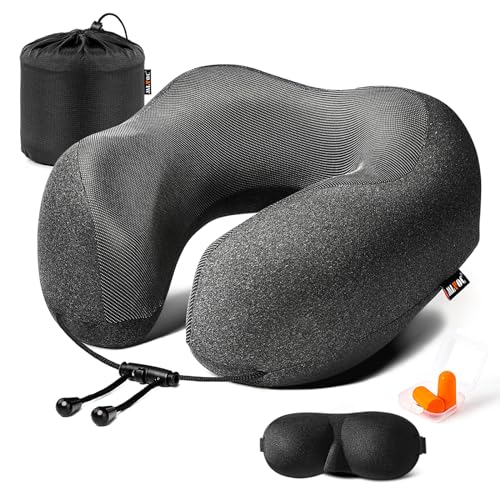
MLVOC bundles a memory foam neck pillow with an eye mask, earplugs and a carry bag, which covers the whole sleep kit in one purchase. The foam is reasonably supportive and the cover is machine washable. It is a fair amount of pillow for the outlay, though it is bulkier than premium compact designs.
Pros
- Complete sleep kit in one purchase
- Decent memory foam support
- Washable breathable cover
Cons
- Packs down less than premium rivals
- Toggle closure is fiddly in the dark

Therm-a-Rest Compressible Pillow Cinch
This is a proper compressible pillow rather than a neck ring, filled with foam offcuts that squeeze into a built in stuff sack and expand into something close to a real pillow. It suits camping, sleeper trains and anywhere you actually lie down. It does nothing for upright seated support, so it is a different tool.
Pros
- Feels closest to a home pillow
- Compresses into its own sack
- Durable brushed fabric cover
Cons
- No support for upright seated sleeping
- Takes up backpack space when packed
Huzi Infinity Pillow
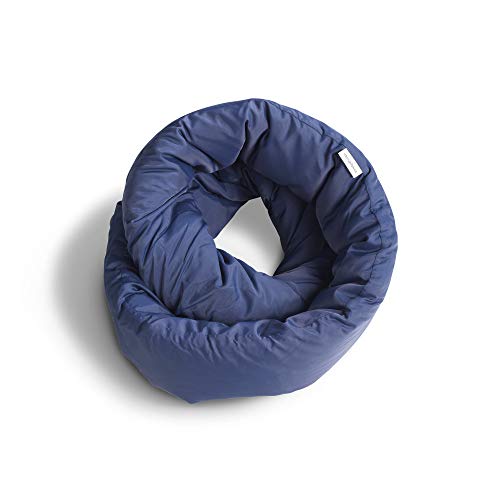
The Infinity Pillow is a soft continuous loop of bamboo fabric that can be twisted into a neck support, a head wrap, an eye shade or a lumbar cushion. That flexibility suits travellers who never sleep the same way twice. Structural support is modest, so it is more about comfort than holding the head firmly.
Pros
- Adapts to several sleeping positions
- Soft breathable bamboo fabric
- Doubles as an eye shade
Cons
- Limited structural neck support
- Loses shape when compressed for long periods
Compared at a glance
| # | Model | Fill | Best for | Score | Price |
|---|---|---|---|---|---|
| 1 | Cabeau Evolution S3 Travel Neck Pillow | Dense memory foam | Best overall | 9.4 | Check price |
| 2 | Trtl Pillow Plus | Internal adjustable rib | Best for side sleepers | 9.2 | Check price |
| 3 | BCOZZY Chin Supporting Travel Pillow | Overlapping adjustable ends | Best for chin support | 9.0 | Check price |
| 4 | Ostrichpillow Go Neck Pillow | Viscoelastic memory foam | Best for packing small | 8.8 | Check price |
| 5 | MLVOC Travel Pillow | Memory foam | Best value | 8.6 | Check price |
| 6 | Therm-a-Rest Compressible Pillow Cinch | Compressible urethane foam | Best for camping | 8.3 | Check price |
| 7 | Huzi Infinity Pillow | Bamboo blend fabric | Best for versatility | 8.0 | Check price |
Before you buy
Understand what actually wakes you up In an upright seat, the problem is not that your head has nothing behind it, it is that your head falls sideways or your chin drops onto your chest. A thick traditional horseshoe fills the space behind the neck and pushes the head forward, which makes both problems worse. Look for a flat or thin back panel, raised side walls, or a chin support element. Those three features address the actual failure modes rather than simply adding padding.
Match the fill to your trip length Memory foam holds its shape through a long haul flight and gives the most consistent support, but it is bulky and traps heat. Polyester fibre fill is softer and cooler but compresses over several hours. Inflatable pillows pack to almost nothing and let you tune firmness, which suits backpacking, though the plastic feel and the risk of a slow leak put some travellers off. For flights over about six hours, foam is usually worth the bulk.
Think about your seat and your sleeping style Window seat travellers can lean against the fuselage, so a pillow with a strong single side or a wrap style design works well. Middle and aisle seats have nothing to lean on, which makes tall side walls that catch the head in both directions far more valuable. If you habitually sleep with your head tipped to one side, a support frame design suits you better than a symmetrical ring.
Packing, hygiene and practical details Check the packed size and whether a compression bag is included, since a pillow that clips flat to a bag is far more likely to come with you than one that swings from a handle. A removable machine washable cover matters more than people expect, given that these pillows spend time against aircraft headrests. Also check the closure, because a magnetic or clip fastening is much easier to manage in a dark cabin than a small toggle.
Good to know
Are memory foam or inflatable travel pillows better?
Memory foam gives more consistent support and holds its shape on long flights, at the cost of bulk and warmth. Inflatable pillows pack to almost nothing and let you adjust firmness, which suits backpackers, but they feel less natural and can develop slow leaks.
Why does my neck still hurt with a travel pillow?
Usually because a thick pillow behind the neck pushes the head forward into an unnatural angle. Pillows with a flat back panel keep the head against the headrest, and taller side walls stop the sideways drop that strains the neck muscles.
What is the best travel pillow for a window seat?
Wrap or frame style designs work well because you can lean into the fuselage and let the pillow support the other side. Middle and aisle seats benefit more from symmetrical designs with high side walls, since there is nothing solid to lean against.
Can I take a travel pillow as carry on?
Yes. Travel pillows are not counted as a bag by most airlines when carried or clipped to luggage, though policies differ, so check if you are flying with a strict basic fare. Compression bags make them easier to fit into a personal item.
How do I clean a travel pillow?
Most have a removable cover that goes in a normal wash. Memory foam cores should never go in a washing machine, since it breaks down the structure. Spot clean the core and let it air dry fully before packing it away.
Do travel pillows work for car journeys?
They do, and they are particularly useful for passengers on long drives. Never use one that restricts head movement if you are driving, and check that the pillow does not interfere with the headrest position or seat belt.
Are wrap style pillows too hot?
Fleece wraps do trap heat, which some travellers find comforting on a cold aircraft and others find uncomfortable. If you tend to overheat, choose a design with a breathable cover and less material around the neck.
How much should a travel pillow pack down to?
A good compressible foam pillow reduces to roughly half its size in a compression bag. Inflatable pillows pack smallest of all. If you travel with carry on only, prioritise a pillow with a supplied bag and a clip, since one that swings loose tends to get left behind.
The bottom line
The Cabeau Evolution S3 is the travel pillow that solves the real problem, keeping the head back against the seat and catching it before it rolls. Side sleepers should try the Trtl Pillow Plus instead, and anyone travelling carry on only will appreciate how small the Ostrichpillow Go compresses.