UHD Monitors Worth the Desk Space This Year
The Dell UltraSharp U2723QE leads for color work and USB-C docking. Gamers get more from the LG UltraGear 27GR93U with its 144Hz IPS panel. On a tight budget, the LG 27UP600 covers 4K creative tasks without the extras.
The Dell UltraSharp U2723QE is the sensible default for most home offices, pairing accurate IPS Black color with a 90W USB-C dock that runs a laptop from one cable. Its 60Hz ceiling is the catch, so fast-paced gamers should look at the LG UltraGear 27GR93U and its 144Hz panel instead. Editors on a budget can drop to the LG 27UP600 and still get real 4K sharpness. Anyone wanting a big canvas should weigh the 32-inch Samsung ViewFinity S8.
UHD advice splits because a 4K monitor serves editors, gamers and coders very differently. A colorist cares about coverage and uniformity. A gamer needs high refresh and low input lag. A desk worker mostly wants clean text and a single docking cable. We compared panel technology, stated sRGB and DCI-P3 coverage, refresh rate, HDR tier, USB-C wattage and the full port list, then weighed owner reports on backlight bleed and coating glare.
Our top picks

Dell UltraSharp U2723QE
The 27-inch IPS Black panel deepens contrast well beyond a standard IPS, which shows in shadow detail during photo work. A single USB-C cable delivers 90W to a laptop while carrying video and driving the built-in hub. Text stays crisp thanks to the 163 pixel-per-inch density, and the matte finish tames office glare.
Pros
- IPS Black lifts contrast for photo and video edits
- 90W USB-C runs and charges a laptop on one cable
- Rich hub with RJ45, USB-C downstream and DisplayPort out
Cons
- 60Hz limits fast gaming and smooth scrolling
- HDR400 brightness is modest for true HDR content

LG UltraGear 27GR93U
This 27-inch UHD IPS panel pushes 144Hz, so competitive titles feel far smoother than on a 60Hz office screen. G-Sync Compatible and FreeSync Premium both work, cutting tearing across GPU brands. Two HDMI 2.1 ports let a PlayStation 5 or Xbox Series X run 4K at 120Hz without a workaround.
Pros
- 144Hz IPS makes fast games noticeably smoother
- HDMI 2.1 supports 4K 120Hz on current consoles
- Adaptive sync covers both Nvidia and AMD cards
Cons
- No USB-C video or laptop charging
- HDR peak brightness stays around entry level

LG 27UP600-W
For creators watching spend, this 27-inch IPS covers 95 percent of DCI-P3 and ships factory calibrated for color accuracy. There is no USB-C dock, but HDMI and DisplayPort inputs handle a desktop or laptop fine. VESA DisplayHDR 400 support gives a taste of HDR in supported apps and games.
Pros
- Wide DCI-P3 coverage at a low outlay
- Factory color calibration report included
- Height and tilt adjustable stand
Cons
- No USB-C or built-in USB hub
- 60Hz only, so not for high refresh gaming

Samsung ViewFinity S8 32-inch
Stretching to 32 inches, this IPS panel keeps the 4K resolution for a roomier workspace without softening text too much. USB-C delivers 90W and pairs with a Thunderbolt-equipped laptop for single-cable use. Pantone validation and a slim three-sided bezel suit design and layout work.
Pros
- Large 32-inch canvas for multitasking and layout
- 90W USB-C keeps the desk to one cable
- Slim bezels help side-by-side dual setups
Cons
- At 32 inches, 4K density is lower than a 27
- HDR performance is entry level
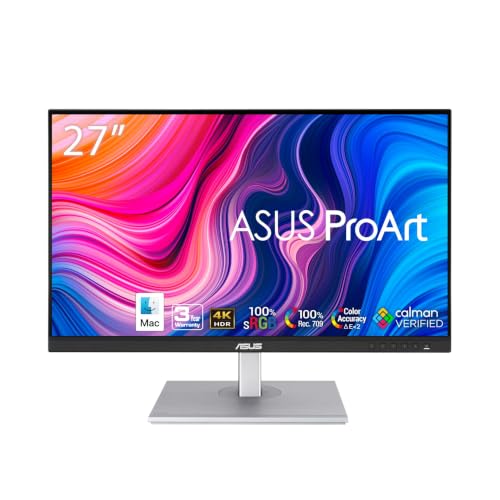
ASUS ProArt PA279CV
Aimed at photo and video editors, this 27-inch panel covers 100 percent of sRGB and ships Calman Verified out of the box. A 65W USB-C port charges a laptop while carrying the picture, and the ProArt hardware controls speed up on-screen adjustments. Factory reports document the color accuracy per unit.
Pros
- Full sRGB coverage with per-unit calibration
- 65W USB-C powers a laptop over one cable
- ProArt preset controls speed up editing
Cons
- USB-C tops out at 65W, short of a big laptop draw
- 60Hz only, not aimed at gamers

Gigabyte M28U
A 28-inch UHD panel with 144Hz and two HDMI 2.1 ports makes this a strong console and PC hybrid. KVM support lets one keyboard and mouse switch between two machines through the built-in hub. USB-C carries video with 15W of power for peripherals, though not enough to charge a laptop.
Pros
- Dual HDMI 2.1 for 4K 120Hz consoles
- KVM switch shares one keyboard and mouse
- 144Hz refresh for PC gaming too
Cons
- USB-C offers only 15W, no laptop charging
- Stand adjusts height and tilt but not much else

BenQ PD2725U
Two Thunderbolt 3 ports let this 27-inch monitor daisy-chain a second display and deliver 65W to a laptop. Coverage spans 95 percent of DCI-P3 with AQCOLOR factory tuning aimed at design work. A hotkey puck brings picture presets and input switching to the desk surface.
Pros
- Thunderbolt 3 daisy-chains a second monitor
- AQCOLOR tuning suits design and photo work
- Hotkey puck speeds up preset changes
Cons
- Thunderbolt power caps at 65W
- Premium price for a 60Hz panel
What to look for
What to look for in a UHD monitor Start with panel type. IPS gives wide viewing angles and steady color, which matters for photos and shared screens. Then check refresh rate, since a 4K panel at 60Hz feels slow next to a 144Hz one for gaming. Look at HDR tier next, because DisplayHDR 400 is a light touch while 600 and above adds real punch. Finally, count the ports and note USB-C wattage if you plan to run a laptop from the screen.
Best for a single-cable home office A USB-C monitor with 90W power delivery removes the separate charger from your desk. The Dell UltraSharp U2723QE and Samsung ViewFinity S8 both hit that mark and include a USB hub for a keyboard, webcam and drive. Check your laptop’s charging need first. A 90W screen keeps most ultrabooks topped up, but a 16-inch workstation laptop may draw more than the monitor supplies under load.
For gaming and consoles Fast games need high refresh and the right ports. The LG UltraGear 27GR93U and Gigabyte M28U both run 144Hz and carry HDMI 2.1, which unlocks 4K at 120Hz on a PlayStation 5 or Xbox Series X. Adaptive sync, sold as G-Sync Compatible or FreeSync, smooths frame delivery and cuts tearing. Office-grade 4K panels usually stop at 60Hz, so a gamer should not buy on resolution alone.
Is 4K worth it at 27 inches At 27 inches, 4K yields about 163 pixels per inch, which sharpens text and fine image detail noticeably over 1440p. Windows and macOS both scale interface elements, so menus stay readable rather than shrinking. On a 32-inch panel the density drops closer to 138 pixels per inch, still crisp but less dense. If you mainly game, a fast 1440p panel can feel smoother than a 60Hz 4K one for the same money.
How they stack up
| # | Model | Panel | Best for | Score | Price |
|---|---|---|---|---|---|
| 1 | Dell UltraSharp U2723QE | 27 inch IPS Black, 3840 x 2160 | Best overall | 9.4 | Check price |
| 2 | LG UltraGear 27GR93U | 27 inch IPS, 3840 x 2160 | Best for gaming | 9.2 | Check price |
| 3 | LG 27UP600-W | 27 inch IPS, 3840 x 2160 | Best value | 8.8 | Check price |
| 4 | Samsung ViewFinity S8 32-inch | 32 inch IPS, 3840 x 2160 | Best large screen | 8.9 | Check price |
| 5 | ASUS ProArt PA279CV | 27 inch IPS, 3840 x 2160 | Best for color accuracy | 9.0 | Check price |
| 6 | Gigabyte M28U | 28 inch IPS, 3840 x 2160 | Best for consoles | 8.7 | Check price |
| 7 | BenQ PD2725U | 27 inch IPS, 3840 x 2160 | Best Thunderbolt hub | 8.8 | Check price |
Frequently asked questions
Is a UHD monitor the same as 4K?
For desktop monitors, yes. UHD means 3840 x 2160, which the industry markets as 4K. True cinema 4K is 4096 x 2160 and appears mostly on professional gear, so a monitor labeled UHD or 4K is the same 3840 x 2160 panel.
Do I need a powerful graphics card for a 4K monitor?
For office work, browsing and video, integrated graphics handle 4K fine. Gaming at native 4K is demanding, so a mid-range or higher GPU helps. Many players run 4K panels at lower in-game resolutions or use upscaling to keep frame rates high.
Can I charge my laptop from a UHD monitor?
Only if the monitor has USB-C with power delivery. Look for the wattage in the specs. A 90W screen suits most ultrabooks, while larger laptops that ship with 100W or higher chargers may not charge fully during heavy tasks.
What refresh rate should a 4K monitor have?
For office and creative work, 60Hz is fine. For gaming, look for 120Hz or 144Hz. Reaching those rates at 4K needs DisplayPort 1.4 or HDMI 2.1, so confirm the cable and port support the speed you want.
Does HDR make a big difference on these monitors?
It depends on the tier. DisplayHDR 400 adds only a slight lift and lacks local dimming. HDR600 and above, or a Mini LED backlight, produces brighter highlights and deeper contrast that look clearly better in supported games and video.
Is 27 or 32 inches better for 4K?
A 27-inch panel packs pixels tighter for the sharpest text and needs less interface scaling. A 32-inch panel gives more usable space for layout and multitasking but at slightly lower density. Desk depth matters too, since a larger screen wants more viewing distance.
Can these monitors run a PlayStation 5 at 4K 120Hz?
Only models with HDMI 2.1 can. The LG UltraGear 27GR93U and Gigabyte M28U both include it. A 60Hz office monitor over HDMI 2.0 will run the console at 4K 60Hz instead.
Do UHD monitors work with a MacBook?
Yes. A USB-C or Thunderbolt model connects with one cable for video and charging. Macs scale the interface well at 4K, and a single-cable dock like the BenQ PD2725U suits a Thunderbolt MacBook Pro.
Are curved UHD monitors better than flat?
Curve helps most on ultrawide and very large panels by reducing off-axis distance. At 27 to 32 inches and a standard 16:9 shape, a flat panel is usually fine and better for precise design work where straight edges matter.
The bottom line
For most buyers, the Dell UltraSharp U2723QE is the pick, combining IPS Black contrast with a 90W USB-C dock that clears cable clutter. Gamers should spend on the LG UltraGear 27GR93U instead for its 144Hz panel and HDMI 2.1 ports, since a 60Hz office screen wastes a fast GPU. Budget creators lose little by choosing the LG 27UP600-W. The one detail buyers overlook is USB-C wattage, so match the screen’s power delivery to your actual laptop before deciding.