Vertical Mice for Wrist Comfort at a Desk All Day
The Logitech MX Vertical is the strongest all round choice thanks to its 57 degree angle and multi device pairing. The Logitech Lift suits small and medium hands better, while the Anker 2.4G Wireless Vertical Mouse covers the basics affordably.
The Logitech MX Vertical is the vertical mouse most people should try first, with the Logitech Lift a better shape for smaller hands and the Anker 2.4G Wireless Vertical Mouse a low cost way to find out whether the format suits you at all.
Vertical mice are difficult to choose because comfort depends on hand size and grip style far more than on features, and a shell that feels natural for one person feels like a brick for another. Angles range from around 55 to 90 degrees, and the steeper ones ask for a bigger adjustment. We compared grip angles, physical dimensions against typical hand sizes, button layouts, sensor specifications and what owners report about the transition period.
The top picks, ranked

Logitech MX Vertical
The MX Vertical uses a 57 degree angle, which is enough to put the forearm in a more neutral position without making the mouse feel alien on day one. It pairs with up to three devices over Bluetooth or the Logi Bolt receiver and charges over USB-C. The textured shell and thumb rest are the details that separate it from cheaper vertical mice.
Pros
- Angle balances neutral posture against adjustment difficulty
- Pairs with three devices and switches between them
- Charges over USB-C and works while charging
Cons
- Large shell is too big for smaller hands
- Costs more than most vertical mice
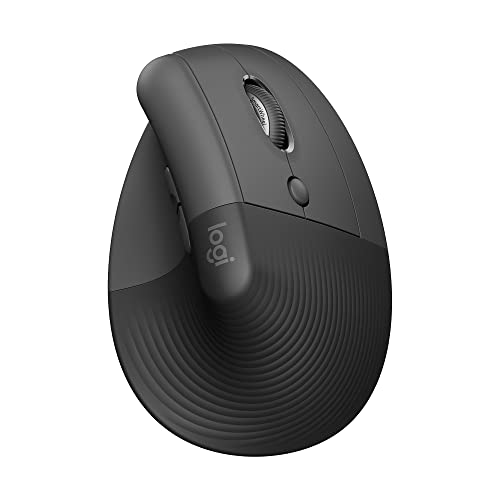
Logitech Lift Vertical Ergonomic Mouse
The Lift takes the MX Vertical concept and shrinks it, moving to a steeper 57 degree shell sized for small to medium hands that the larger model overwhelms. It keeps multi device pairing and adds quiet clicking switches, which matters in shared offices. A left handed version is available, which is rare in this category.
Pros
- Properly sized for hands the MX Vertical does not fit
- Quiet switches suit shared and home offices
- Left handed version available
Cons
- Uses a replaceable AA rather than a rechargeable cell
- Too small for users with large hands

Evoluent VerticalMouse 4
Evoluent has been making vertical mice longer than anyone and the VerticalMouse 4 uses a near vertical shell with a pronounced lip that stops the last finger dragging on the desk. It comes in several hand sizes and in wired and wireless versions, so you can match it precisely. The adjustment period is longer than gentler angles, but users who commit tend to stay with it.
Pros
- The most neutral forearm position of the group
- Available in several hand sizes and a left handed version
- Lower lip keeps fingers off the desk surface
Cons
- Steepest learning curve of any mouse here
- Design and software feel dated next to Logitech

Kensington Pro Fit Ergo Vertical Wireless Mouse
Kensington aims at the office market with a 60 degree shell, dual wireless connection over Bluetooth or a 2.4GHz receiver, and a straightforward button layout with a DPI switch on top. It runs on AA batteries, which suits workplaces where charging cables go missing. The build is plain but solid and it is far cheaper than the premium options.
Pros
- Dual wireless modes for desktops and laptops
- Priced well below the premium vertical mice
- AA batteries avoid charging downtime
Cons
- Lower maximum sensor resolution than rivals
- Plastic finish feels less refined than Logitech shells

Anker 2.4G Wireless Vertical Ergonomic Optical Mouse
This is the mouse most people use to find out whether a vertical grip suits them, and it has stayed popular for years because it does the core job properly. The angled shell, thumb rest and three DPI settings cover ordinary office work. It uses a 2.4GHz USB receiver rather than Bluetooth, so check you have a spare port.
Pros
- Cheapest sensible way to trial a vertical grip
- Comfortable thumb rest despite the low price
- Simple plug and play with no software required
Cons
- No Bluetooth, so it occupies a USB port
- Shell is large for smaller hands

J-Tech Digital Scroll Endurance Wired Vertical Mouse
For desktop users who never want to think about batteries or pairing, the Scroll Endurance is a straightforward wired vertical mouse with a removable palm rest and five buttons. The DPI switch sits on top for quick changes between browsing and detailed work. It is a practical office tool rather than a design object.
Pros
- No batteries or pairing to manage
- Removable palm rest adapts to different grips
- Consistent response with no wireless latency
Cons
- Cable clutter on a tidy desk
- Not practical for laptop users on the move

Delux M618 Mini Wireless Vertical Mouse
The M618 Mini is the smallest vertical mouse here, aimed at people with compact hands or anyone who wants a vertical grip in a laptop bag. It supports both Bluetooth and a 2.4GHz receiver and charges over USB. The compact size means fewer buttons and a shorter palm support than full size vertical mice.
Pros
- Fits in a laptop bag unlike full size vertical mice
- Dual wireless modes for switching between machines
- Rechargeable rather than battery dependent
Cons
- Too small to support a large hand comfortably
- Limited palm support compared with full size models
Side by side
| # | Model | Grip angle | Best for | Score | Price |
|---|---|---|---|---|---|
| 1 | Logitech MX Vertical | 57 degrees | Best overall | 9.4 | Check price |
| 2 | Logitech Lift Vertical Ergonomic Mouse | 57 degrees | Best for small and medium hands | 9.2 | Check price |
| 3 | Evoluent VerticalMouse 4 | Near fully vertical | Best for a fully vertical grip | 9.0 | Check price |
| 4 | Kensington Pro Fit Ergo Vertical Wireless Mouse | 60 degrees | Best value | 8.8 | Check price |
| 5 | Anker 2.4G Wireless Vertical Ergonomic Optical Mouse | Angled ergonomic shell | Best budget | 8.6 | Check price |
| 6 | J-Tech Digital Scroll Endurance Wired Vertical Mouse | Wired USB | Best wired option | 8.3 | Check price |
| 7 | Delux M618 Mini Wireless Vertical Mouse | Compact, small hand oriented | Best for travel | 8.0 | Check price |
Before you buy
The angle is the whole point, so choose it deliberately A conventional mouse forces your forearm into a pronated position, palm down, which some people find uncomfortable over a long day. Vertical mice rotate your hand toward a handshake position. Gentler angles around 55 to 60 degrees, as on the Logitech models, feel familiar quickly and still change your posture meaningfully. Near vertical designs such as the Evoluent go further but ask for a longer adjustment. If this is your first vertical mouse, the middle of the range is the safer starting point.
Size matters more than any feature The single most common complaint about vertical mice is that the shell does not fit the hand. Too large and your fingers stretch across the buttons with the palm unsupported, too small and your hand curls awkwardly. Measure from your wrist crease to the tip of your middle finger, then compare that against the mouse dimensions in the listing. Logitech makes the point directly by offering the large MX Vertical and the smaller Lift as separate products rather than one compromise shape.
Expect an adjustment period and plan for it Almost everyone is slower and less accurate with a vertical mouse for the first few days, because the muscles controlling fine movement are being used differently. Owners commonly report a week or two before it feels natural. Do not judge the purchase on day one, and if precision work is critical in that period, keep your old mouse on the desk. Switching between the two occasionally is a reasonable transition strategy rather than a failure.
Think about connection type and how you work Desktop users who never move their machine get the simplest experience from a wired vertical mouse, with no batteries or pairing to manage. Laptop users benefit from Bluetooth, which leaves the USB ports free, while a 2.4GHz receiver generally gives slightly more consistent response at the cost of a port. Multi device pairing is genuinely useful if you switch between a work laptop and a personal machine on the same desk.
Frequently asked questions
Do vertical mice actually help with wrist discomfort?
Many users report improvement, because the handshake position reduces forearm rotation compared with a flat mouse. Individual results vary considerably and a mouse is only one part of a workstation. If you have persistent pain or numbness, speak to a qualified professional rather than relying on equipment changes alone.
How long does it take to get used to a vertical mouse?
Owners typically describe a few days of feeling clumsy and around one to two weeks before it feels normal. Steeper angles take longer than gentler ones. Cursor speed settings often need adjusting during this period, since the movement comes more from the forearm and less from the wrist.
Are vertical mice good for gaming?
Generally not for competitive gaming, where fast repeated flick movements favour a low profile shape and very high sensor performance. For slower paced games, strategy titles and general use, a vertical mouse works perfectly well. Most vertical models prioritise comfort and office features over polling rate and sensor speed.
What angle should I choose?
Around 55 to 60 degrees is the most approachable range and covers the Logitech and Kensington models here. Near vertical designs around 85 to 90 degrees give the most neutral forearm position but take longer to adapt to. If you are unsure, start with the gentler angle and see how you get on before committing to a steeper shell.
Are there left handed vertical mice?
Yes, though the selection is much smaller. The Logitech Lift and several Evoluent VerticalMouse models are offered in left handed versions. Most other vertical mice are right hand only, because the shell shape is asymmetric and cannot simply be reversed.
Do vertical mice need special software?
They work as standard mice without software, but manufacturer applications unlock extra button assignments and pointer settings. Logitech Options+ handles the MX Vertical and Lift, while Evoluent and Kensington supply their own utilities. If you want the side buttons mapped to specific functions, install the software.
Should I use a wrist rest with a vertical mouse?
A gel or foam rest can help, but many vertical mice already include an integrated palm or thumb support, and adding a rest can lift the hand into an awkward position. Try the mouse alone first. What matters more is that your desk height lets your forearm sit roughly level rather than reaching upward.
Is a trackball a better option than a vertical mouse?
They solve different problems. A trackball removes arm movement entirely, which suits limited desk space and shoulder discomfort, while a vertical mouse changes wrist rotation but keeps normal arm movement. Some people alternate between the two through the day rather than choosing one.
The bottom line
The Logitech MX Vertical is the strongest overall pick, combining an approachable 57 degree angle with multi device pairing and a genuinely comfortable shell for larger hands. Choose the Logitech Lift if the MX feels oversized, the Evoluent VerticalMouse 4 if you want the most neutral position available, and the Anker wireless model if you simply want to try the format cheaply first.
You might also need

Adjustable Beds That Actually Deliver Better Comfort
