Volleyball Nets for Backyards, Beaches and Tournaments
The Park & Sun Sports Spectrum 2000 leads on pole rigidity and a tensioning system that keeps the net taut through a long session. The Baden Champions Volleyball Set is the value pick for casual play, and the CROSSNET Four Square Volleyball Net offers a different game entirely.
For serious backyard or club play, the Park & Sun Sports Spectrum 2000 is the strongest choice because its poles and tension system hold a proper net height under real play. Casual gatherings are well served by the Baden Champions Volleyball Set, and the CROSSNET four square net is the pick if you want something people will actually keep playing.
Nearly every complaint about a volleyball net comes down to two things: the poles lean and the net sags. Both trace back to pole diameter, guy line design and how the net edges are cabled rather than to the net fabric itself. We compared pole materials and diameters, tensioning hardware, net cabling, anchoring options and how quickly each packs down, then weighed those against what owners report about setup time and how the system holds up after a season outdoors.
The shortlist, ranked

Park & Sun Sports Spectrum 2000 Portable Outdoor Volleyball Net System
A steel pole system with a proper cable tensioning arrangement that keeps the top of the net straight rather than dipping in the middle. Height adjusts for volleyball and badminton, and the guy lines anchor properly into grass. Owners report it is the system that stops the constant retensioning cheaper sets demand.
Pros
- Holds tension through a long session
- Includes boundary lines and a ball
- Height adjusts for multiple sports
Cons
- Heavier to carry than aluminium systems
- Setup takes longer than casual sets

Park & Sun Sports Tournament Flex 1000
A step up in pole strength aimed at competitive and club level play, with a flex resistant design that keeps the net height consistent when players hit the tape. The heavier duty net resists stretching over a season. It is more system than a casual garden game needs, which is exactly the point.
Pros
- Poles resist flexing under hard play
- Net height stays consistent through a match
- Durable mesh for repeated seasons
Cons
- Heavy and bulky to transport
- Overkill for occasional garden use

CROSSNET Four Square Volleyball Net
A four way net that turns volleyball into a four square game, which works far better than a standard net when you have an odd number of players of mixed ability. Setup is quick and it packs into a carry bag. It is a different game rather than a substitute for a regulation net.
Pros
- Works well with four players of mixed ability
- Fast to set up and pack down
- Genuinely popular at gatherings
Cons
- Not a regulation volleyball net
- Centre pole needs firm ground to stay upright

Baden Champions Volleyball Set
A complete backyard set with poles, net, ball, pump and boundary markers, aimed at casual family play rather than competition. Setup is straightforward and the whole thing packs into one bag. The poles are lighter than tournament systems, so expect to retension after heavy play.
Pros
- Everything needed in one purchase
- Quick and simple to set up
- Packs into one bag for storage
Cons
- Poles lean under aggressive play
- Net needs retensioning during long sessions
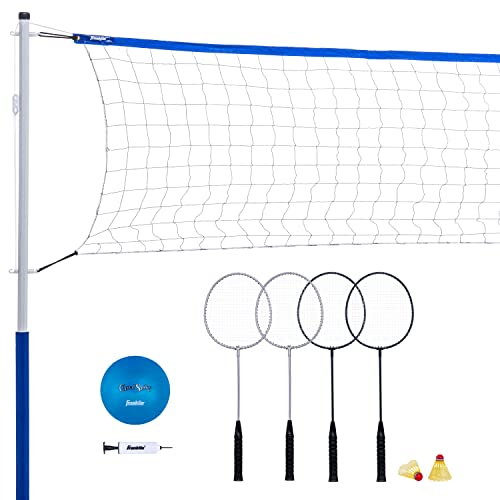
Franklin Sports Volleyball and Badminton Combo Set
A combination set that switches between volleyball and badminton by changing net height, with rackets and shuttlecocks included alongside the volleyball. It suits gardens where the same posts need to serve two games. Build quality is aimed at recreational rather than competitive use.
Pros
- Covers two games with one setup
- All accessories included
- Height changes quickly between sports
Cons
- Neither sport gets a competition grade net
- Lightweight poles need careful staking

GSE Games & Sports Expert Portable Volleyball Net Set
A portable system that prioritises speed of assembly, with sectional poles that slot together and a simple tension arrangement. It suits beach trips and park sessions where you want to be playing within a few minutes. Based on specifications it is one of the lighter full size sets here.
Pros
- Very quick to assemble
- Light enough to carry to a beach
- Compact when packed down
Cons
- Less rigid than heavy duty systems
- Sand anchoring needs additional weight

Boulder Portable Volleyball Net Set
A basic portable set for occasional garden and park play, with adjustable height and a carry bag. It does the job for informal games and stores easily out of season. Owners report the poles need firm staking and a check between sets to stay upright.
Pros
- Simple setup for casual games
- Adjustable height across sports
- Compact storage between uses
Cons
- Poles lean without careful staking
- Net stretches over repeated seasons
Side by side
| # | Model | Poles | Best for | Score | Price |
|---|---|---|---|---|---|
| 1 | Park & Sun Sports Spectrum 2000 Portable Outdoor Volleyball Net System | Steel, telescoping | Best overall | 9.4 | Check price |
| 2 | Park & Sun Sports Tournament Flex 1000 | Heavy duty steel | Best for regulation play | 9.2 | Check price |
| 3 | CROSSNET Four Square Volleyball Net | Four square, four way net | Best for something different | 9.0 | Check price |
| 4 | Baden Champions Volleyball Set | Lightweight steel telescoping | Best value | 8.8 | Check price |
| 5 | Franklin Sports Volleyball and Badminton Combo Set | Telescoping steel | Best for mixed games | 8.6 | Check price |
| 6 | GSE Games & Sports Expert Portable Volleyball Net Set | Sectional telescoping | Best for quick setup | 8.3 | Check price |
| 7 | Boulder Portable Volleyball Net Set | Telescoping steel | Best budget | 8.0 | Check price |
What matters most
Pole rigidity decides everything else A net is only as good as the poles holding it. Thin walled telescoping poles bend inward as tension increases, which drops the centre of the net and makes the height inconsistent across the court. Heavier gauge steel resists that. If a set is marketed mainly on how light it is to carry, expect to trade rigidity for portability, which is fine for a beach trip and frustrating for regular play.
Check how the net edges are finished A net with steel cable or rope sewn through the top and bottom hems can be tensioned properly and will hold a straight line. A net with only a webbing top and nothing along the bottom will bow and flap. This detail rarely appears in the headline description but shows clearly in product photographs, and it is the single best predictor of whether a net will sag.
Anchoring depends on your surface Standard stakes work in grass and soft ground. Sand needs sand anchors or buried bags, because stakes pull straight out under tension. Hard ground and paved areas need weighted bases, which most portable sets do not include. Decide where you will actually play before buying, since a set that works perfectly on a lawn can be unusable on a beach without extra hardware.
Set the right height and leave room around the court Standard indoor and outdoor net height is around 7 feet 11 5/8 inches for men and 7 feet 4 1/8 inches for women, with lower settings used for youth play. A full court needs roughly 60 by 30 feet plus clear space around the edges for safe movement. Most gardens cannot fit that, which is a good argument for a four square net or a shortened casual court rather than forcing a regulation setup into a small space.
Good to know
How high should a volleyball net be?
The standard height is about 7 feet 11 5/8 inches for men’s play and 7 feet 4 1/8 inches for women’s play. Youth divisions use lower settings that step down by age. Most portable sets adjust across that range plus a badminton height.
How much space does a volleyball court need?
A regulation court is 59 by 29.5 feet, and you want additional clear run off space around it. If your garden cannot accommodate that, shorten the court and adjust the rules, or choose a four square format designed for a smaller footprint.
Why does my net keep sagging?
Either the poles are flexing inward under tension or the net has no cable along its top and bottom edges. Retensioning helps temporarily. A permanent fix means heavier poles, properly angled guy lines and a net with cabled hems.
Can I use a backyard net on sand?
Only with proper sand anchors. Standard stakes pull free under tension in loose sand. Some beach specific systems include sand bags or screw anchors, and you can improvise with buried bags, though guy line angles matter more in sand than on grass.
How do I stop the poles leaning?
Drive the stakes at an angle away from the pole rather than straight down, keep the guy lines symmetrical on both sides, and tension gradually and evenly rather than pulling one side taut first. Uneven tensioning is the most common cause of a leaning pole.
Are combination volleyball and badminton sets worth it?
For casual family use, yes, since one setup covers two games and both are played at recreational intensity. For anyone playing volleyball seriously, a dedicated system with stronger poles will hold up better and keep the net height consistent.
How long does a portable net last outdoors?
Left out permanently, expect ultraviolet degradation of the netting within a season or two. Packing the net away between sessions dramatically extends its life. Steel poles should be dried before storage to avoid rust at the joints.
What is the difference between indoor and outdoor nets?
Outdoor nets use heavier, ultraviolet resistant mesh and stronger edge cabling to cope with wind and sun, and outdoor systems include guy lines because the poles are not fixed into sleeves. Indoor nets attach to permanent posts and use lighter construction.
Our pick
The Park & Sun Sports Spectrum 2000 is the pick for anyone playing regularly, because rigid poles and proper tensioning are what stop a net sagging halfway through the afternoon. Step up to the Tournament Flex 1000 for competitive play, or save the effort and choose the Baden Champions set for occasional family games. The CROSSNET is the one that gets played most at gatherings with four people.