Voltage Testers for DIYers: Smart Picks for Safe Home Wiring
For most DIYers, the Klein Tools NCVT-3PK non-contact voltage tester is the top pick. It offers dual-range detection for both low and standard voltage, which is ideal for a wide range of home projects. Its main advantage is the clear visual and audible alerts that make it easy to confirm power presence. The main limitation is that it cannot measure exact voltage levels, so for that you would need a multimeter.
Working on home electrical projects requires confidence that circuits are off before you touch them. A voltage tester is a small, essential tool that helps you verify power presence quickly and safely. Whether you are replacing a light switch, installing a ceiling fan, or troubleshooting an outlet, the right tester can prevent accidents.
This roundup covers seven of the best voltage testers for DIYers, each with unique strengths. From the compact and affordable to the feature-rich, you will find a model that fits your needs. We considered safety ratings, ease of use, and practical features that matter in real home scenarios.
What matters most
The shortlist, ranked

Klein Tools NCVT-3PK Non-Contact Voltage Tester
This pen-style tester from Klein Tools is a favorite among electricians and DIYers. It detects voltage from 12 to 1000V AC and also has a low-voltage mode for detecting 12V circuits, which is useful for landscape lighting and doorbells. The bright LED light and loud beeper make it easy to see and hear alerts. Its built-in flashlight helps in dark areas.
Pros
- Dual-range detection for versatile use
- Bright flashlight for dark spaces
- Clear visual and audible alerts
Cons
- Cannot measure exact voltage
- Some users find the button placement awkward

Fluke 1AC-A1-II VoltAlert Non-Contact Voltage Tester
Fluke is a trusted name in test tools, and this VoltAlert tester is built to last. It is rated CAT IV 1000V for safety, making it suitable for a range of environments. The tip glows red and beeps when voltage is present, providing a simple yes/no indication. It is compact and clips easily to a pocket.
Pros
- Rugged build quality
- High safety rating
- Simple operation with clear indication
Cons
- No low-voltage detection
- Not as feature-rich as others

Klein Tools NCVT1P Voltage Tester
If you want a reliable non-contact tester without spending much, the Klein Tools NCVT1P is a great choice. It detects voltage from 50 to 1000V AC and has a bright green LED that turns red when voltage is detected. It also features a flashlight for working in dim areas. Its compact size fits easily in a tool bag.
Pros
- Affordable price point
- Lightweight and portable
- Integrated flashlight
Cons
- No low-voltage mode
- Batteries are not included
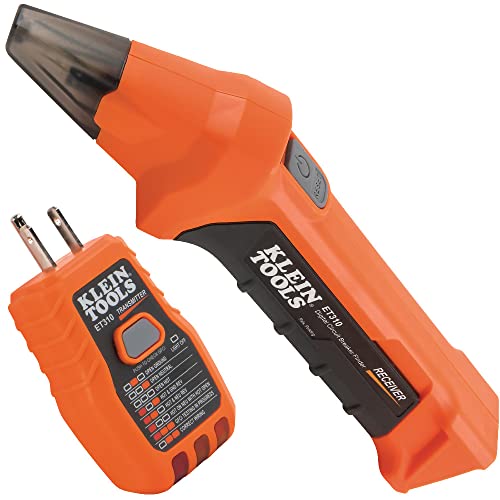
Klein Tools ET310 AC Circuit Breaker Finder with Integrated GFCI Tester
This tool from Klein Tools combines a circuit breaker finder and a GFCI tester in one device. It helps you identify which breaker controls an outlet or light fixture, saving time during electrical work. It also checks GFCI outlets for proper wiring. The transmitter plugs into an outlet, and the receiver scans the panel.
Pros
- Saves time locating breakers
- Tests GFCI functionality
- Easy to use with clear signals
Cons
- Only works with 120V outlets
- Requires two parts
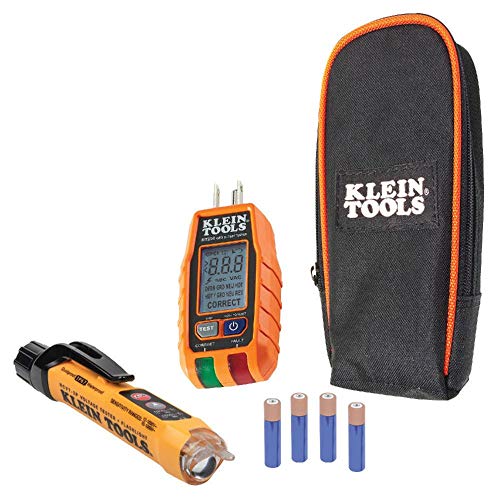
Klein Tools NCVT4P Voltage Tester with Receptacle Tester
This kit includes a non-contact voltage tester and a receptacle tester. The voltage tester detects 50-1000V AC, and the receptacle tester checks wiring in standard outlets. It is great for verifying that an outlet is correctly wired and safe. The tools are compact and come with a storage pouch.
Pros
- Two tools for comprehensive checks
- Receptacle tester identifies wiring issues
- Good value for money
Cons
- Receptacle tester only for 3-prong outlets
- Non-contact tester lacks low-voltage
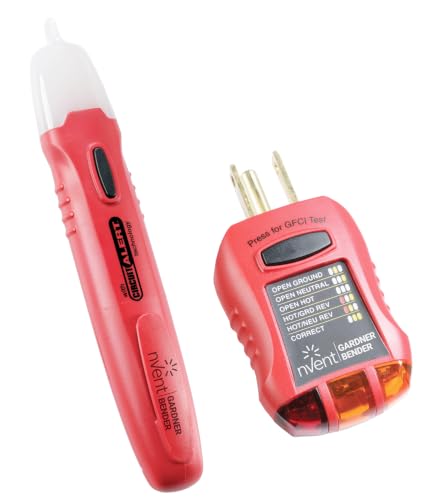
Gardner Bender GT-251 Voltage Tester
The Gardner Bender GT-251 is a pocket-sized voltage tester that can measure both AC and DC voltage. It automatically selects the range, making it easy to use. It displays readings on an LCD and also has a non-contact function. It is useful for checking batteries and low-voltage circuits.
Pros
- Measures AC and DC voltage
- LCD display for exact readings
- Compact and easy to carry
Cons
- Not as rugged as some others
- Limited to 600V

Southwire 40130N Voltage Tester
The Southwire 40130N is a non-contact tester with a bright flashlight and a backlit tip. It detects voltage from 50 to 1000V AC. Its ergonomic design makes it comfortable to hold for extended periods. It is ideal for use in dark crawl spaces or outdoor lighting fixtures.
Pros
- Bright flashlight for dark areas
- Backlit tip for visibility
- Comfortable grip
Cons
- No low-voltage detection
- Some users report intermittent beeping
Compared at a glance
| # | Model | Voltage Range | Best for | Score | Price |
|---|---|---|---|---|---|
| 1 | Klein Tools NCVT-3PK Non-Contact Voltage Tester | 12-1000V AC, Low: 12V | Best Overall for Dual-Range Detection | 9.4 | Check price |
| 2 | Fluke 1AC-A1-II VoltAlert Non-Contact Voltage Tester | 90-1000V AC | Best for Durability and Trust | 9.2 | Check price |
| 3 | Klein Tools NCVT1P Voltage Tester | 50-1000V AC | Best Budget Non-Contact Tester | 9.0 | Check price |
| 4 | Klein Tools ET310 AC Circuit Breaker Finder with Integrated GFCI Tester | Breaker Finder and GFCI Tester | Best for Identifying Circuits | 8.8 | Check price |
| 5 | Klein Tools NCVT4P Voltage Tester with Receptacle Tester | 50-1000V AC | Best 2-in-1 Tester for Outlets | 8.7 | Check price |
| 6 | Gardner Bender GT-251 Voltage Tester | 12-600V AC/DC | Best for Auto-Ranging DC/AC Measurement | 8.5 | Check price |
| 7 | Southwire 40130N Voltage Tester | 50-1000V AC | Best for Outdoor and Low-Light Work | 8.3 | Check price |
Good to know
What is the difference between a non-contact voltage tester and a multimeter?
A non-contact voltage tester only indicates if voltage is present, without giving a measurement. A multimeter can measure exact voltage, current, and resistance. For simple safety checks, a non-contact tester is sufficient, but for troubleshooting, a multimeter is more versatile.
Can I use a voltage tester on low-voltage systems like doorbells?
Some voltage testers have a low-voltage mode (e.g., 12V) that can detect low-voltage signals. The Klein Tools NCVT-3PK has a low-voltage setting. Standard testers that start at 50V will not detect 12V systems, so check the specifications.
How do I test if an outlet is live?
Insert the tip of a non-contact tester into the smaller slot of an outlet (the hot slot). If voltage is present, the tester will light up and beep. For outlets, you can also use a receptacle tester that plugs into the outlet and shows lights indicating wiring status.
Are voltage testers safe to use?
Yes, when used correctly. Non-contact testers are designed for safety, but always follow instructions. They are not a substitute for proper electrical safety practices. Always verify the tester works on a known live circuit before trusting it on an unknown circuit.
What does CAT rating mean on a voltage tester?
CAT rating indicates the level of transient voltage the tester can withstand. CAT III is for distribution circuits, and CAT IV is for utility connections. For home use, a CAT III rating is usually sufficient, but higher ratings offer more protection.
Can a voltage tester detect DC voltage?
Some voltage testers can detect both AC and DC voltage, such as the Gardner Bender GT-251. However, most non-contact testers are designed only for AC voltage used in home wiring. Check the specifications before testing DC circuits.
Why does my voltage tester beep intermittently?
Intermittent beeping can be due to nearby electromagnetic fields or a low battery. It may also be a sign of a faulty tester. Test the tester on a known live circuit to verify functionality. If it continues, replace the batteries or the tester.
How often should I replace my voltage tester?
Voltage testers do not have a specific lifespan, but they should be tested regularly for accuracy. If the tester fails to detect voltage on a known live circuit or shows signs of damage, replace it immediately. Also, replace the batteries as needed.
Do I need a voltage tester if I have a multimeter?
A multimeter can do everything a voltage tester does, but it is more complex to use. A voltage tester is quicker for a simple yes/no check. Many DIYers find it convenient to have both, using the voltage tester for daily checks and the multimeter for detailed measurements.
What is the best voltage tester for a beginner?
For a beginner, a non-contact voltage tester like the Klein Tools NCVT1P is ideal. It is simple to use, affordable, and safe. It gives a clear indication of voltage presence, which is all you need for most basic tasks.
The bottom line
For most DIYers, the Klein Tools NCVT-3PK is the best choice due to its dual-range detection and practical features. If you need a rugged tool that can withstand job site conditions, the Fluke 1AC-A1-II is worth the extra cost. For budget-conscious shoppers, the Klein Tools NCVT1P offers reliable performance at a lower price. If you often work with outlets, consider the Klein Tools ET310 to quickly identify circuits and test GFCI outlets.


