Walkie Talkies Ranked for Range, Clarity and Kids
The Motorola Talkabout T260 is the best all round set for families, with rechargeable batteries and clear audio across a neighbourhood. The Retevis RT628 is the pick for younger children thanks to its simple controls, while the Midland X-TALKER T51VP3 suits camping trips.
The Motorola Talkabout T260 is the walkie talkie set most families should buy, with the Retevis RT628 better for young children and the Midland X-TALKER T51VP3 for camping and outdoor trips.
Walkie talkies are one of the most misleading categories to shop because every box quotes a range figure measured between two hilltops with nothing in between, while real use involves houses, trees and hills. We compared channel and privacy code counts, battery types, published power output and control layouts, then weighed those specifications against what owners report about actual usable range in suburbs, campsites and large buildings.
What to look for
Ignore the range number on the box Advertised ranges of 20 or 35 miles are measured with clear line of sight between elevated points and nothing in between. In a suburban street with houses and trees, expect somewhere between a quarter of a mile and a mile from most consumer sets. Inside a large building or shopping centre it can drop to a few hundred feet. Judge sets on channel count, audio clarity and battery instead, and treat range figures as marketing rather than specification.
Channels and privacy codes stop crossed conversations Consumer radios share a small number of public frequencies, so in a busy campground or a neighbourhood with several families using them, crossed conversations are common. Privacy codes do not encrypt anything, but they filter out transmissions that do not carry the same code, which keeps your channel usable. More channels and codes give more combinations to find a quiet one.
Battery type shapes the ongoing cost Sets running on AAA cells are cheap to buy and expensive to keep fed, particularly with children who leave them switched on. Rechargeable packs or built in USB charging cost more upfront and remove that drain entirely. The most flexible designs accept both, so you can charge normally and drop in disposable cells on a trip away from power.
Licensing, safety and sensible use In the United States, FRS radios can be used without a licence within their power limits, while higher powered GMRS radios require an inexpensive licence that covers a whole family. Check which category a set falls into before buying if range genuinely matters. For children, agree a channel before setting off, set a check in interval, and make clear that a radio is not a substitute for adult supervision near roads or water.
What we recommend

Motorola Talkabout T260 Two-Way Radio Set
The T260 combines rechargeable battery packs with the option of running on standard AA cells, which solves the biggest annoyance in this category. Audio is clear and the 22 channels with privacy codes keep conversations separate from neighbours using the same band. Owners report reliable performance across a suburban neighbourhood, which is a realistic expectation rather than the headline number on the box.
Pros
- Runs on rechargeable packs or AA batteries
- Clear audio at realistic distances
- Weather alert channels included
Cons
- Not waterproof, only splash resistant
- Range claims far exceed real conditions
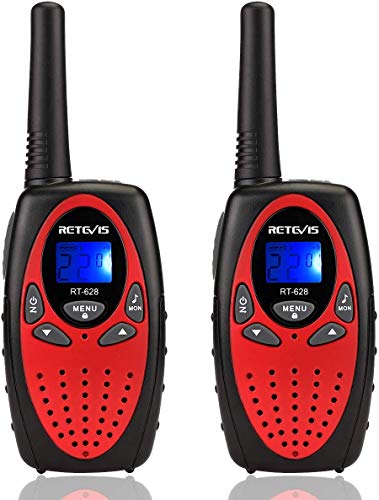
Retevis RT628 Kids Walkie Talkies
Retevis strips the interface down to a push to talk button and a volume control, which is exactly right for children who will otherwise change the channel and wonder why nobody answers. The bodies are light with a lanyard loop and survive being dropped on a patio. Based on specifications the range suits a garden, a park or a campsite rather than across a town.
Pros
- Very simple for young children to operate
- Light and easy for small hands
- Inexpensive enough to replace if lost
Cons
- Short usable range around buildings
- Runs through AAA batteries quickly

Midland X-TALKER T51VP3 Two-Way Radio
Midland builds these for outdoor use with NOAA weather scan that alerts you to incoming storms, which matters more on a campsite than any range specification. The 22 channels with privacy codes work well in busy campgrounds where several groups share the band. Battery life on AA cells is respectable for a weekend away from power.
Pros
- Weather alerts useful for outdoor trips
- Privacy codes reduce campground interference
- Compact enough for a pocket
Cons
- AAA batteries rather than rechargeable packs
- Modest transmit power limits range

Motorola Talkabout T110 Two-Way Radio
The T110 covers the essentials with 16 channels, clear audio and a simple layout that anyone can pick up. It is the set to buy for occasional use around a house, garden or shopping trip rather than sustained outdoor work. Battery life on AAA cells is adequate, and no charging cradle is included.
Pros
- Cheap and easy to use
- Recognised brand with reliable audio
- Light enough for children to carry
Cons
- No rechargeable option included
- Fewer channels and no privacy codes

Obuby Rechargeable Kids Walkie Talkies
Obuby solves the battery problem for children’s radios by making them rechargeable over USB, which removes the steady drain of AAA cells. Three unit sets are common, which suits groups of siblings or friends. Build quality is fair rather than rugged, so expect them to look worn after a summer.
Pros
- USB rechargeable, no battery buying
- Three unit sets available for groups
- Bright colours are easy to find outdoors
Cons
- Plastic bodies scuff quickly
- Battery life shorter than AA powered radios

USA Toyz Vox Box Walkie Talkies
The Vox Box uses voice activation so children can talk without holding a button, which is genuinely easier for younger kids and for anyone carrying something. Rechargeable batteries and a simple two button layout keep operation manageable. Voice activation can trigger on background noise, so a busy playground is not its best environment.
Pros
- Hands free operation suits young children
- Rechargeable rather than disposable cells
- Simple to set up out of the box
Cons
- Voice activation triggers on background noise
- Short range in built up areas
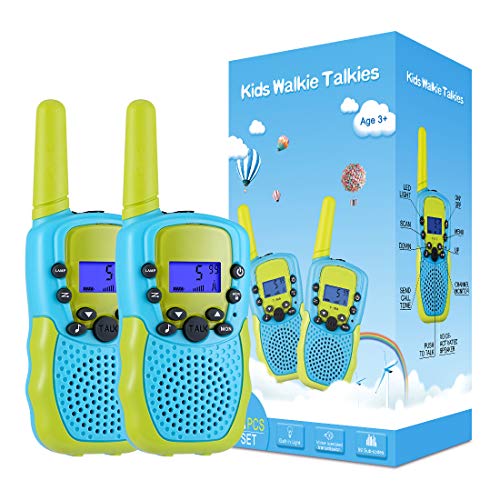
Selieve Kids Walkie Talkies
Selieve packages a bright, simple set with a flashlight and lanyard aimed squarely at birthday presents and camping trips. The controls are limited enough that a child cannot easily get lost in settings. Range and audio are basic, so treat it as a toy that works rather than a piece of communications equipment.
Pros
- Very easy for children to operate
- Flashlight is a genuinely used feature
- Presented well as a gift
Cons
- Few channels increases interference
- Limited range outdoors
Side by side
| # | Model | Channels | Best for | Score | Price |
|---|---|---|---|---|---|
| 1 | Motorola Talkabout T260 Two-Way Radio Set | 22 with 121 privacy codes | Best overall | 9.4 | Check price |
| 2 | Retevis RT628 Kids Walkie Talkies | 8 preset channels | Best for young children | 9.2 | Check price |
| 3 | Midland X-TALKER T51VP3 Two-Way Radio | 22 with 38 privacy codes | Best for camping | 9.0 | Check price |
| 4 | Motorola Talkabout T110 Two-Way Radio | 16 | Best budget | 8.8 | Check price |
| 5 | Obuby Rechargeable Kids Walkie Talkies | 22 channels | Best value for kids | 8.6 | Check price |
| 6 | USA Toyz Vox Box Walkie Talkies | 22 channels | Best hands free | 8.3 | Check price |
| 7 | Selieve Kids Walkie Talkies | 3 preset channels | Best gift set | 8.0 | Check price |
Frequently asked questions
How far do walkie talkies really reach?
In practice, a quarter of a mile to about a mile between houses and trees for typical consumer sets, and further with clear line of sight across open ground. The mileage figures on packaging assume ideal conditions that almost never exist in normal use.
Do walkie talkies work inside buildings?
They work, but range drops sharply. Concrete, steel and multiple floors absorb the signal, so a set that covers half a mile outdoors may manage only a few hundred feet inside a large building. Higher powered radios help but do not eliminate the problem.
What age are walkie talkies suitable for?
Simple kid focused sets work from around four or five, since the controls amount to a talk button and volume. Children of eight and up manage full featured radios with channels and codes without difficulty.
Do I need a licence to use walkie talkies?
In the United States, FRS radios operating within their power limits require no licence. GMRS radios, which transmit at higher power for longer range, require an inexpensive licence that covers your whole household. Rules differ by country, so check locally.
What do privacy codes actually do?
They filter incoming transmissions so your radio only plays those carrying the same code. They do not encrypt anything and anyone scanning can still hear you, but they solve the practical problem of overhearing other families on the same channel.
Are walkie talkies better than phones for kids?
For short range play in a garden, park or campsite, they are simpler, need no subscription and work where there is no cellular signal. They are not a replacement for a phone when a child is genuinely out of range or needs to call for help.
Why can I hear other people on my channel?
Consumer radios share public frequencies, so other users nearby transmit on the same channel. Changing channel and setting a privacy code usually resolves it, and in busy areas trying a few combinations is normal.
Are any of these waterproof?
Most consumer sets are splash resistant at best. If radios will be used on the water or in heavy rain, look specifically for an IP rating in the listing, since the majority of family sets do not carry one.
The bottom line
The Motorola Talkabout T260 is the set most families will get the most from, with rechargeable and AA flexibility, clear audio and enough channels to stay out of the neighbours’ conversations. Choose the Retevis RT628 if young children are the main users, or the Midland X-TALKER T51VP3 if the radios travel to campsites where weather alerts matter.


