Wall-Mounted Outdoor Fans That Won’t Rust or Wobble
The Hurricane Classic 20 Inch Wall Mount Fan suits most covered patios, since its wide oscillation and pull-chain control need no extra thought. Workshops and bay doors do better with the fixed-head Air King 9018. Anyone mounting on a fully exposed exterior wall should choose the TPI Corporation CACU Series instead.
Wind and rain do to a cheap wall fan what humidity does to old wiring, corroding it or shaking it loose within a season. The Hurricane Classic handles a covered patio well, thanks to its wide oscillation. Fully exposed walls need the sealed motor on the TPI Corporation CACU Series instead.
Most fans labeled outdoor still expect a roof overhead, not direct rain, and that distinction gets lost in listing titles. We compared motor sealing, blade diameter, mounting hardware and owner reports on rust and wobble to rank these seven.
The shortlist, ranked
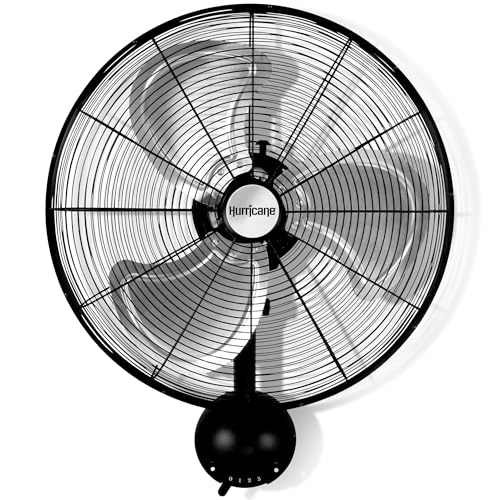
Hurricane Classic 20 Inch Wall Mount Fan (HGC736505)
This 20-inch fan oscillates through a wide arc, clearing a whole covered patio instead of one spot. A pull chain switches between three speeds without a remote to lose. Owners mount it in garages, porches and covered patios and report years of steady use.
Pros
- Wide oscillation covers a full patio
- Pull chain needs no remote or batteries
- Tilts to aim airflow up or down
Cons
- Not rated for direct rain exposure
- Bracket hardware sold separately from wall anchors
Hurricane Pro Series 20 Inch Wall Mount Fan (HGC736570)
It shares the 20-inch head of the Classic, but a heavier duty motor pushes more air across bigger spaces. Continuous running in a warehouse or barn wears down lighter motors first, and this one is built for that duty cycle. A steel mounting arm holds steady even at top speed.
Pros
- Moves more air than the standard Classic model
- Steel arm resists wobble at high speed
- Built for continuous industrial duty cycles
Cons
- Draws more power than smaller wall fans
- Overkill for a small balcony or porch
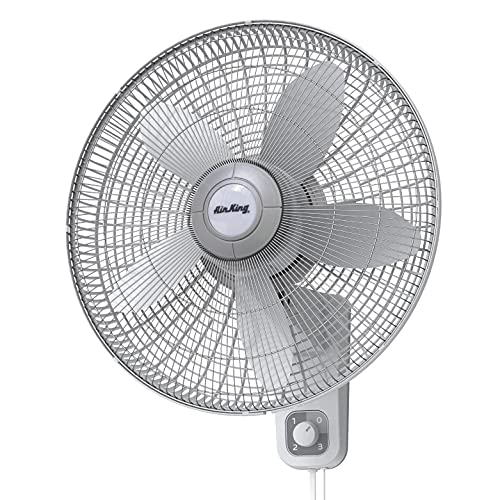
Air King 9018 18-Inch Industrial Grade Wall Mount Fan
Air King skips oscillation and points 18 inches of steel blade straight at a workbench or bay door. A totally enclosed motor keeps sawdust and moisture out of the windings. Three speeds and a pull chain are the only controls, suited to a shop that needs airflow, not settings.
Pros
- Enclosed motor resists dust and moisture
- Steel blades outlast plastic in a workshop
- High airflow for its size
Cons
- Fixed head cannot oscillate across a room
- Heavier to mount than plastic wall fans

TPI Corporation CACU Series Agricultural Wall Mount Fan
Barns and greenhouses expose a fan to dust, moisture and temperature swings that kill household models fast. TPI Corporation builds this one with a sealed motor housing for that environment. A wall or ceiling bracket kit ships with it, so it mounts in either orientation.
Pros
- Sealed motor suits barns and greenhouses
- Mounts to a wall or ceiling with the same kit
- Built for agricultural duty cycles
Cons
- Larger and heavier than patio fans
- Fixed head, no oscillation

Patton PUF1810W-BM Indoor/Outdoor Misting Wall Mount Fan
A misting ring wraps the front of this 18-inch fan and connects to a garden hose. Water evaporates in the airflow, dropping the felt temperature several degrees on a dry patio. It oscillates and mounts to a wall or the included pole stand.
Pros
- Misting adds real cooling in dry heat
- Works wall mounted or as a pole fan
- Oscillation spreads the mist further
Cons
- Misting raises humidity in already humid climates
- Nozzle needs periodic cleaning against mineral buildup

iLIVING Wall Mounted Shutter Exhaust Fan
This one exhausts air instead of circulating it, pulling hot air out of a garage or attic through automatic shutters. Shutters open only when the fan runs, keeping weather out the rest of the time. Variable speed control matches airflow to the space.
Pros
- Automatic shutters block weather when off
- Variable speed matches airflow to the room
- Purpose built for exterior wall installation
Cons
- Exhausts air rather than cooling a person directly
- Installation cuts a wall opening, unlike bracket mount fans
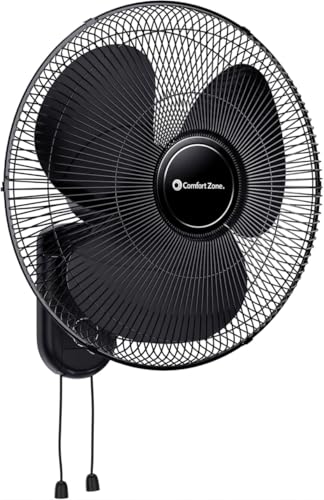
Comfort Zone CZWM16 16 Inch Wall Mount Fan
A smaller 16-inch head suits a porch or small covered patio rather than a whole yard. Three speeds and a pull chain keep the control simple. Light weight makes it one of the easier fans here to mount solo.
Pros
- Affordable entry point into wall mounting
- Light enough to install without help
- Compact size suits small porches
Cons
- Smaller blade moves less air than 18 to 20 inch models
- Plastic housing less durable than steel options
Compared at a glance
| # | Model | Blade diameter | Best for | Score | Price |
|---|---|---|---|---|---|
| 1 | Hurricane Classic 20 Inch Wall Mount Fan (HGC736505) | 20 inches | Best overall | 9.4 | Check price |
| 2 | Hurricane Pro Series 20 Inch Wall Mount Fan (HGC736570) | 20 inches | Best for large or fully covered patios | 9.2 | Check price |
| 3 | Air King 9018 18-Inch Industrial Grade Wall Mount Fan | 18 inches, powder coated steel | Best for garages and workshops | 9.0 | Check price |
| 4 | TPI Corporation CACU Series Agricultural Wall Mount Fan | 24 inches | Best for barns and fully exposed outdoor mounting | 8.7 | Check price |
| 5 | Patton PUF1810W-BM Indoor/Outdoor Misting Wall Mount Fan | 18 inches | Best for misting and dry-heat cooling | 8.4 | Check price |
| 6 | iLIVING Wall Mounted Shutter Exhaust Fan | Shutter exhaust, single direction | Best for garage and attic ventilation | 8.2 | Check price |
| 7 | Comfort Zone CZWM16 16 Inch Wall Mount Fan | 16 inches | Best budget | 8.0 | Check price |
What matters most
What should you look for in a wall-mounted outdoor fan? Four specs decide most of these purchases: blade diameter, motor sealing, mounting bracket strength and oscillation. Blade diameter sets how much air moves, with 16 inches suiting a small porch and 20 to 24 inches covering a full patio or bay door. Motor sealing determines whether dust and moisture reach the windings, which matters more outside than in a living room. A steel wall bracket rated for the fan’s weight stops wobble at higher speeds. Oscillation spreads air across a space, while a fixed head concentrates it on one spot like a workbench.
Covered patio vs fully exposed mounting: what changes A roof overhead changes what a fan needs to survive. Under a covered patio or porch, a damp-rated fan like the Hurricane Classic handles occasional splash and humidity fine. Barns and open decks expose the motor to direct rain and demand a sealed housing like the one on the TPI Corporation CACU Series. Mixing these ratings up is the most common outdoor fan mistake, since damp-rated and wet-rated are not interchangeable terms on a listing.
Wall-mounted fans for garages and workshops Shops need airflow aimed at a task, not spread evenly, so a fixed head often beats an oscillating one. The Air King 9018 points steadily at a workbench or bay door with an enclosed motor that shrugs off sawdust. Ventilation is a separate job from cooling, and the iLIVING shutter exhaust fan handles that by pulling hot air out through a wall opening instead of circulating it. Pick airflow for cooling a person, exhaust for clearing heat and fumes from the whole room.
Oscillating heads, misting and everyday extras Oscillation matters most when several people share one fan across a wide patio. A fixed head wins when the target is one spot, like a grill station or a doorway. None of these seven wall-mounted fans ship with a remote, since pull chains remain the standard control at this size. Misting models like the Patton PUF1810W-BM add a garden hose connection for extra cooling, worth the plumbing only in genuinely dry climates.
Good to know
Are wall-mounted fans safe to use outdoors?
Only if the listing states an outdoor or wet location rating. A fan built for indoor damp areas like a covered patio can still corrode fast in open rain. Check the motor housing description, not just the product category, before mounting one on an exposed exterior wall.
What is the difference between damp-rated and wet-rated fans?
Damp-rated fans tolerate humidity and occasional splash, which suits a covered porch or patio. Wet-rated fans have a sealed motor built for direct rain and standing moisture, needed on a fully exposed wall or in a barn. Mixing the two up is a common return reason for outdoor fans.
How high should you mount an outdoor wall fan?
Most manufacturers recommend seven to eight feet, high enough to clear head height but still within reach of a pull chain or the bracket’s tilt adjustment. Going higher spreads airflow further but makes the chain harder to reach without a pole.
Can a wall-mounted fan get rained on?
Only wet-rated models with a sealed motor housing should take direct rain, and even those do better under some shelter. Standard damp-rated fans like most patio models will corrode or short out if rain reaches the motor regularly.
What size wall fan do I need for a patio?
A 16-inch head suits a small porch or balcony. Most covered patios do well with 18 to 20 inches, which is where models like the Hurricane Classic sit. Larger open patios or barns benefit from 24-inch options like the TPI Corporation CACU Series.
Wall-mounted fan vs ceiling fan for a patio, which is better?
Wall-mounted fans install without cutting into a ceiling and cost less to add later. Ceiling fans move more air across a larger footprint but need existing wiring and clearance overhead. A low or angled patio roof often rules out a ceiling fan entirely, leaving wall mounting as the practical option.
Do wall-mounted fans come with a remote control?
Rarely at this size. All seven fans compared here use a pull chain for speed control instead. Remote control wall fans exist but usually cost more and add a battery component that can fail outdoors.
How much airflow do I need for a garage fan?
A one or two car garage does well with an 18-inch fixed-head fan like the Air King 9018 for spot cooling. For pulling out heat, fumes or sawdust entirely, an exhaust option like the iLIVING shutter fan clears the room instead of just moving air around it.
Which wall-mounted fan works best for a barn?
The TPI Corporation CACU Series suits barns best, since its sealed motor housing resists dust, moisture and temperature swings. Its 24-inch blade also covers more open space than smaller patio fans.
Final word
Covered patios are well served by the Hurricane Classic, since its oscillation and pull chain need no extra thought. Barns and fully exposed walls call for the sealed motor on the TPI Corporation CACU Series. Workshops that need steady airflow on one spot should skip oscillation and mount the Air King 9018 instead.