Washable Aquarium Filters: HOB, Canister and Sponge Compared
AquaClear 50 Power Filter leads this comparison with an adjustable flow lever and reusable foam and BioMax media across 20 to 50 gallon tanks. Fluval C4 Power Filter offers a wider intake for less. Penn-Plax Cascade 1000 Canister Filter brings washable canister filtration in at a lower cost.
AquaClear 50 Power Filter suits community tanks from 20 to 50 gallons, thanks to an adjustable flow lever and widely stocked foam and BioMax media. Its hang-on-back design sits outside the tank, which rimless setups can’t hide. Rimless tank owners should look toward a canister option instead.
Flow rate, media capacity and tank shape pull in different directions, which makes picking a washable filter harder than it looks. We compared published specifications, gallon ratings and owner feedback across hang-on-back, canister and sponge designs to find filters that hold up to repeated rinsing.
The best picks, ranked

AquaClear 50 Power Filter
A foam sponge, BioMax ceramic rings and an optional carbon insert make up the media stack, and owners rinse and reuse all three for years. An intake lever dials flow down for betta tanks or up for heavier bioloads. One unit covers anything from a 20 to a 50 gallon tank.
Pros
- Flow lever adjusts output for different bioloads
- Foam and ceramic media rinse clean instead of needing replacement
- Media baskets sell separately for easy customization
Cons
- Splash noise grows louder as the water level drops
- Hangs outside the tank, which rimless aquariums can’t hide

Fluval C4 Power Filter
Multi-stage washable foam pads fill a wide intake that pulls debris from a larger surface area than narrow HOB filters manage. Its rating covers tanks up to 70 gallons, more headroom than most filters near its price. A flip-up feeding lid pauses flow without pulling the whole unit off the tank.
Pros
- Wide intake resists clogging between cleanings
- Higher gallon rating than similarly priced HOB filters
- Feeding pause lid skips full disassembly
Cons
- Runs louder than the smaller C2 and C3 models
- Media baskets fit only Fluval C-series pads
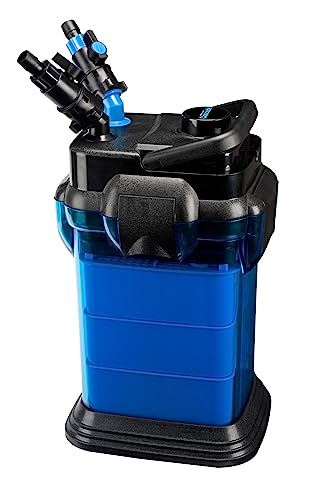
Penn-Plax Cascade 1000 Canister Filter
Canister filtration reaches a lower price point here than most competing brands offer. Four media trays hold reusable foam pads and bio-media that owners rinse in tank water rather than replace. Sitting below the tank, it frees up hood space for lighting.
Pros
- Lower entry cost than most canister filters this size
- Multiple trays allow mixing mechanical and biological media
- Quiet operation since the unit sits outside the tank
Cons
- Priming and hose setup take longer than HOB filters
- Flow rate trails premium canisters at the same tank size

Seachem Tidal 55
A self-cleaning intake strainer pairs with a large media basket sized for chemical filtration like Purigen alongside washable sponge inserts. That extra basket volume suits planted tanks where owners dose ferrous supplements without clouding the water. A wave-driven paddle keeps the strainer clear of substrate debris automatically.
Pros
- Self-cleaning intake resists clogging from planted substrate
- Larger media basket than most HOB filters its size
- Quiet pump with adjustable flow control
Cons
- Basket clips need periodic checking so the lid seals fully
- Costs more than standard HOB filters without the auto-clean feature
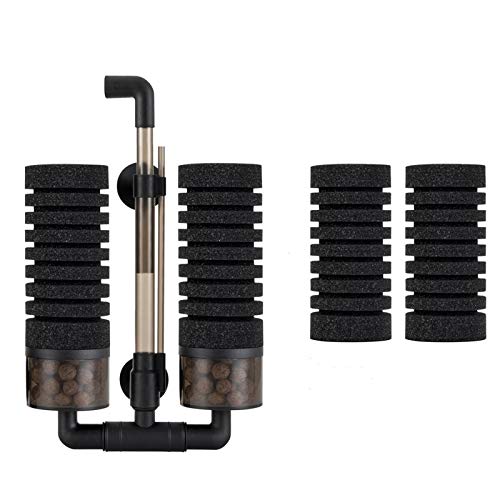
Hygger Double Sponge Filter
No motor sits inside the tank on this air-driven filter, just two washable sponge cylinders connected to an external air pump. Bettas and shrimp tolerate the gentle output better than powered hang-on-back flow. Squeezing the sponges in tank water clears debris without disturbing the bacteria colonies inside.
Pros
- Near-silent operation compared to motorized filters
- Gentle flow protects fry, shrimp and betta fins
- Two sponges allow staggered cleanings that preserve bacteria
Cons
- Requires a separate air pump and airline tubing
- No mechanical polishing for fine particles like HOB filters offer

Fluval 407 Canister Filter
383 GPH moves through multi-stage washable foam and BioMax media, enough turnover for heavily stocked tanks up to 100 gallons. Pump-assisted priming starts water flow without manual suction. Media trays lift out as one stack, so rinsing the entire set takes minutes rather than an hour.
Pros
- High flow rate suits heavily stocked or messy fish
- One-stack media tray simplifies rinsing all at once
- Pump-assisted priming skips manual siphoning
Cons
- Bulkier footprint needs cabinet space below the tank
- Higher flow can overpower slow swimmers without baffling

AquaClear 20 Power Filter
Scaled down from the AquaClear 50, this filter suits nano tanks from 5 to 20 gallons without overpowering slow swimmers. The same foam and BioMax media rinse clean in tank water instead of needing monthly replacement. A single flow lever adjusts output for betta or shrimp tanks.
Pros
- Compact size fits nano and desktop tanks
- Adjustable flow lever suits low-flow species
- Shares reusable media design with larger AquaClear models
Cons
- Limited media volume compared to the AquaClear 50
- Not enough turnover for tanks approaching 30 gallons
How they compare
| # | Model | Filter type | Best for | Score | Price |
|---|---|---|---|---|---|
| 1 | AquaClear 50 Power Filter | Hang-on-back (HOB) | Best overall | 9.4 | Check price |
| 2 | Fluval C4 Power Filter | Hang-on-back (HOB) | Best value | 9.1 | Check price |
| 3 | Penn-Plax Cascade 1000 Canister Filter | Canister | Best budget | 8.8 | Check price |
| 4 | Seachem Tidal 55 | Hang-on-back (HOB) | Best for planted tanks | 8.6 | Check price |
| 5 | Hygger Double Sponge Filter | Air-driven sponge | Best for quiet operation | 8.4 | Check price |
| 6 | Fluval 407 Canister Filter | Canister | Best for high bioload | 8.2 | Check price |
| 7 | AquaClear 20 Power Filter | Hang-on-back (HOB) | Best for small tanks | 8.0 | Check price |
Before you buy
What makes a filter washable Washable filters replace disposable cartridges with foam, sponge or ceramic media that owners rinse in tank water instead of throwing away. Hang-on-back units clip to the rim and pull water through a foam pad before returning it. Canister filters sit below the tank and push water through several media trays. Sponge filters skip a motor entirely, running instead on air pump pressure.
Matching flow rate to tank size Most filters list flow rate in gallons per hour, and aquarists target four to six times the tank volume hourly for freshwater fish. A 30 gallon tank calls for roughly 150 GPH, ruling out undersized filters along with oversized ones that stress weak swimmers. Canister filters generally handle higher turnover than HOB units at the same tank size. Betta and shrimp tanks often need less flow than that standard formula suggests.
Sponge filters for fry and small tanks Gentle currents from air-driven sponge filters protect fry, shrimp and long-finned bettas from getting pulled into an intake. They also run nearly silent, since no motor sits inside the tank. Breeders often run two sponge filters in a nursery tank so one stays seeded with bacteria while the other dries out between cleanings. Quarantine tanks benefit too, since sponge media transfers established bacteria from a healthy tank.
Cleaning media without losing beneficial bacteria Rinse foam and sponge media in removed tank water rather than tap water, since chlorine and chloramine kill the bacteria colonies that break down ammonia. Squeeze gently until the runoff turns mostly clear, then return the media right away. Saltwater setups need the same approach, though marine bacteria react more sharply to temperature swings during cleaning. Staggering cleaning schedules across multiple media types keeps the whole colony from getting rinsed at once.
Good to know
How often should you wash a washable aquarium filter?
Rinse foam or sponge media every two to four weeks, based on owner reports and stocking level. Heavily stocked tanks may need weekly rinsing, while lightly stocked tanks can stretch to a month.
What is the difference between a washable filter and a cartridge filter?
Washable filters use foam, sponge or ceramic media that gets rinsed and reused indefinitely. Cartridge filters use disposable pads that need replacement every few weeks, adding ongoing cost.
Can washable filters work in saltwater tanks?
Yes, foam and sponge media handle saltwater the same way they handle freshwater. Canister filters like the Fluval 407 are common in reef and fish-only marine setups because of their higher flow and media capacity.
Which filter type works best for a 20 gallon tank?
A compact hang-on-back filter like the AquaClear 20 matches a 20 gallon tank without overwhelming it with flow. Sponge filters also work well if the tank houses bettas or shrimp that prefer gentler currents.
Is a sponge filter better than a hang-on-back filter for bettas?
Sponge filters produce gentler flow, which suits long-finned bettas better than most hang-on-back units running at full power. HOB filters like the AquaClear 20 can match that gentleness once the flow lever gets turned down.
Do washable filters remove ammonia as well as chemical cartridges?
Washable media handles ammonia through biological filtration once bacteria colonize the foam or sponge, not through chemical absorption. Adding a reusable carbon or Purigen insert, as the Seachem Tidal 55 allows, adds chemical filtration without going fully disposable.
How do you clean filter media without killing beneficial bacteria?
Rinse media in water removed from the tank rather than tap water, since chlorine kills the bacteria that process ammonia and nitrite. Squeeze gently until the runoff turns mostly clear, then reinstall it right away.
Are canister filters worth it for smaller tanks under 30 gallons?
Canister filters like the Penn-Plax Cascade 1000 are usually overkill for tanks under 30 gallons, since their flow rate and footprint suit larger setups. A hang-on-back or sponge filter typically covers smaller tanks at lower cost and simpler maintenance.
Hang-on-back vs canister filter: which is better for beginners?
Hang-on-back filters install faster and need no priming, which suits a first tank. Canister filters take longer to set up but handle higher bioloads and hide below the tank once running.
Our pick
AquaClear 50 Power Filter earns the top spot for its adjustable flow, widely stocked reusable media and coverage across 20 to 50 gallon tanks that fit most community setups. Owners running nano tanks under 20 gallons should size down to the AquaClear 20 instead, since the 50’s flow rate can overpower smaller volumes. Anyone keeping bettas, shrimp or fry should skip powered filters altogether and choose the Hygger Double Sponge Filter for its gentler, near-silent output.