Which Water Pressure Gauge Reads Your Home Correctly?
The Rain Bird P2A leads for straightforward hose bib readings with a clear dial. The Watts IWTG is the pick for plumbers who want a lazy hand that records peak pressure, and the Flow Doctor gauge suits anyone needing several thread adapters in one kit.
The Rain Bird P2A tops our water pressure gauge ranking, with the Watts IWTG best for tracking peak pressure overnight and the Flow Doctor covering multiple thread fittings. Regulators with built in gauges from Camco and Renator handle recreational vehicle use.
Water pressure is trickier to judge than it seems because the figure moves. Municipal supply rises at night when demand falls, thermal expansion spikes pressure after a hot water cycle, and a single daytime reading can look perfectly normal while overnight peaks damage fittings. We compared dial ranges, increments, peak hold features and what owners report about seal quality, then ranked on usefulness rather than dial size.
What to look for
Know the number you are aiming for Most household plumbing is designed for roughly 40 to 60 psi, with 80 psi commonly cited as the upper limit before fittings, valves and appliance hoses come under strain. If a reading sits above that, a pressure reducing valve is the usual fix. Very low readings point instead to a partly closed valve, a blockage or a supply problem.
Take readings at more than one time Mains pressure often climbs overnight when demand across the network falls, and thermal expansion in a closed system can spike pressure sharply after the water heater runs. A single afternoon reading can look fine while overnight peaks quietly damage things. A gauge with a lazy hand left on overnight tells the real story.
Measure at the right point An outside tap close to where the supply enters gives the cleanest picture of incoming pressure. Reading after a filter, softener or long run of narrow pipe shows what that fixture receives instead, which is useful for chasing a drop but not for judging the supply. Note where each reading was taken.
Hand tight is tight enough These gauges seal on a rubber washer, so wrenching them onto a hose bib crushes the seal and can crack a plastic body. Screw on by hand, open the tap fully and check for weeping before walking away. Store the gauge dry so the washer does not perish between uses.
Our top picks

Rain Bird P2A Water Pressure Test Gauge
The P2A threads onto a standard hose bib and gives a clear reading with sensible dial increments, which is all most homeowners need to know whether a pressure regulator is required. The build is simple, with a rubber gasket that seals without tools. Owners report it is accurate enough to make decisions with and cheap enough to keep in a drawer.
Pros
- Threads onto any outside tap in seconds
- Dial is legible without leaning in
- Inexpensive enough to keep permanently
Cons
- No lazy hand to record peak pressure
- Plastic body is less durable than brass gauges

Watts IWTG Water Pressure Test Gauge
The IWTG adds a second indicator that stays at the highest pressure reached, so you can leave it on overnight and see what actually happened. That matters because thermal expansion and night time mains pressure cause most damage. Owners report it is the gauge plumbers reach for when diagnosing intermittent problems.
Pros
- Records peak pressure while unattended
- Wide range covers spikes from expansion
- Metal case survives being knocked about
Cons
- Lazy hand must be reset manually each time
- Wide range means coarser increments

Flow Doctor Water Pressure Gauge
Flow Doctor ships with adapters that let one gauge fit hose bibs, washing machine connections and smaller threaded fittings, so you can measure at several points in the system. That flexibility helps when you are chasing a pressure drop rather than just checking supply. Owners report the adapters are the reason to choose it over a single fitting gauge.
Pros
- Measures at several points in the system
- Dual scale suits mixed unit households
- Adapters stored together in one kit
Cons
- More parts to lose in a toolbox
- No maximum pressure memory

Camco 40064 RV Water Pressure Regulator
This unit combines a brass regulator with an integrated gauge, so you both measure and limit the pressure entering a vehicle. Campsite supply pressure is famously unpredictable, and plumbing in a vehicle is far less tolerant than household pipework. Owners report it as a routine part of hookup rather than an occasional tool.
Pros
- Protects vehicle plumbing from pressure spikes
- Brass body suited to outdoor use
- Reads and regulates in one fitting
Cons
- Fixed regulation point with no adjustment
- Restricts flow more than an adjustable unit

Renator M11-0660R Water Pressure Regulator Valve
The Renator lets you set the outlet pressure with an adjustment screw while watching the gauge, which is useful when a fixed regulator strangles your flow. The oil filled gauge damps needle bounce so the reading settles quickly. Owners report the adjustment makes showers usable again compared with a fixed unit.
Pros
- Adjustable outlet pressure preserves flow
- Oil filled gauge reads steadily
- Includes filter screen and washers
Cons
- Adjustment can drift and needs rechecking
- Bulkier at the hookup point
Measureman Water Pressure Test Gauge
Measureman offers a gauge with a maximum pressure indicator at a lower price than the established plumbing brands, with a stainless case and a hand tighten swivel connection. It covers the same diagnostic job of leaving it on overnight. Owners report the accuracy is fine for household decisions, though repeatability across units varies a little.
Pros
- Peak hold at a low cost
- Stainless case handles outdoor storage
- Swivel fitting seals by hand
Cons
- Calibration consistency varies between units
- Smaller dial than premium gauges
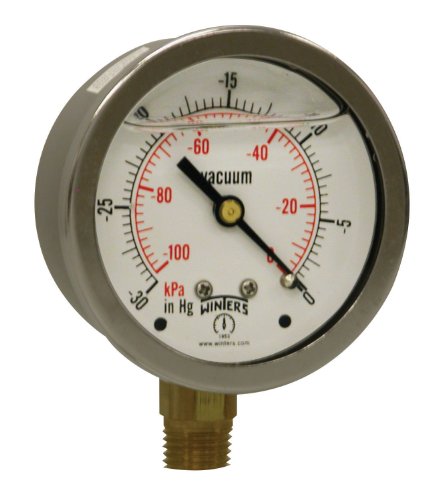
Winters PEM Series Dual Scale Pressure Gauge
The PEM series is a general purpose industrial gauge with a threaded pipe connection, intended to be plumbed in permanently rather than screwed onto a tap. That makes it a good choice next to a pressure reducing valve or on a well system where you want a constant readout. Owners report choosing the pressure range carefully so the normal reading sits mid dial.
Pros
- Built for permanent plumbed in use
- Dual scale dial
- Available in several pressure ranges
Cons
- Needs plumbing rather than screwing on
- No hose thread without an adapter
How they stack up
| # | Model | Range | Best for | Score | Price |
|---|---|---|---|---|---|
| 1 | Rain Bird P2A Water Pressure Test Gauge | 0 to 200 psi | Best overall | 9.4 | Check price |
| 2 | Watts IWTG Water Pressure Test Gauge | 0 to 300 psi | Best for tracking peaks | 9.2 | Check price |
| 3 | Flow Doctor Water Pressure Gauge | 0 to 200 psi | Best adapter kit | 9.0 | Check price |
| 4 | Camco 40064 RV Water Pressure Regulator | Regulator with integrated gauge | Best for recreational vehicles | 8.8 | Check price |
| 5 | Renator M11-0660R Water Pressure Regulator Valve | Adjustable regulator with gauge | Best adjustable regulator | 8.6 | Check price |
| 6 | Measureman Water Pressure Test Gauge | 0 to 200 psi | Best value with peak hold | 8.3 | Check price |
| 7 | Winters PEM Series Dual Scale Pressure Gauge | NPT threaded stem | Best for permanent installation | 8.0 | Check price |
Good to know
What is a normal home water pressure reading?
Around 40 to 60 psi suits most household plumbing and fixtures. Below 40 psi showers and appliances feel weak, and sustained readings above 80 psi put stress on hoses, valves and seals. Local codes and utility guidance vary, so check what applies in your area.
How do I know if I need a pressure reducing valve?
If readings regularly exceed the upper limit for your area, especially overnight, a reducing valve at the supply entry is the standard remedy. Recurring appliance hose failures, running toilet fill valves and banging pipes are supporting symptoms. A plumber can confirm and size the valve correctly.
Why does my pressure spike after a shower or laundry?
Heating water expands it, and in a closed system with a check valve or backflow preventer that expansion has nowhere to go. The result is a sharp pressure rise. An expansion tank absorbs it, which is why they are commonly fitted alongside reducing valves.
Can I leave a gauge attached permanently?
A hose bib gauge can stay on if the tap is not needed, though freezing weather will damage it. For a permanent readout, an industrial gauge plumbed near the supply entry is the better approach. Remove hose mounted gauges before winter in cold climates.
Do these gauges measure flow as well?
No. Pressure and flow are different things, and a system can show good pressure with poor flow if pipes are narrow or partly blocked. Measuring flow needs a timed volume test with a bucket. Diagnose the two separately rather than assuming one explains the other.
How accurate are inexpensive gauges?
Typically within a few psi, which is fine for deciding whether pressure is too high or too low. They are not laboratory instruments and can drift after knocks or freezing. If a reading is borderline, take a second reading with a different gauge before spending money.
What thread do house taps use?
Outside taps commonly use standard hose thread, which is what most of these gauges fit directly. Washing machine connections, well tanks and interior pipework often use different sizes, which is where adapter kits earn their place. Check the fitting before ordering.
Is high pressure ever a good thing?
Strong showers feel better, but the strain on fittings, flexible hoses and appliance valves is real and cumulative. Sitting at the upper end of the normal band is a reasonable compromise. Sustained readings well above it usually cost more in leaks than they deliver in comfort.
Our take
For a quick answer to whether your home pressure is sensible, the Rain Bird P2A costs little and reads clearly. If you suspect overnight spikes, the Watts IWTG with its lazy hand is the gauge that actually proves it. Vehicle owners should skip straight to a regulator with a built in gauge such as the Renator adjustable unit.