Water Test Kits That Match Betta, Goldfish And Shrimp Tanks
For most owners, the API Freshwater Master Test Kit gives the most accurate readings across ammonia, nitrite, nitrate and pH. Tetra EasyStrips suit quick daily checks, while API 5 in 1 Test Strips cover multi-parameter monitoring on a budget.
The API Freshwater Master Test Kit is the strongest overall pick for small aquatic pets. Liquid reagents give lab-grade accuracy at a lower per-test cost than most strip products. Reading a result takes several minutes longer than a strip does, though.
A betta bowl and a 20 gallon goldfish tank do not fail the same way. We compared parameters tested, result speed and test count per kit against owner feedback and manufacturer specifications. That approach sorts these kits by real use case rather than price alone.
The best picks, ranked

API Freshwater Master Test Kit
Liquid reagent drops measure ammonia, nitrite, nitrate and pH in glass test tubes. Owners report the color charts match more precisely than strip pads, which matters once ammonia starts creeping up in a small bowl.
Pros
- High accuracy for ammonia and nitrite spikes
- Large test count lowers cost per reading
- Includes laminated color charts
Cons
- Takes longer than strips to complete
- Glass tubes require careful cleaning between uses

API 5 in 1 Test Strips
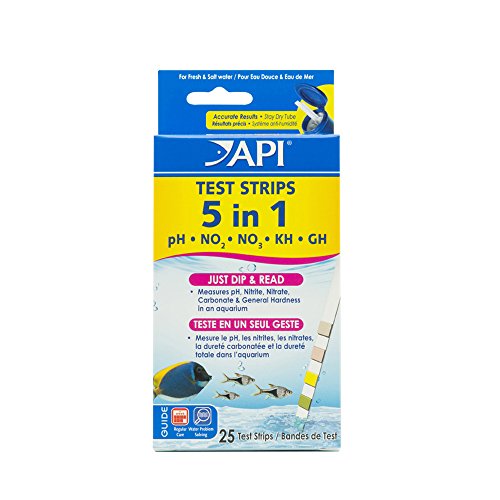
Each strip checks GH, KH, pH, nitrite and nitrate in under a minute. That speed makes it a practical daily-glance option for goldfish tanks, which produce heavier waste loads than a betta bowl.
Pros
- Fast dip-and-read process
- Covers hardness alongside nitrogen cycle checks
- No mixing or measuring required
Cons
- Does not test ammonia directly
- Strip pads fade faster if stored in humid rooms

Tetra EasyStrips 6 in 1 Test Strips
Ammonia joins the usual pH, nitrite, nitrate, GH and KH lineup on this strip, giving small tank owners a full snapshot in one dip. Betta and shrimp keepers who check water weekly find this faster than mixing liquid reagents.
Pros
- Ammonia included unlike most competing strips
- Single dip covers six parameters
- Compact bottle fits a small fishroom shelf
Cons
- Less precise gradient than liquid reagent ammonia tests
- Requires a fresh cap seal to avoid moisture damage

JNW Direct Aquarium Test Strips
This 7 in 1 strip adds chlorine and alkalinity readings to the standard nitrogen and hardness checks. New owners setting up a first bowl or nano tank get a wide baseline reading without buying a liquid kit.
Pros
- Large strip count keeps per-test cost low
- Chlorine check useful for tap water fill-ups
- Wide color chart printed on the bottle
Cons
- Owners report color matching can be subjective in low light
- Not as precise as liquid reagent for ammonia trending
API GH & KH Test Kit
This liquid drop-count kit isolates general and carbonate hardness, both of which shift betta and shrimp health more than most owners expect. It pairs well with a master kit that skips detailed hardness readings.
Pros
- Drop-count method gives precise dGH and dKH values
- Useful for shrimp tanks sensitive to mineral swings
- Small bottle size fits alongside a master kit
Cons
- Only covers hardness, not nitrogen cycle parameters
- Drop counting takes practice to read consistently

Seachem MultiTest Ammonia Alert
Rather than a one-time reading, this sensor sticks inside the tank and shifts color continuously for up to a year. Betta bowl owners without an established filter cycle get an early warning between manual tests.
Pros
- No reagents or strips to restock monthly
- Detects free ammonia specifically, the toxic form
- Simple color scale visible through the glass
Cons
- Does not test nitrite, nitrate, or pH
- Sensor needs replacing after roughly a year

Salifert Reef Test Kits
Titration-based kits target calcium, alkalinity, magnesium and phosphate, the parameters that matter for nano reef setups housing small saltwater invertebrates. Titration gives finer resolution than color-matched strips.
Pros
- Titration method gives finer precision than color charts
- Trusted by reef keepers for small invertebrate tanks
- Separate kits let buyers test only what they need
Cons
- Not designed for freshwater ammonia or nitrite
- Each parameter sold as a separate kit, raising total cost
How they stack up
| # | Model | Test type | Best for | Score | Price |
|---|---|---|---|---|---|
| 1 | API Freshwater Master Test Kit | Liquid reagent | Best overall | 9.4 | Check price |
| 2 | API 5 in 1 Test Strips | Dip strip | Best value | 9.1 | Check price |
| 3 | Tetra EasyStrips 6 in 1 Test Strips | Dip strip | Best test strips (fast) | 8.9 | Check price |
| 4 | JNW Direct Aquarium Test Strips | Dip strip | Best budget | 8.6 | Check price |
| 5 | API GH & KH Test Kit | Liquid reagent, drop count | Best for hardness (GH/KH) | 8.4 | Check price |
| 6 | Seachem MultiTest Ammonia Alert | Continuous gas-sensing badge | Best for ammonia monitoring | 8.2 | Check price |
| 7 | Salifert Reef Test Kits | Liquid reagent, titration | Best for reef or saltwater nano tanks | 8.0 | Check price |
What to look for
What to look for in a water test kit Match the kit to your tank type first. Freshwater bowls and tanks need ammonia, nitrite, nitrate and pH coverage at minimum. Saltwater nano tanks add calcium, alkalinity and magnesium to that list. Check how many tests come per kit, since a bottle of reagent often outlasts a box of strips by a wide margin.
Test strips vs liquid reagent kits Strips trade some precision for speed, delivering a result in about a minute with no mixing. Liquid reagent kits take longer but resolve finer gradients, which matters when ammonia sits just above a safe threshold. Owners running multiple small tanks often keep both: strips for weekly checks, liquid kits to confirm a borderline reading.
Testing small bowls, betta tanks, and goldfish setups A betta bowl with no filter builds ammonia faster than a filtered 10 gallon tank, so daily or every-other-day checks make sense early on. Goldfish produce more waste per inch of body than most fish, pushing nitrate up quickly in small enclosures. A continuous ammonia sensor like Seachem’s badge helps catch spikes between manual tests in these unfiltered or lightly filtered setups.
Reef and shrimp tanks need different parameters Shrimp are sensitive to copper and mineral swings, so a dedicated GH and KH kit matters more than it does for goldfish. Nano reef tanks housing small saltwater invertebrates need calcium, alkalinity and magnesium tracking that freshwater kits do not cover. Skip a standard freshwater master kit for these setups and choose a titration-based reef kit instead.
Questions worth asking
How often should I test aquarium water for a small pet tank?
New or unfiltered setups like betta bowls benefit from testing every two to three days during the first month. Established, cycled tanks can shift to weekly checks once ammonia and nitrite consistently read zero.
Test strips vs liquid test kit, which is more accurate?
Liquid reagent kits generally resolve finer gradients, especially for ammonia and nitrite near dangerous thresholds. Strips are faster and adequate for routine monitoring once a tank is stable.
What water parameters matter most for a betta fish?
Ammonia and nitrite matter most since bettas are often kept in smaller, lightly filtered volumes. pH stability also matters more than hitting an exact number, since swings stress bettas faster than a slightly off baseline.
Can I use a freshwater test kit for a saltwater shrimp tank?
A freshwater kit will read pH and ammonia fine, but it will not measure calcium, alkalinity, or magnesium that reef invertebrates need tracked. Use a dedicated reef test kit like Salifert for saltwater nano setups.
Is the API Freshwater Master Test Kit worth it for one small tank?
For a single bowl, the roughly 800 tests included last years, more capacity than most single-tank owners need. It still makes sense if accuracy on ammonia and nitrite matters more than speed.
How do I know if my tank is fully cycled?
A cycled tank reads zero ammonia and zero nitrite, with nitrate present and rising slowly between water changes. Testing twice weekly during setup shows this pattern emerging over several weeks.
Do goldfish need different water testing than betta fish?
Goldfish produce more waste, so nitrate and ammonia climb faster in an equivalent tank size. Testing frequency should stay higher for goldfish bowls than for a lightly stocked betta tank of the same volume.
What is the difference between GH and KH in aquarium testing?
GH measures general hardness from calcium and magnesium dissolved in the water, affecting how fish and shrimp regulate minerals. KH measures carbonate hardness, which buffers pH swings and keeps readings stable between water changes.
How long does a bottle of liquid reagent last compared to a box of strips?
API’s Freshwater Master Kit ships with roughly 800 tests, which can last a single tank owner for years. A 25-strip box like Tetra’s EasyStrips runs out within a few months of weekly checks.
Do shrimp need a different water test kit than fish?
Shrimp react more strongly to copper and mineral swings than most fish, so a dedicated GH and KH kit matters more. A standard freshwater master kit still covers the ammonia and pH readings shrimp keepers also need.
Final word
The API Freshwater Master Test Kit remains the strongest choice for anyone keeping bettas, goldfish, or shrimp in freshwater setups, since its liquid reagent accuracy covers the four parameters that matter most day to day. Owners who want a faster weekly check should pick Tetra EasyStrips instead, and reef or nano saltwater keepers should skip freshwater kits entirely in favor of Salifert’s titration-based tests.