Water Timers That Keep a Garden Alive on Holiday
The Orbit B-hyve Hose Faucet Timer is our overall pick because weather based skipping prevents watering in the rain. The Melnor AquaTimer 4-Zone handles separate beds independently, and the Orbit Single-Dial timer covers a single hose for very little.
If you want a hose faucet timer that actually adapts to the weather rather than watering through a downpour, the Orbit B-hyve Hose Faucet Timer is the one to buy, with the Melnor AquaTimer 4-Zone the better choice when different beds need different schedules and the Orbit Single-Dial timer the sensible pick for one hose and one job.
Water timers are harder to judge than they look because the specification that matters is how the unit behaves when the battery dies or the signal drops, and no box mentions that. We compared outlet counts, scheduling flexibility, valve types, battery arrangements and what owners report about long term reliability, then ranked the seven below.
The top picks, ranked

Orbit B-hyve Smart Hose Faucet Timer
A connected faucet timer that pairs to a phone over Bluetooth and, with the optional hub, to a home network, so schedules adjust automatically based on local weather data and skip watering when rain is forecast. That single feature saves more water than any nozzle upgrade. Owners report the app is genuinely usable, and that the hub is worth adding if the tap is far from the house.
Pros
- Automatically skips watering when rain is forecast
- Full schedule control from a phone
- Manual override on the unit itself
Cons
- Remote control away from home needs the separate hub
- More to go wrong than a mechanical timer

Melnor AquaTimer 4-Zone Digital Water Timer
A four outlet digital timer where each outlet runs its own independent schedule, so a vegetable bed, a container group, a lawn sprinkler and a soaker hose can all run at different times from one tap. Independent zones are the practical difference between watering correctly and compromising. Owners report the single controller handling four schedules is far tidier than stacking multiple timers on a splitter.
Pros
- Four genuinely independent schedules
- Removes the need for splitters and multiple timers
- Manual watering without disturbing the programme
Cons
- Bulky and heavy on the tap when connected
- No weather awareness of any kind

RAINPOINT Smart Water Timer with WiFi Hub
A connected timer supplied with the Wi-Fi hub rather than as a separate purchase, so remote control and rain delay work from the outset. It supports multiple timers on one hub, which suits a garden with taps at both ends. Owners report the hub placement matters, since the signal has to reach a metal tap on an outside wall.
Pros
- Hub included rather than sold separately
- One hub covers several timers around a garden
- Watering history in the app
Cons
- Signal range to outdoor taps needs planning
- App reliability depends on the manufacturer’s service
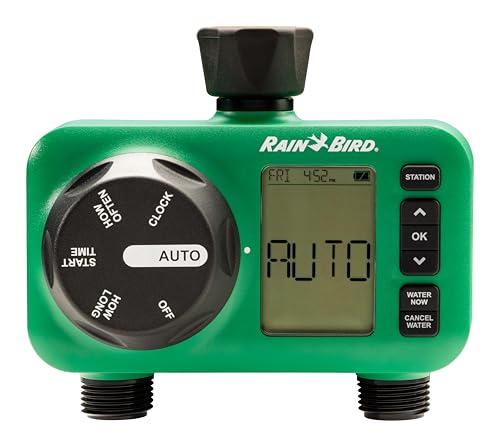
Rain Bird Electronic Hose End Timer
A straightforward digital hose end timer from an established irrigation manufacturer, with an on unit display and no app, hub or account involved. For many gardens that is exactly right, since the schedule rarely changes once set. Owners report it as the timer to choose when you want irrigation grade hardware without connectivity to maintain.
Pros
- No app, account or hub required
- Established irrigation manufacturer
- Simple to programme and forget
Cons
- No weather awareness or remote control
- Single outlet only

Orbit Single-Dial Hose Faucet Timer
A single dial timer that reduces programming to choosing a frequency and a duration, which is all many gardens actually need. There is no display to fail and no app to update. Owners report it as the timer to buy for a single soaker hose or a container group where you want reliable repetition rather than flexibility.
Pros
- Almost impossible to programme incorrectly
- Low cost for a whole set of taps
- No app or connectivity to maintain
Cons
- Very limited scheduling options
- No manual override on some versions

Raindrip Analog Water Timer
A purely mechanical wind up timer that opens the valve for a set duration and closes it as the dial returns to zero, with no batteries and no electronics involved. It cannot run an unattended schedule, but it also cannot fail open because a battery died. Owners report using it as a safety measure when hand watering, since it stops the tap if you get distracted.
Pros
- No batteries or electronics to fail
- Cannot leave the tap running indefinitely
- Very simple and long lasting
Cons
- Cannot run an unattended repeating schedule
- Must be wound each time it is used

Nelson Dual Outlet Electronic Water Timer
A two outlet digital timer that covers the common case of a garden needing two different schedules, such as a lawn sprinkler and a drip line, without stepping up to a four zone unit. The controls are physical buttons rather than an app. Owners report it as a good middle option when one outlet is not enough and four is more than needed.
Pros
- Two independent zones without extra hardware
- Simple button programming
- Compact compared with four zone units
Cons
- No weather awareness
- Display can be hard to read in bright sunlight
How to pick the right one
Count your zones before anything else A single outlet timer forces every plant on that tap onto the same schedule, which is wrong the moment you have both a lawn sprinkler and a drip line for containers. Containers need short frequent watering, established beds need long infrequent soaks, and a lawn sits somewhere between. Two or four outlet timers let each of those run properly from one tap. Work out how many genuinely different schedules your garden needs, then buy a timer with at least that many outlets rather than stacking timers on a splitter.
Weather awareness is the feature that pays for itself The most common failure of any irrigation schedule is that it waters regardless of what the sky is doing. A connected timer that checks local forecast data and skips a cycle after rain saves water, saves money and prevents the root problems that come from waterlogged soil. If you do not want a connected device, the low technology equivalent is a rain sensor that interrupts the cycle, or simply the discipline of adjusting the schedule seasonally rather than setting it once in spring.
Know how the timer behaves when the battery dies This is the specification nobody publishes and everyone eventually discovers. Most battery powered timers use a latching solenoid valve that stays in its current position when power is lost, so a dead battery mid cycle can leave the valve open. Change the batteries at the start of every season regardless of the indicator, use good quality alkaline cells rather than the cheapest available, and check the unit after a cold snap. If you are away for a long period, a manual shut off valve upstream of the timer is cheap insurance.
Protect it from freezing and from the sun Water timers are the most commonly frost damaged item in a garden, because water trapped in the valve body expands and cracks the housing. Disconnect, drain and store the timer indoors before the first frost every year, without exception. In summer, direct sun degrades the plastic housing and makes displays hard to read, so a timer in a shaded position or with a simple cover lasts noticeably longer. Fit a filter washer at the tap if your water carries any grit, since a small particle lodged in the valve seat causes the slow leak that people mistake for a failed timer.
How they compare
| # | Model | Outlets | Best for | Score | Price |
|---|---|---|---|---|---|
| 1 | Orbit B-hyve Smart Hose Faucet Timer | Single outlet, dual outlet version available | Best overall | 9.4 | Check price |
| 2 | Melnor AquaTimer 4-Zone Digital Water Timer | Four independently programmed | Best for multiple zones | 9.2 | Check price |
| 3 | RAINPOINT Smart Water Timer with WiFi Hub | Single or dual depending on model | Best value smart timer | 9.0 | Check price |
| 4 | Rain Bird Electronic Hose End Timer | Single outlet | Best simple digital | 8.8 | Check price |
| 5 | Orbit Single-Dial Hose Faucet Timer | Single outlet | Best budget | 8.6 | Check price |
| 6 | Raindrip Analog Water Timer | Mechanical wind up timer | Best without batteries | 8.3 | Check price |
| 7 | Nelson Dual Outlet Electronic Water Timer | Two independently programmed | Best dual outlet | 8.0 | Check price |
Good to know
Will a water timer work without water pressure?
Most hose faucet timers need a minimum pressure to open and close the valve reliably, typically a few pounds per square inch, and some need more. Gravity fed systems from a water butt usually do not provide enough pressure for a standard timer, so look for a model specifically rated for low pressure or gravity feed if that is your source.
What happens if the battery runs out mid cycle?
It depends on the valve design. Many timers use a latching solenoid that holds its current position without power, which means a battery failure during a cycle can leave the water running. This is why changing batteries at the start of each season matters, and why a manual shut off valve upstream is worth fitting if you travel.
Can I connect several timers to one tap?
Yes, using a splitter, and many people do. The drawbacks are weight hanging off the tap connection and the pressure drop when two zones run at once. A multi outlet timer is tidier, lighter on the fitting and usually staggers zones automatically so they do not compete for pressure.
Do I need to bring the timer inside for winter?
Yes. Water left in the valve body freezes and expands, cracking the housing. Disconnect it before the first frost, drain it fully, remove the batteries and store it somewhere dry. This is the single biggest factor in whether a timer lasts one season or many.
Are smart water timers worth it?
If your garden is watered on a schedule you rarely think about, yes, mainly because weather based skipping prevents watering during and after rain. If you are home most days and adjust watering by eye, a simple digital timer does the job without an app to maintain. Consider also that a connected device depends on the manufacturer keeping its service running.
How long should I run each watering cycle?
Longer and less often is generally better for beds and lawns, because it encourages roots to grow downward rather than staying near the surface. Containers are the exception and need shorter, more frequent watering because they dry out quickly. Check the soil a few inches down rather than judging from the surface, and adjust with the season.
Why is my timer leaking or dripping?
Usually a grit particle on the valve seat or a perished washer. Disconnect, check and clean the filter washer at the inlet, and inspect the rubber seals. Overtightening a hose connector also distorts the washer and causes drips. If the housing itself is cracked, that is almost always previous frost damage and the unit needs replacing.
Can I use a water timer with a drip irrigation system?
Yes, and it is the ideal pairing, since drip systems need frequent short runs that nobody wants to do manually. Check the pressure requirements of your drip components, as many need a pressure regulator between the timer and the drip line. Add a filter as well, since drip emitters block easily.
Our take
The Orbit B-hyve Hose Faucet Timer is the buy for most gardens because skipping a cycle when rain is forecast is worth more than any other feature in the category. If your garden needs several genuinely different schedules, the Melnor AquaTimer 4-Zone handles that better than any single outlet unit, and whichever you choose, bring it indoors before the first frost.


