How to Choose a Welding Fume Extractor for Your Shop
Lincoln Electric’s Miniflex handles single-operator MIG and stick work with a flexible capture arm, making it the top pick for most shops. KEMPER’s SmartFil MICRO suits tight benchtop setups that need self-cleaning filtration. VEVOR’s Portable Welding Fume Extractor delivers solid CFM for hobbyists without the cost of European brands.
Fine metal particulate from welding drifts into lungs long before it becomes visible smoke. Portable arm-style units like the Lincoln Electric Miniflex clear a single station, while benchtop systems such as the Miller FILTAIR SWX 2000 pull fume through a fixed table.
CFM ratings, filter media, and duty cycle all shift with the welding process, since aluminum TIG throws different particulate than flux-core stick. We compared listed airflow specs, hose reach, filter replacement needs, and owner feedback on noise and filter life across seven current listings.
Our top picks

Lincoln Electric Miniflex Portable Fume Extractor
A 2 hp motor pairs with a self-cleaning cartridge filter rated for continuous MIG and stick fume capture. A 10-foot articulating arm with a 6-inch hood reaches most fixed stations without moving the base unit. Owners report the pulse-clean cycle keeps suction steady through full shifts.
Pros
- Pulse-clean cartridge extends filter life
- Casters make it easy to roll between stations
- Handles continuous MIG and stick duty cycles
Cons
- Weighs more than lighter benchtop units
- Cartridge replacement adds an ongoing cost

KEMPER SmartFil MICRO Welding Fume Extractor
SmartFil MICRO tucks under a standard workbench and uses a self-cleaning cartridge that pulses clean without opening the housing. An 8-foot extraction arm suits single-operator TIG and light MIG work in shops under 1,500 square feet. Its compact footprint leaves floor space clear around the welding table.
Pros
- Small enough for tight benchtop setups
- Self-cleaning filter cuts down on manual maintenance
- Quiet enough for shared shop spaces
Cons
- Lower CFM than full-size mobile units
- Not rated for heavy multi-shift production welding
Miller FILTAIR SWX 2000 Extraction Table
FILTAIR SWX 2000 pulls fume down through a perforated table surface rather than relying on an overhead arm. A 2000 CFM blower and pleated filter cartridge suit stationary MIG and stick work on parts up to table size. Owners note it keeps smoke off the ceiling in shops without existing ventilation ductwork.
Pros
- High CFM handles heavier stick and MIG smoke loads
- No overhead arm needs repositioning between passes
- Table surface doubles as a fixed work platform
Cons
- Cannot move between welding stations
- Needs more floor space than arm-style units

Sentry Air Systems SS-200 Portable Fume Extractor
SS-200 runs a HEPA filter stage rated to 99.97% at 0.3 micron, suited to fine TIG fume on stainless and aluminum. A flexible extraction arm with a 4-inch hood sits close to the work without blocking the torch angle. Casters let the unit move between benches.
Pros
- HEPA stage suits fine stainless and aluminum fume
- Low-profile hood stays clear of the torch
- Moves easily between benches on casters
Cons
- Smaller hood needs closer positioning than larger arms
- HEPA filters cost more to replace than pleated media

VEVOR Portable Welding Fume Extractor
VEVOR’s portable unit runs a 550 watt motor through a two-stage filter combining a pre-filter and activated carbon layer. A 6.5-foot hose and adjustable hood cover single-station MIG or light stick welding. It targets hobbyists and small fabrication shops rather than continuous production runs.
Pros
- Costs less than commercial-grade extractors
- Activated carbon layer helps with light odor control
- Compact enough for home and hobby shops
Cons
- Duty cycle is not rated for continuous production welding
- Filter capacity runs smaller than commercial cartridge units
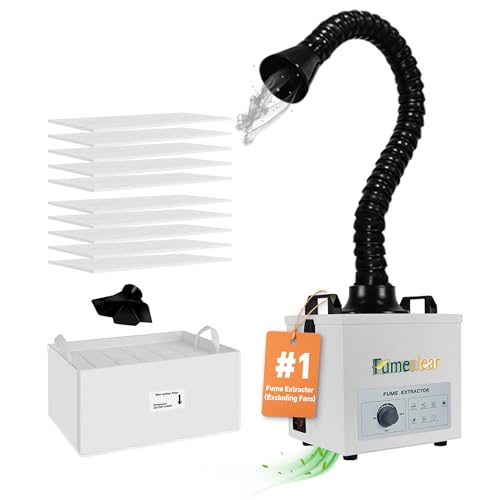
Weldclass ProFume 5000 Fume Extractor
ProFume 5000 delivers a rated 1000 CFM through a three-stage filter with a washable pre-filter ahead of the main cartridge. A 3-meter extraction arm covers most single-bay welding setups without extending the base unit. The washable pre-filter stage cuts how often the main cartridge needs replacing.
Pros
- Washable pre-filter extends main cartridge life
- Delivers solid CFM for the price point
- Arm length covers most single-bay setups
Cons
- Availability varies more than major US brands
- Replacement filter stock can take longer to source

Lincoln Electric Mobiflex 200-M Mobile Fume Extractor
Mobiflex 200-M mounts on a wheeled base built to move between multiple welding bays in a single shift. A 2 hp motor and cartridge filter support MIG and stick work, with an optional extended arm kit for taller stations. Owners use it as a shared unit across several part-time welding cells.
Pros
- Wheeled base built for moving between bays
- Cartridge filter is cleanable rather than disposable only
- Extended arm option reaches taller fixed stations
Cons
- Sharing between stations means downtime during moves
- Base unit alone has a shorter reach without the extension
Compared at a glance
| # | Model | Airflow | Best for | Score | Price |
|---|---|---|---|---|---|
| 1 | Lincoln Electric Miniflex Portable Fume Extractor | 800 CFM at hood | Best overall | 9.4 | Check price |
| 2 | KEMPER SmartFil MICRO Welding Fume Extractor | Fits under standard workbench | Best for small shop or benchtop use | 9.2 | Check price |
| 3 | Miller FILTAIR SWX 2000 Extraction Table | 2000 CFM blower | Best for fixed downdraft workstations | 8.9 | Check price |
| 4 | Sentry Air Systems SS-200 Portable Fume Extractor | HEPA, 99.97% at 0.3 micron | Best for TIG and precision welding | 8.7 | Check price |
| 5 | VEVOR Portable Welding Fume Extractor | 550 W | Best budget | 8.5 | Check price |
| 6 | Weldclass ProFume 5000 Fume Extractor | 1000 CFM rated | Best value | 8.2 | Check price |
| 7 | Lincoln Electric Mobiflex 200-M Mobile Fume Extractor | 2 hp | Best for mobile or multi-station shops | 8.0 | Check price |
What to look for
Should a welding fume extractor be portable or fixed? Arm-style extractors, like the Lincoln Electric Miniflex, roll to whichever bay needs fume capture that day. A flexible hood positions near the arc without changing the whole shop layout. Benchtop and downdraft systems, such as the Miller FILTAIR SWX 2000, stay in one spot and pull smoke through a fixed table. Shops running one welder across multiple stations usually do better with a mobile arm. Dedicated fabrication cells suit a fixed table instead.
How much CFM airflow does a welding fume extractor need? Light TIG work on thin stainless can get by on 300 to 500 CFM, the range covered by the KEMPER SmartFil MICRO. Continuous MIG or stick welding on thicker steel produces more particulate and calls for 800 CFM or higher. Both the Miniflex and the FILTAIR SWX 2000 sit in that higher range. Undersized airflow lets visible smoke drift past the hood before it gets captured.
HEPA vs activated carbon: which filter suits metal fume particulate? HEPA media, used in the Sentry Air Systems SS-200, rates 99.97% capture at 0.3 micron and suits fine stainless or aluminum TIG fume. Activated carbon layers, found in the VEVOR unit, add odor control but capture fewer sub-micron particles on their own. Cartridge and pleated filters, as in the Weldclass ProFume 5000, land between the two on cost and replacement frequency.
How do you match capture arm reach to your welding process? A short 4 to 6 inch hood needs to sit within about a foot of the arc, which works for seated TIG work using the SS-200’s 6.5-foot arm. Longer 10-foot arms, like the Miniflex or the optional Mobiflex 200-M extension, reach across taller fixtures or overhead welds without repositioning the base. Narrow aisles call for measuring clearance before choosing a unit with a wide-swing arm.
Good to know
What does a welding fume extractor actually remove?
It captures airborne metal particulate and gases from the arc, including manganese, chromium and hexavalent chromium compounds, before they spread through the shop. Filters trap the solid particulate while some units add activated carbon for gas and odor control.
How much CFM do you need for a weld smoke extractor?
Light single-station TIG work is often covered by 300 to 500 CFM. Continuous MIG or stick welding on thicker material needs 800 CFM or more to keep pace with the fume volume.
Can a fume extractor replace a respirator?
No, source capture reduces ambient particulate but does not guarantee zero exposure at the arc itself. Many shops still require a respirator for processes with high fume generation or poor ventilation.
Is HEPA or activated carbon better for welding smoke?
HEPA filters capture more of the sub-micron solid particulate that makes up most weld fume. Activated carbon suits odor and light gas control better and is often paired with a pre-filter rather than used alone.
Is a portable welding fume extractor loud?
Most portable units run between 65 and 75 dB at a few feet, similar to a shop vacuum. Fixed downdraft tables with larger blowers can run louder depending on duct configuration.
What is the best fume extractor for TIG welding?
The Sentry Air Systems SS-200 uses a HEPA filter stage suited to fine TIG fume on stainless and aluminum, with a low-profile hood that stays clear of the torch angle.
Can one fume extractor cover multiple welding stations?
Mobile units like the Lincoln Electric Mobiflex 200-M move between bays on a wheeled base, but only one station gets active capture at a time. Shops running simultaneous welding at several stations typically need one unit per bay or a ducted central system.
How often do fume extractor filters need replacing?
Self-cleaning cartridge filters, like those in the Miniflex and SmartFil MICRO, can run for months between full replacements thanks to pulse cleaning. Standard pleated or carbon filters typically need checking every few weeks depending on welding volume.
Does a benchtop fume extractor work for MIG welding?
Compact units like the KEMPER SmartFil MICRO handle light MIG work well but are rated for lower CFM than full-size mobile units. Heavier or continuous MIG production usually calls for an 800 CFM unit like the Miniflex instead.
Final word
Lincoln Electric’s Miniflex covers the widest range of shop setups with steady CFM and a self-cleaning filter. Buyers on a tighter budget still get usable capture from the VEVOR unit. Miller’s FILTAIR SWX 2000 suits shops that can dedicate floor space to a fixed downdraft table.


