Choosing Welding Gloves for TIG, MIG and Stick Work
Based on specifications and owner feedback, Rapicca’s 16-inch Leather Forge gloves lead for general shop use, Black Stallion’s GX1002 Ironhand suits TIG welders who need rod feel, and Lincoln Electric’s K2979-ALL handles MIG and stick welding with a longer protective cuff.
Leather type, cuff length and process fit separate one welding glove from another. Rapicca’s 16-inch Leather Forge gloves balance heat protection and comfort for general MIG and stick work. TIG welders often reach for the thinner Black Stallion GX1002 instead, since it preserves rod feel.
Picking the right pair gets tricky because TIG, MIG and stick welding stress gloves in different ways. We compared published specifications, cuff lengths and owner feedback across seven current Amazon listings to match gloves to real welding tasks.
How to choose
What Should You Look for in Welding Gloves? Most welding gloves use cowhide, deerskin or goatskin, and each trades heat resistance for dexterity. Cuff length ranges from 4 inches for TIG work to 16 inches for heavy MIG and stick jobs. Cotton or kevlar lining affects comfort and how seams hold up near spatter. Stitching thread matters too, since kevlar resists burn-through longer than cotton.
Do TIG, MIG and Stick Welding Need Different Gloves? TIG welding rewards thin goatskin gloves like the Black Stallion GX1002 for better rod feel. MIG and stick welding push more heat and spatter, favoring thicker cowhide gauntlets such as the Lincoln Electric K2979-ALL. Higher amperage stick work often calls for a reinforced thumb, as seen on the Tillman 1350A. Matching thickness to process keeps dexterity and protection balanced.
How Long Should the Cuff Be for Heavy Spark Protection? Gauntlet cuffs from 14 to 16 inches, like the Rapicca and Miller Arc Armor Elite, block slag during overhead or foundry style work. Shorter 4 to 5 inch cuffs suit bench work where wrist mobility matters more than forearm coverage. Foam or kevlar lining under the cuff adds a second heat barrier. Position at the workbench, not just process, should guide cuff length.
Which Leather Offers the Best Dexterity for Detail Work? Deerskin, used on the Caiman 1878-5 and Hobart 770714, stays soft without a break-in period and suits detail passes. Cowhide costs less to replace but stiffens until broken in. Goatskin splits the difference, offering some heat resistance with a thinner profile. Owners report deerskin fits snugger, which helps with small parts and tight joints.
What we recommend
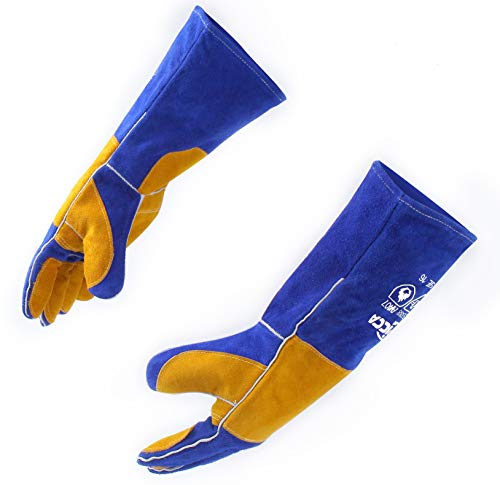
Rapicca Leather Forge Welding Gloves, 16 Inch
A 16-inch gauntlet on the Rapicca gloves covers the forearm during MIG and stick welding. Foam padding cushions the palm through long shifts. Kevlar stitching resists scorching better than plain cotton thread.
Pros
- Long 16-inch cuff shields the forearm from spatter
- Foam padded palm eases fatigue on extended welds
- Kevlar stitched seams hold up under sustained heat
Cons
- Thick cowhide limits fine finger movement
- Sizing runs large according to owner feedback

Black Stallion GX1002 Ironhand TIG Welding Gloves
Thin goatskin on the GX1002 lets welders feel the torch and filler rod. A kevlar lined palm adds heat resistance without extra bulk. Its short 4-inch cuff suits close TIG work over full gauntlet coverage.
Pros
- Thin goatskin preserves finger dexterity for TIG passes
- Kevlar lined palm resists heat without added bulk
- Short cuff avoids snagging equipment during precision work
Cons
- Short cuff leaves the forearm exposed to spatter
- Not built for heavy MIG or stick amperage work
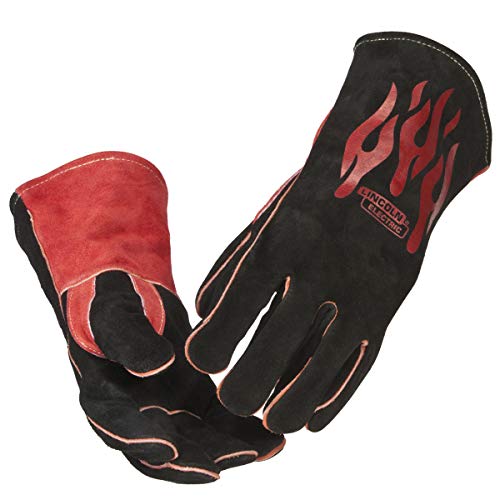
Lincoln Electric K2979-ALL Traditional MIG/Stick Welding Gloves
Straight thumb construction on the K2979-ALL suits MIG and stick amperage work. Cotton fleece lining absorbs sweat during long shop shifts. A 5-inch cuff blocks slag while still allowing wrist motion.
Pros
- Cotton fleece lining stays comfortable through long shifts
- 5-inch cuff blocks slag while keeping the wrist mobile
- Backed by a wide parts and support network
Cons
- One size fits most limits fit for smaller hands
- Leather stiffens somewhat after repeated moisture exposure

Tillman 1350A Top Grain Cowhide Welding Gloves
Top grain cowhide and a wing thumb give the 1350A extra grip on rod and clamp. Foam lining on the back of the hand cushions against sparks. A 14-inch cuff suits stick welding at higher amperage.
Pros
- Wing thumb design improves grip on rods and clamps
- Foam lined back of hand cushions spark impact
- 14-inch cuff handles higher amperage stick welding
Cons
- Bulkier build reduces feel for detail work
- Leather needs a break-in period before it softens

Miller Electric Arc Armor Elite Gauntlet Welding Gloves
Foam insulation on the Arc Armor Elite manages foundry style heat exposure. A deerskin palm keeps grip supple despite the thicker shell. Its extended cuff protects past the wrist during overhead welding.
Pros
- Foam insulated lining manages sustained high heat
- Deerskin palm keeps grip supple despite the thick shell
- Extended gauntlet protects the wrist during overhead passes
Cons
- Higher bulk than standard gauntlet gloves
- Size range runs narrower than other models here

Caiman 1878-5 Deerskin MIG Welding Gloves
American deerskin gives the 1878-5 a soft feel with little break-in needed. Foam padding on the back of the hand absorbs minor impacts. Its 4.5-inch cuff suits MIG work where mobility matters more than coverage.
Pros
- Soft deerskin needs little to no break-in period
- Foam padded back absorbs incidental bumps and impacts
- Reinforced wing thumb extends grip durability
Cons
- Shorter cuff offers less forearm coverage than gauntlet styles
- Deerskin shows wear faster under abrasive grinding work

Hobart 770714 Premium Deerskin Welding Gloves
Deerskin leather keeps the 770714 at an accessible entry point for hobbyist welders. Cotton lining wicks moisture during garage projects. Straight thumb construction keeps the pattern simple and easy to replace.
Pros
- Accessible entry point for hobbyist and occasional welders
- Cotton lining wicks moisture during shop use
- Straight thumb pattern simplifies replacement sourcing
Cons
- Thinner deerskin offers less heat barrier than cowhide
- Cuff length falls short for heavy overhead welding
Compared at a glance
| # | Model | Material | Best for | Score | Price |
|---|---|---|---|---|---|
| 1 | Rapicca Leather Forge Welding Gloves, 16 Inch | Split cowhide leather | Best overall | 9.4 | Check price |
| 2 | Black Stallion GX1002 Ironhand TIG Welding Gloves | Grain goatskin leather | Best for TIG welding | 9.2 | Check price |
| 3 | Lincoln Electric K2979-ALL Traditional MIG/Stick Welding Gloves | Cowhide leather | Best for MIG and stick welding | 9.0 | Check price |
| 4 | Tillman 1350A Top Grain Cowhide Welding Gloves | Top grain cowhide | Best for heavy spark protection | 8.8 | Check price |
| 5 | Miller Electric Arc Armor Elite Gauntlet Welding Gloves | Top grain deerskin palm | Best for high-heat foundry work | 8.6 | Check price |
| 6 | Caiman 1878-5 Deerskin MIG Welding Gloves | American deerskin palm | Best for dexterity and comfort | 8.3 | Check price |
| 7 | Hobart 770714 Premium Deerskin Welding Gloves | Deerskin leather | Best value for occasional welders | 8.0 | Check price |
Good to know
What material makes the best welding gloves?
Cowhide handles the most heat and abrasion, deerskin offers the most dexterity, and goatskin sits between the two. Most welders match material to process rather than picking one material for every job.
Are TIG welding gloves different from MIG gloves?
Yes. TIG gloves like the Black Stallion GX1002 stay thin for rod control, while MIG and stick gloves such as the Lincoln Electric K2979-ALL run thicker with longer cuffs for spatter protection.
How long should a welding glove cuff be?
Cuff length should match welding position. Bench and TIG work suit 4 to 5 inch cuffs, while overhead MIG or stick welding benefits from 14 to 16 inch gauntlets like the Rapicca or Tillman 1350A.
What is the best welding glove for beginners?
The Hobart 770714 offers deerskin leather and straight thumb construction at an accessible entry point, making it a common pick for hobbyist and occasional welders.
Do welding gloves need a kevlar lining?
Kevlar lining adds heat resistance without much added bulk, which is why gloves like the Black Stallion GX1002 use it on the palm. Cotton lining costs less but offers less sustained heat protection.
Which gloves work best for high amperage stick welding?
Thicker cowhide gauntlets with reinforced thumbs, such as the Tillman 1350A, hold up better under high amperage stick welding than thin TIG style gloves.
Cowhide vs deerskin welding gloves: which lasts longer?
Cowhide resists abrasion and grinding wear better over time. Deerskin feels softer immediately but shows wear faster under heavy grinding, according to owner feedback on gloves like the Caiman 1878-5.
Can one pair of gloves handle TIG, MIG and stick welding?
A mid-weight glove can cover light MIG and occasional TIG work, but dedicated gloves perform better at their specific process. Welders who switch often keep a thin TIG pair and a thicker gauntlet pair on hand.
Why do some welding gloves have foam padding?
Foam padding on the palm or back of the hand cushions against sparks and reduces fatigue during long shifts, as seen on the Rapicca and Tillman 1350A.
Is goatskin good for welding gloves?
Goatskin, used on the Black Stallion GX1002, offers a thinner profile than cowhide while still resisting moderate heat, which suits TIG work over heavy stick welding.
The bottom line
Process and position decide the right pick more than any single spec. The Rapicca gauntlet suits general MIG and stick shop use, the Black Stallion GX1002 fits TIG work that needs dexterity, and the Hobart 770714 covers occasional hobbyist welding on a tight budget.


