Which Welding Magnet Actually Holds an Angle Steady
Strong Hand Tools MagTAB MTS41 leads with a switchable magnet that releases without prying. Multi-angle jobs suit the Strong Hand Tools MC44S better, since it offers four preset angles. Budget shoppers should look at the HFS On Off Switchable Welding Magnet for basic tacking work.
An arc starts, and a weak magnet shifts instantly, leaving the joint crooked. Strong Hand Tools addresses that with a switchable magnet rated to hold steel plate through vibration.
Switch type and angle range separate a dependable welding magnet from a frustrating one. We compared rated holding force, preset angle counts and owner reports on magnets that weaken or fail to release cleanly.
How to pick the right one
What to look for in a welding magnet Holding force, angle range and switch type drive most buying decisions. Holding force needs to match the gauge of steel you actually weld. Angle range decides how many joint types one magnet can handle. A switch adds convenience but also another part that can wear out over years of shop use.
Fixed angle vs multi-angle magnets A fixed 90 degree magnet handles most bracket and frame corners on its own. Multi-angle magnets add 45 and 135 degree settings for miters and braces. Varied fabrication work benefits more from multi-angle tools. Repetitive square-corner jobs rarely need the extra settings at all.
Best magnets for pipe, tube and round stock Flat magnetic squares slide off curved surfaces instead of gripping them. Notched designs like the Strong Hand Tools MPS44 seat directly against pipe and round tube. Handrail, gate and roll cage work benefits most from this notched style over a standard flat square.
Switchable vs fixed magnets for daily use A switchable magnet releases with a lever instead of a firm pull, saving time across many small tacks. Fixed magnets tend to hold slightly stronger since they lack the internal mechanism a switch requires. High volume shops generally prefer the time savings a switch provides.
The top picks, ranked

Strong Hand Tools MagTAB MTS41 Switchable Welding Magnet
Flipping the switch releases the magnet instantly, so removal never means prying at a stuck plate. Full contact with the base steel gives it more holding force than a fixed magnet of similar size. Fabricators reach for it daily on bracket and frame corner tacks.
Pros
- Switch releases without prying
- Strong hold through light vibration
- Compact enough for tight corners
Cons
- Single angle limits versatility
- Switch mechanism adds a moving part to wear

Strong Hand Tools MC44S Multi-Angle Magnetic Clamp
Four preset angles cover most bracket and frame layouts without swapping tools mid-job. A wide base spreads the magnetic field for a steadier hold on thin sheet metal. Flat and round stock both work under the same clamp during general fabrication.
Pros
- Multiple angles cover common joint types
- Wide base steadies thin sheet metal
- Works on both flat and curved stock
Cons
- No switch, so removal takes more effort
- Bulkier than single angle magnets

POWERTEC 71134 Magnetic Welding Squares 4 Pack
Four squares in one box brace a whole frame at once instead of one corner at a time. Each holds a fixed 90 degree angle, covering most shop tack welds. Shops often buy extras just to keep spare pairs on hand for larger assemblies.
Pros
- Four magnets cover a full assembly at once
- Low cost per magnet in the set
- Simple fixed angle needs no adjustment
Cons
- No on off switch for quick release
- Single angle only, no flexibility

Bessey WSM-90 Magnetic Welding Square
Thicker steel plate stays put under this magnet even near a running grinder. Bessey builds it as one rigid unit rather than a hinged design, so the angle never drifts. Shops running heavier stock reach for it over lighter multi-angle tools.
Pros
- Rigid body resists angle drift
- Strong hold on thicker gauge steel
- Durable enough for daily shop use
Cons
- No release switch, needs a firm pull
- Heavier to carry between jobs
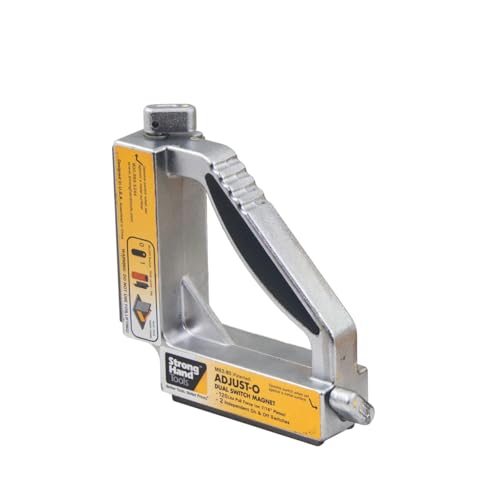
Strong Hand Tools MPS44 Multi-Angle Magnetic Square
Notched edges seat against round tube and pipe instead of sliding off a curved surface. Four angle settings handle flat brackets and round frame joints in the same session. Handrail and gate fabricators rate it above flat-only magnets.
Pros
- Notches grip round pipe and tube
- Multiple angles suit mixed stock types
- Useful for handrail and gate fabrication
Cons
- Notch design adds bulk versus flat squares
- Weaker hold on very thin wall tube
POWERTEC 71114 Triangle Magnetic Welding Square
A smaller triangular footprint reaches corners a full-size square cannot fit into. Light weight makes it easy to reposition several times per joint. Small brackets and detail work suit it better than structural frames.
Pros
- Small size reaches tight corners
- Light enough to reposition quickly
- Affordable for a spare or backup magnet
Cons
- Weaker hold on heavier plate
- Single fixed angle only

HFS On Off Switchable Welding Magnet
A basic on off switch gives budget buyers the same release convenience as pricier magnets. Holding force stays adequate for light sheet metal and small brackets. Many treat it as a starter magnet before upgrading to a heavier duty brand.
Pros
- Switch adds easy release at low cost
- Good starter magnet for light work
- Compact and easy to store
Cons
- Holding force trails premium brands
- Switch feel is less refined than Strong Hand
Compared at a glance
| # | Model | Holding force | Best for | Score | Price |
|---|---|---|---|---|---|
| 1 | Strong Hand Tools MagTAB MTS41 Switchable Welding Magnet | Rated for standard steel plate tacking | Best overall | 9.4 | Check price |
| 2 | Strong Hand Tools MC44S Multi-Angle Magnetic Clamp | Rated for sheet and plate steel | Best for multi-angle work | 9.1 | Check price |
| 3 | POWERTEC 71134 Magnetic Welding Squares 4 Pack | Rated for standard steel plate | Best value | 8.8 | Check price |
| 4 | Bessey WSM-90 Magnetic Welding Square | Rated for heavier gauge steel | Best for heavy fabrication | 8.6 | Check price |
| 5 | Strong Hand Tools MPS44 Multi-Angle Magnetic Square | Rated for pipe and flat stock | Best for pipe and round stock | 8.4 | Check price |
| 6 | POWERTEC 71114 Triangle Magnetic Welding Square | Rated for light gauge steel | Best for small and tight joints | 8.2 | Check price |
| 7 | HFS On Off Switchable Welding Magnet | Rated for light to medium steel | Best budget | 8.0 | Check price |
Frequently asked questions
What is a welding magnet used for?
It holds two pieces of steel at a set angle while you tack weld them together. This frees both hands for the torch or stinger instead of holding the joint yourself. Most shops use them for brackets, frames and box corners.
Can a welding magnet lose its strength from heat?
Prolonged heat near the arc can weaken a magnet over time, especially rare earth types. Keeping the magnet a few inches from the weld puddle extends its life. Replacing a weak magnet costs far less than fixing a joint it let slip.
Are switchable welding magnets worth the extra cost?
Shops doing many repetitive tacks save real time with the lever, so yes. Occasional home shop use may not justify the price gap over a fixed magnet. Holding force differences between the two types stay minor.
What angles do welding magnets commonly offer?
Most squares are fixed at 90 degrees, covering standard box and bracket corners. Multi-angle magnets add 45 and 135 degree settings for miters and angled braces. Adjustable models dial in angles outside those common presets.
Do welding magnets work on stainless steel?
Magnets grip ferromagnetic steel but weaker on some stainless grades, since certain alloys resist magnetism. Standard carbon steel and mild steel hold the strongest. Test the grip on your specific stainless grade before trusting it on a critical joint.
How much holding force does a welding magnet need?
Light sheet metal and small brackets need less force than thick structural plate. Match the magnet’s rated capacity to your heaviest regular material, not your lightest job. Undersized magnets slip exactly when you need them most, mid tack.
Can welding magnets damage a torch or stinger nearby?
A magnetic field can pull a wire feed liner or arc slightly off course when the magnet sits too close to the weld. Keeping a few inches of clearance avoids most arc blow issues. Move the magnet back further if the arc starts wandering.
What is the difference between a welding magnet and a magnetic square?
The terms overlap in most listings, though a magnetic square usually means a fixed angle triangular tool. A welding magnet can describe any magnetic holding device, including switchable and multi-angle designs. Both serve the same core purpose of holding a joint steady.
Fixed angle vs switchable magnet: which suits a home shop better?
Occasional home use rarely justifies the extra cost of a switchable magnet. A fixed 90 degree square like the POWERTEC 71134 covers most home bracket work. Upgrade to a switchable model once tack welding becomes a daily task.
Our take
Daily tacking across mixed jobs points to the Strong Hand Tools MagTAB MTS41, since the switch saves real time. Shops handling pipe and round stock get more use from the Strong Hand Tools MPS44. Starting out on a budget, the HFS On Off Switchable Welding Magnet covers the basics without overspending.