Wheel Chocks That Hold a Trailer Steady on a Slope
MAXXHAUL 70075 solid rubber chocks take the top spot for their weight and grip on both concrete and gravel. The Camco X-Chock is the specialist pick for tandem axle RVs, and Camco Heavy Duty chocks are the practical value choice for lighter vehicles.
For most trailers and vehicles, MAXXHAUL 70075 solid rubber chocks are the ones to buy, with the Camco X-Chock for tandem axle RVs and Camco Heavy Duty chocks when weight and storage space matter more than outright grip.
Wheel chocks look like a commodity, which is exactly why so many people buy the wrong ones: a lightweight plastic chock rated for a small trailer will simply slide across smooth concrete under a loaded RV, and a chock too short for a large tyre acts as a ramp rather than a stop. We compared published material, weight and tyre size ratings alongside consistent owner reports about slipping and cracking, weighting grip on real surfaces and load rating over price.
What we recommend

MAXXHAUL 70075 Solid Rubber Heavy Duty Wheel Chock
Solid rubber is the material that separates a chock that works from one that skates, because the weight keeps it in place and the compound grips concrete rather than sliding on it. These are heavy enough to feel substantial in the hand and have a moulded handle so you are not scrabbling under a bumper to retrieve them. Owners report them holding trailers and vehicles on sloped drives where plastic chocks moved.
Pros
- Weight and compound grip concrete reliably
- Moulded handle makes placement easy
- Ribbed face bites into the tyre tread
Cons
- Heavy to carry as a pair in a boot
- Rubber leaves marks on pale garage floors
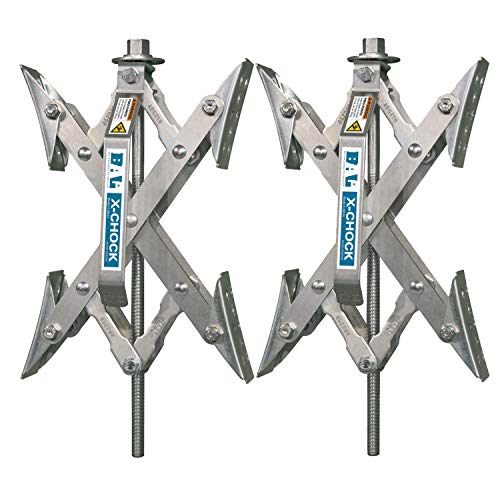
Camco X-Chock Tire Locking Chock
The X-Chock works on a completely different principle, wedging between the two tyres of a tandem axle and expanding with a ratchet to push them apart, which removes the rocking motion that makes an RV feel unstable when you walk around inside it. It does not replace conventional chocks for parking on a slope but solves a problem no ordinary chock addresses. It only fits tandem axles with the right tyre spacing.
Pros
- Removes side to side rocking in an RV
- Ratchet operation is quick and tool light
- Works alongside conventional chocks
Cons
- Only useful on tandem axle trailers
- Needs sufficient clearance between tyres

Camco Heavy Duty Wheel Chock
Camco’s moulded plastic chocks are the ones you see behind most travel trailers, and for lighter loads on level or gently sloped ground they do the job at a fraction of the weight of rubber. They stack for storage and will not scuff a garage floor. The honest limitation is that on smooth wet concrete under a heavy load, plastic can slide where rubber grips.
Pros
- Very light to carry and store
- Stackable design saves space
- Will not mark a garage floor
Cons
- Can slide on smooth wet concrete
- Plastic becomes brittle after years outdoors

Buyers Products RC1815 Rubber Wheel Chock
Buyers Products supplies the commercial truck trade, and this chock reflects that with a large rubber body and the mass needed to hold a loaded vehicle. It is considerably bigger than a typical trailer chock, which is the point when the tyre is tall enough that a small chock simply lifts and rolls over. Storage and lifting are the practical trade offs.
Pros
- Sized correctly for large truck tyres
- Substantial weight resists sliding
- Built for commercial duty cycles
Cons
- Heavy and awkward to store
- Oversized for cars and small trailers

AFA Tooling Wheel Chocks
AFA’s rubber chocks are aimed at home mechanics who need something reliable behind a wheel while working under a jacked vehicle, with a moulded rope handle for retrieval and a compact size that fits in a boot. They grip concrete well and the size suits passenger cars and light trailers. They are a good complement to jack stands rather than a substitute for them.
Pros
- Reliable grip for garage and driveway work
- Rope handle simplifies retrieval
- Compact enough for boot storage
Cons
- Too small for large truck tyres
- Rubber can transfer marks onto flooring

Homeon Wheels Heavy Duty Wheel Chocks
Homeon Wheels offers rubber chocks with reflective strips and carry handles at a price closer to plastic than premium rubber, which makes them an easy upgrade from moulded plastic. The reflective element is genuinely useful when chocking a trailer at the roadside at night. Rubber quality is fair rather than exceptional and they benefit from being stored out of direct sun.
Pros
- Reflective strips aid roadside visibility
- Rubber grip at close to plastic pricing
- Handles make placement straightforward
Cons
- Rubber compound is softer than premium chocks
- Reflective strips wear off with rough use

Fasmov Solid Rubber Wheel Chocks
Fasmov’s compact rubber chocks suit motorcycles, small trailers and passenger cars where a full size chock is overkill and storage space is limited. The solid rubber construction still grips far better than plastic of the same size. They are not the right choice for a caravan or a loaded truck, and the sizing makes that obvious.
Pros
- Compact enough to keep in any vehicle
- Rubber grip in a small footprint
- Sensible price for a pair
Cons
- Undersized for large tyres
- Not suitable for heavy loaded trailers
Before you buy
Size the chock to the tyre, not to the vehicle The rule of thumb used across industry is that a chock should be roughly a quarter of the tyre’s height. Anything shorter and the tyre can climb over it, which turns your chock into a small ramp. Measure the tyre diameter and check the chock’s rating rather than assuming that a chock sold for trailers fits your trailer, since tyre sizes vary enormously between a small utility trailer and a loaded fifth wheel.
Rubber, plastic and where each one fails Solid rubber chocks are heavy and their compound grips concrete and asphalt, which is why they hold under load and on slopes. Moulded plastic chocks are light, stackable and cheap, and they work perfectly well on level ground with modest loads, but they can slide on smooth wet concrete and grow brittle after several years of ultraviolet exposure. Metal chocks are strong but can slide on hard surfaces without a rubber pad. Match the material to the surface you park on.
Placing chocks correctly Chock the wheels in the direction the vehicle would roll: downhill side if you are on a slope, both sides if the ground is level or the situation is uncertain. Push the chock firmly against the tyre so there is no gap, because even a small run up lets the vehicle build enough momentum to climb over. On a trailer, chock the wheels before unhitching, not after, and use chocks on both sides of at least one wheel when the trailer will be unattended.
Chocks are not a substitute for jack stands This is worth stating plainly. Chocks stop a vehicle rolling, they do not hold weight. Any time you go underneath a vehicle, it must be supported on properly rated jack stands on solid level ground, with chocks used on the wheels still on the ground as an additional precaution. Relying on a jack, a chock or both together to support a vehicle you are underneath is how people get seriously hurt.
Compared at a glance
| # | Model | Material | Best for | Score | Price |
|---|---|---|---|---|---|
| 1 | MAXXHAUL 70075 Solid Rubber Heavy Duty Wheel Chock | Solid moulded rubber | Best overall | 9.4 | Check price |
| 2 | Camco X-Chock Tire Locking Chock | Expanding tandem axle stabiliser | Best for tandem axle RVs | 9.2 | Check price |
| 3 | Camco Heavy Duty Wheel Chock | Moulded high impact plastic | Best value | 9.0 | Check price |
| 4 | Buyers Products RC1815 Rubber Wheel Chock | Moulded rubber | Best for heavy vehicles | 8.8 | Check price |
| 5 | AFA Tooling Wheel Chocks | Solid rubber | Best for garage work | 8.6 | Check price |
| 6 | Homeon Wheels Heavy Duty Wheel Chocks | Rubber with reflective strip | Best budget rubber pair | 8.3 | Check price |
| 7 | Fasmov Solid Rubber Wheel Chocks | Solid rubber | Best compact set | 8.0 | Check price |
Good to know
What size wheel chock do I need?
Aim for a chock roughly a quarter of your tyre’s height. Measure the tyre diameter and compare it to the manufacturer’s rating rather than guessing, because an undersized chock lets the tyre roll straight over it.
Are rubber chocks better than plastic ones?
For grip and load capacity, yes, because the weight and compound resist sliding on concrete. Plastic chocks are lighter, cheaper and easier to store, and they are fine for lighter loads on level ground. Choose rubber if you park on slopes or smooth concrete.
How many chocks do I need?
At minimum a pair, placed on either side of one wheel or on the downhill side of two wheels. For a tandem axle trailer, four chocks are the safer setup, and an expanding stabiliser between the tyres adds stability on top of that.
Which side of the wheel should the chock go?
On a slope, the downhill side, since that is the direction the vehicle will roll. On level ground, chocking both sides of a wheel prevents movement in either direction. Always push the chock tight against the tyre with no gap.
Do I still need chocks if the parking brake is on?
Yes for anything you are working on or leaving unattended on a gradient. Parking brakes act on two wheels only, can fail and can slip on a steep slope. Trailers frequently have no functioning brake at all when unhitched, which makes chocks the primary restraint.
Can I use wheel chocks on gravel or grass?
Yes, and they often work better there than on smooth concrete because the surface itself provides resistance. The chock may sink slightly into soft ground, so check that it is still bearing against the tyre rather than pushed into a rut.
Do chocks work while jacking up a vehicle?
They are an essential part of the process, applied to the wheels that stay on the ground to stop the vehicle moving off the jack. They do not support any weight, so jack stands are still mandatory before you go underneath.
How long do wheel chocks last?
Rubber chocks last many years if stored out of direct sunlight, while plastic chocks left permanently outdoors can become brittle and crack after a few seasons of ultraviolet exposure. Inspect for cracks and worn ribs before each significant use and replace anything showing damage.
The verdict
MAXXHAUL 70075 solid rubber chocks are the sensible buy for most people because weight and grip are the only two things that genuinely matter once the ground is not perfectly level. RV owners with tandem axles should add the Camco X-Chock to stop the rocking that ordinary chocks cannot address, and Camco Heavy Duty plastic chocks remain a fair choice for light loads where storage space is tight.