Top Wire Connectors for Reliable Electrical Repairs
For most homeowners and DIYers, the WAGO 221 Lever-Nuts are the top pick, offering tool-free, reusable connections that are fast and reliable, though they cost more than twist-on options. Their main advantage is the clear lever that shows a secure connection, and the main limitation is that they are not ideal for very fine stranded wire without ferrules.
Wire connectors are essential for any electrical repair, but choosing the right one can be confusing. This guide compares the most trusted connector types available on Amazon.
From push-in to twist-on, each design has strengths and weaknesses. We break down what owners report to help you make a safe and effective splice.
Our top picks

WAGO 221 Lever-Nuts (6-Pack)
The WAGO 221 Lever-Nuts are a favorite among electricians and DIYers for their simplicity and reliability. The lever clamps the wire firmly, and the transparent housing lets you verify the connection at a glance. They are rated for solid and stranded copper wire, and they can be reused many times.
Pros
- Tool-free operation saves time
- Clear lever confirms secure connection
- Reusable for temporary setups
Cons
- More expensive than twist-on connectors
- Not for fine stranded wire without ferrule

Ideal Industries 452 Blue Wire Connector (100-Pack)
Ideal’s 452 Blue Wire Connectors are a classic twist-on choice that has been trusted for decades. They feature a square-wire spring that grips wires tightly and a vinyl shell that resists pull and vibration. This 100-pack is ideal for large projects or stocking up.
Pros
- Very affordable per connector
- Proven twist-on design
- Flame-retardant shell
Cons
- Requires twisting by hand or tool
- Not reusable if over-tightened
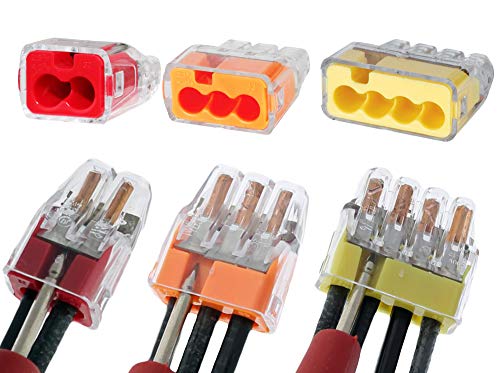
IDEAL In-Sure Push-In Wire Connectors (50-Pack)
The IDEAL In-Sure connectors allow you to simply push stripped wires in; they lock securely and can be removed with a twist-and-pull. They are rated for copper and are a good alternative to twist-ons when you need to save time. The clear body lets you see the wire insertion depth.
Pros
- No tools needed for insertion
- Clear housing for visual check
- Can be removed and reused
Cons
- Not for aluminum wire
- Limited wire range per port
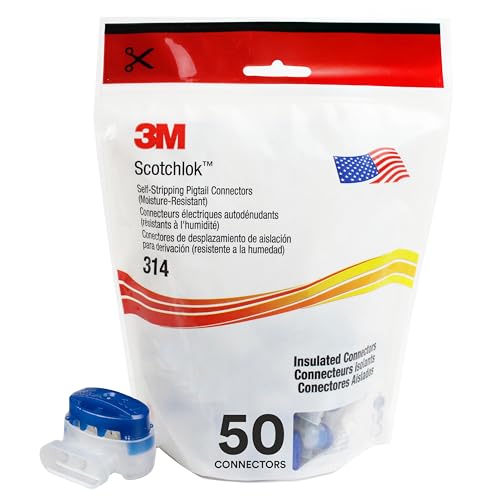
3M Scotchlok 314 Wire Connectors (100-Pack)
The 3M Scotchlok 314 connectors are designed for direct burial and outdoor use. They feature a grease-filled cap that seals out moisture and prevents corrosion. They are commonly used for sprinkler systems and landscape lighting.
Pros
- Excellent moisture protection
- Easy to install with a crimping tool
- Reliable in harsh conditions
Cons
- Requires a crimping tool
- Not reusable after crimping

Gardner Bender 20-2218 WeatherProof Wire Connectors (25-Pack)
These Gardner Bender connectors have a rubber boot that covers the twist-on wire connector, providing a water-resistant seal. They are ideal for outdoor fixtures, marine applications, and damp environments. The boot also adds strain relief.
Pros
- Weatherproof seal
- Built-in strain relief
- Suitable for wet locations
Cons
- Bulky in tight junction boxes
- Boot can be tricky to seat over wires

NSI Industries Tork Heavy Duty Wire Connectors (10-Pack)
NSI Tork Heavy Duty connectors are built for larger wire sizes, such as #8 to #4 AWG. They have a long, deep shell and a powerful spring for a secure grip. Often used for HVAC, appliances, and service entrances.
Pros
- Handles large gauge wires
- High torque spring for strong connection
- Rugged construction
Cons
- Overkill for small wire
- Limited availability in small packs

Buchanan B-2 Wire Connector (50-Pack)
Buchanan B-2 connectors are made of ceramic, which can withstand higher temperatures than plastic connectors. They are often used in lighting fixtures and appliances where heat is a concern. The threaded insert ensures a firm grip.
Pros
- High heat resistance
- Durable ceramic shell
- Classic design still trusted
Cons
- Ceramic can crack if dropped
- No built-in strain relief
How they stack up
| # | Model | Wire Range | Best for | Score | Price |
|---|---|---|---|---|---|
| 1 | WAGO 221 Lever-Nuts (6-Pack) | 12 to 24 AWG (depending on connector size) | Fast, tool-free, and reusable connections | 9.4 | Check price |
| 2 | Ideal Industries 452 Blue Wire Connector (100-Pack) | 2 #12 or 3 #14 AWG | Budget-friendly bulk for many splices | 8.8 | Check price |
| 3 | IDEAL In-Sure Push-In Wire Connectors (50-Pack) | Solid: 12-18 AWG, Stranded: 14-16 AWG | Quick push-in connections in tight spaces | 8.9 | Check price |
| 4 | 3M Scotchlok 314 Wire Connectors (100-Pack) | Up to 3 #14 AWG solid copper | Moisture-resistant underground splices | 8.7 | Check price |
| 5 | Gardner Bender 20-2218 WeatherProof Wire Connectors (25-Pack) | Up to 2 #12 AWG | Outdoor and wet location splices | 8.5 | Check price |
| 6 | NSI Industries Tork Heavy Duty Wire Connectors (10-Pack) | #8 to #4 AWG | Large gauge wire connections | 8.6 | Check price |
| 7 | Buchanan B-2 Wire Connector (50-Pack) | #14 to #10 AWG (up to 3 conductors) | Classic ceramic twist-on for high heat | 8.3 | Check price |
How to pick the right one
Good to know
Can I mix solid and stranded wire with these connectors?
Most modern connectors like WAGO and IDEAL In-Sure are rated for both solid and stranded wire, but always check the product specifications. Some twist-on connectors are best for solid only, and push-in connectors may have separate ports for each type.
Are wire connectors reusable?
Some are, like lever nuts and certain push-in types. Twist-on connectors are generally not recommended for reuse because the spring may lose tension. If you need to disconnect and reconnect often, choose a reusable type.
What does UL listed mean for wire connectors?
UL listing indicates that a sample of the product was tested by Underwriters Laboratories and meets safety standards for electrical connections. Using UL listed connectors is important for safety and may be required by local electrical codes.
Can I use wire connectors for aluminum wire?
Only if the connector is specifically rated for aluminum. Aluminum requires special connectors with anti-oxidant compound and proper torque. Many standard connectors are only for copper. Check the package or use connectors marked AL-CU.
How do I know what size wire connector I need?
Look at the wire gauge (AWG) and the number of wires you are connecting. Connectors typically list a range like ’12-14 AWG’ or ‘up to 3 #12’. Match the connector to the largest wire in the splice and count all conductors.
Are push-in wire connectors safe?
Yes, when used correctly and from reputable brands. They are widely used by professionals. The key is to strip the wire to the right length and push it in straight. They provide a solid connection and are often faster than twist-ons.
Can I use these connectors in a junction box?
Yes, but ensure the box is large enough to accommodate the connectors and wires without excessive crowding. Some connectors, especially those with boots, take up more space. Overcrowding can lead to overheating or difficulty closing the box.
What is the difference between a wire connector and a wire nut?
Wire nut is a common term for twist-on connectors, which are threaded and twisted onto wires. Wire connector is a broader term that includes wire nuts, push-in connectors, lever nuts, and other types. All serve the same purpose of joining wires safely.
Do I need to use electrical tape over wire connectors?
No, it is not required if the connector is properly rated and installed. However, some electricians use tape as an extra precaution or to secure the connector. If you do, use a high-quality electrical tape and wrap it tightly, but do not rely on tape to make the connection.
Can I use these connectors for automotive wiring?
Most are not recommended for automotive due to vibration and temperature extremes. There are specialized crimp connectors for automotive. If you do use them, choose ones with high temperature ratings and secure them well, but consider a proper automotive connector.
Our take
For the best overall replacement, choose the WAGO 221 Lever-Nuts. They offer the perfect balance of speed, safety, and reusability, making them ideal for most home electrical projects. If you are on a tight budget and need a large quantity, the Ideal 452 Blue Wire Connectors are a proven, low-cost alternative. For outdoor or underground splices, the 3M Scotchlok 314 connectors are the safest choice due to their waterproof seal.


