Wireless AV Receivers That Cut the Cord Without Cutting Quality
The Yamaha RX-V6A stands out as the best wireless AV receiver for most people because it combines robust wireless streaming features with solid home theater performance. It supports MusicCast multiroom audio, AirPlay 2, and Bluetooth, making it easy to play music anywhere. However, it lacks the advanced room correction of pricier models, so audiophiles may want to look elsewhere.
Modern AV receivers have evolved beyond just amplifying sound. They now act as wireless hubs for your entire entertainment system, letting you stream music, connect to smart speakers, and control everything from your phone.
Choosing the right one can be tricky with so many options. We compared top models to help you find the perfect balance of power, features, and wireless freedom.
Our top picks

Yamaha RX-V6A
The Yamaha RX-V6A is a 7.2-channel receiver with 100W per channel. It offers MusicCast wireless multiroom, AirPlay 2, Spotify Connect, and Bluetooth. It supports 4K/120Hz and 8K pass-through, making it future-proof for gaming and video. Owners praise its clear sound and easy setup.
Pros
- Excellent wireless multiroom via MusicCast
- Supports 8K and 4K/120Hz pass-through
- User-friendly setup with YPAO calibration
Cons
- No phono input for turntables
- Limited to one subwoofer output

Denon AVR-X1700H
The Denon AVR-X1700H is a 7.2-channel receiver with 80W per channel. It features 8K HDMI inputs, supports HEOS multiroom, AirPlay 2, and Bluetooth. It has three HDMI 2.1 inputs with 8K/60Hz and 4K/120Hz, making it ideal for next-gen gaming. Owners appreciate its robust build and immersive sound.
Pros
- Three 8K HDMI inputs for gaming
- Audyssey MultEQ room correction
- Supports Dolby Atmos and DTS:X
Cons
- Slightly lower power output
- No phono input

Sony STR-AN1000
The Sony STR-AN1000 is a 7.2-channel receiver with 100W per channel. It supports 360 Spatial Sound Mapping, Dolby Atmos, and DTS:X. Wireless features include Chromecast, AirPlay 2, Spotify Connect, and Bluetooth. It has a built-in calibration mic for easy setup. Users report a wide, enveloping soundstage.
Pros
- Immersive 360 Spatial Sound Mapping
- Good selection of streaming services
- Accurate room calibration
Cons
- No 8K pass-through
- Interface can be cluttered

Onkyo TX-NR6100
The Onkyo TX-NR6100 is a 7.2-channel receiver with 100W per channel. It offers THX Certified performance, supports Dolby Atmos and DTS:X, and includes Chromecast, AirPlay 2, and Bluetooth. It has a phono input for vinyl lovers. Owners find it a solid performer for the price.
Pros
- THX Certified for high quality
- Includes phono input
- Great price for features
Cons
- No 8K support
- AccuEQ room correction is less advanced

Marantz NR1711
The Marantz NR1711 is a slim 7.2-channel receiver with 50W per channel. It features HEOS multiroom, AirPlay 2, and Bluetooth. It supports Dolby Atmos and DTS:X with height channels. Its compact size fits easily into entertainment centers. Users like its elegant design and clear sound.
Pros
- Slim profile saves space
- High-quality Marantz sound
- Supports HEOS multiroom
Cons
- Lower power output
- Only one subwoofer pre-out
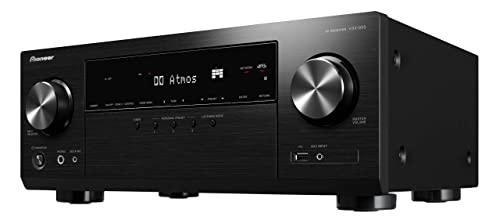
Pioneer VSX-935
The Pioneer VSX-935 is a 7.2-channel receiver with 80W per channel. It integrates with Chromecast, AirPlay 2, and Bluetooth. It supports Dolby Atmos and DTS:X. It has a built-in phono stage. Users appreciate its straightforward setup and reliable performance.
Pros
- Easy to set up and use
- Built-in phono input
- Good value for money
Cons
- No 8K support
- Room correction is basic

Sonos Amp
The Sonos Amp is a stereo amplifier with 125W per channel. It is designed for wireless music streaming and can power passive speakers. It supports AirPlay 2 and integrates seamlessly with Sonos speakers for multiroom audio. It has no video inputs, so it is not for home theater. Owners love its simplicity and sound quality.
Pros
- Seamless Sonos integration
- High power output
- Compact and sleek design
Cons
- No surround sound support
- No HDMI inputs
How to choose
The lineup, side by side
| # | Model | Channels | Best for | Score | Price |
|---|---|---|---|---|---|
| 1 | Yamaha RX-V6A | 7.2 | Best Overall | 9.4 | Check price |
| 2 | Denon AVR-X1700H | 7.2 | Best for Gaming | 9.2 | Check price |
| 3 | Sony STR-AN1000 | 7.2 | Best for Immersive Sound | 9.0 | Check price |
| 4 | Onkyo TX-NR6100 | 7.2 | Best Value | 8.8 | Check price |
| 5 | Marantz NR1711 | 7.2 | Best Slim Design | 8.7 | Check price |
| 6 | Pioneer VSX-935 | 7.2 | Best for Music Streaming | 8.5 | Check price |
| 7 | Sonos Amp | 2.0 | Best for Whole-Home Audio | 8.0 | Check price |
Good to know
What is a wireless AV receiver?
A wireless AV receiver is a home theater component that amplifies audio and routes video signals. It includes built-in Wi-Fi, Bluetooth, and often AirPlay or Chromecast, allowing you to stream music and connect to smart devices without extra cables.
Can I use a wireless AV receiver with my existing speakers?
Yes. Most wireless AV receivers have traditional speaker terminals that connect to passive speakers. You can use your current wired speakers. The wireless features are for audio streaming and control, not for connecting speakers wirelessly.
Do I need a separate wireless speaker system?
No. A wireless AV receiver can power regular speakers and also stream music to them. If you want wireless surround speakers, you may need a different solution, as most receivers require wired rear speakers.
What is the difference between Wi-Fi and Bluetooth on a receiver?
Wi-Fi offers higher bandwidth, so it can stream lossless audio and is more reliable over distance. Bluetooth is simpler but compresses audio, which may reduce quality. Many receivers support both for flexibility.
What is AirPlay 2?
AirPlay 2 is Apple’s wireless streaming protocol. It allows you to stream audio from your iPhone, iPad, or Mac to multiple speakers in different rooms, with synchronized playback. It also supports voice control via Siri.
What is Chromecast built-in?
Chromecast built-in is Google’s technology that lets you stream audio from apps like Spotify, Pandora, and TuneIn directly to the receiver. You control playback from your phone or tablet.
Can I connect a turntable to a wireless AV receiver?
Some receivers have a dedicated phono input for turntables with a moving magnet cartridge. If your receiver lacks one, you can connect a turntable to a regular audio input if it has a built-in preamp, or you can buy an external phono preamp.
What is Dolby Atmos and do I need it?
Dolby Atmos is an object-based surround sound format that adds height channels for a more immersive experience. It requires at least two in-ceiling or up-firing speakers. Many receivers support it. If you want the latest home theater experience, look for it.
How many HDMI ports do I need?
Consider how many devices you want to connect. Most receivers have 5 to 7 HDMI inputs. You need at least one output to your TV. If you have many gaming consoles and streaming devices, get a receiver with more inputs.
What is eARC and why is it important?
eARC (Enhanced Audio Return Channel) allows your TV to send high-quality audio formats like Dolby Atmos back to the receiver through the HDMI cable. It simplifies connections and ensures you get the best sound from TV apps and connected devices.
Our pick
The Yamaha RX-V6A is our top recommendation for most users because it delivers excellent wireless features, robust power, and future-proof video support at a reasonable price. If you are a gamer, consider the Denon AVR-X1700H with its 8K inputs and low latency. For whole-home audio, the Sonos Amp is unbeatable if you don’t need video switching. Ultimately, choose the Yamaha for the best balance of performance and versatility.


