Wireless Solar RV Tire Pressure Monitors That Earn Their Keep
For most RV owners, the TireMinder Smart TPMS stands out because it offers a large solar display, reliable long-range signal, and replaceable sensors. It is best for those who want a proven system with minimal maintenance. Its main limitation is a higher upfront cost compared to simpler models.
Proper tire pressure is critical for RV safety, affecting handling, fuel economy, and blowout risk. Wireless solar monitors eliminate the hassle of checking each tire manually, and they keep the display powered without draining your rig’s battery.
We compared seven of the most popular models currently on Amazon, focusing on what owners actually report about signal reliability, sensor durability, and display readability in bright sunlight.
Before you buy
What we recommend

TireMinder Smart TPMS
The TireMinder Smart is a premium system with a 6-sensor capacity and a solar-powered display that tilts for optimal viewing. It uses replaceable sensors and offers a signal range of up to 100 feet, making it suitable for fifth wheels and trailers. Owners praise its accurate alarms and long battery life, though the price is higher than many competitors.
Pros
- Reliable long-range signal
- Replaceable sensors extend lifespan
- Bright display with clear alerts
Cons
- Higher cost than basic models
- Sensors can be stolen if not locked
Minder Research RV TPMS with Solar Power
This Minder Research system offers a solar display that can also charge via USB, and it comes with 4 sensors that cover most RVs. It has a 50-foot range, which works for many single-axle trailers. Owners like the simple setup and the clear voice alerts, but some note the signal can weaken if the trailer is very long.
Pros
- Affordable price point
- Easy installation
- Voice alerts for critical conditions
Cons
- Shorter range than some
- Pressure max may be low for heavy trucks
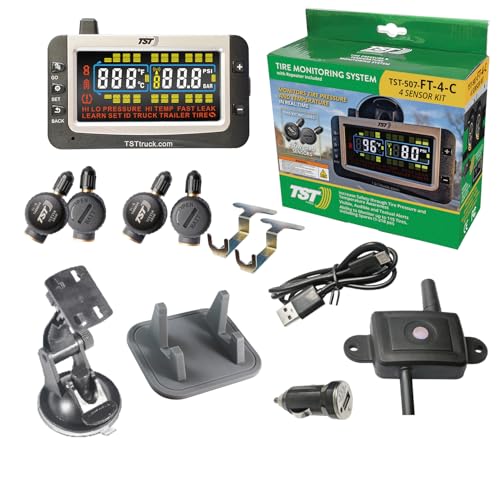
TST 507 Series Flow Through TPMS
TST’s 507 series is a favorite among RVers because of its flow-through sensors, which allow inflating tires without removing the sensor. The display is solar-powered and can monitor up to 12 tires with optional sensors. It offers a 100-foot range and robust metal construction. Owners report high accuracy and dependable alerts, though the system is pricier.
Pros
- Flow-through sensors for easy inflation
- Can monitor up to 12 tires (with add-ons)
- Durable metal valve stems
Cons
- Higher price
- Display can be less bright in direct sun
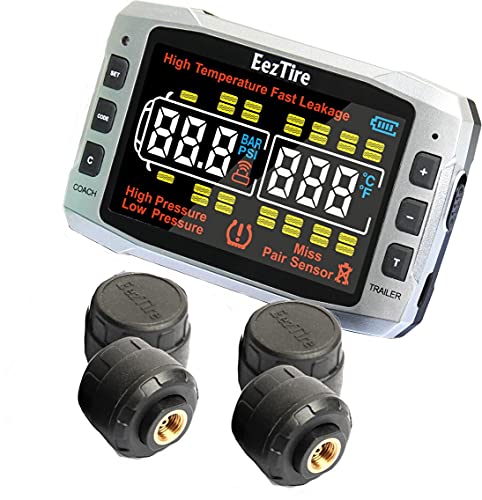
EEZTire TPMS Solar
The EEZTire system is a budget-friendly option that still provides a solar display and external sensors. It covers up to 6 tires and has a 40-foot range, which is adequate for most travel trailers. Owners find it easy to use and appreciate the color display. However, some report shorter battery life on sensors and occasional false alarms.
Pros
- Very affordable
- Color display is easy to read
- Simple setup
Cons
- Range may be insufficient for large rigs
- Sensor battery non-replaceable in some versions

TireMinder TM55c with Solar Display
The TireMinder TM55c is a popular choice for fifth wheels due to its impressive 100-foot range and 6-sensor capacity. The solar display is large and shows all tire pressures at once. It includes alerts for rapid pressure loss and high temperature. Owners appreciate the reliability but note that sensors are not flow-through, so removing them for air is a bit inconvenient.
Pros
- Long range for large trailers
- Clear display showing all tires
- Rapid leak detection
Cons
- No flow-through feature
- Sensors may be large and protrude

FOBO TPMS 2
FOBO TPMS 2 uses Bluetooth to send data to your smartphone, and its solar-powered display is optional. It offers advanced features like tire rotation tracking and customizable alerts. The system works with a dedicated app that stores historical data. Owners enjoy the app’s detail, but some find the Bluetooth connection less reliable than dedicated RF systems.
Pros
- Rich app with data logging
- Solar charging for optional display
- Sleek sensor design
Cons
- Bluetooth range limited
- Requires phone for full functionality

GUTA RV Tire Pressure Monitoring System
The GUTA system features a bright 2.6-inch color display that is solar-powered and swivels for viewing. It comes with 4 sensors and offers a range of about 50 feet. Owners like the simple menu and clear high-temperature alerts. A few mention that the sensors are plastic and may not be as durable as metal ones.
Pros
- Easy-to-read display
- Quick setup
- Good value
Cons
- Plastic sensors less durable
- Range may drop near large metal objects
The lineup, side by side
| # | Model | Sensor Type | Best for | Score | Price |
|---|---|---|---|---|---|
| 1 | TireMinder Smart TPMS | External, replaceable | Best Overall for Large RVs | 9.4 | Check price |
| 2 | Minder Research RV TPMS with Solar Power | External, replaceable | Best Value for Money | 9.1 | Check price |
| 3 | TST 507 Series Flow Through TPMS | Flow-through, external | Best for Dual Wheel RVs | 9.0 | Check price |
| 4 | EEZTire TPMS Solar | External | Best Budget Pick | 8.5 | Check price |
| 5 | TireMinder TM55c with Solar Display | External, non-flow-through | Best for Fifth Wheels | 8.8 | Check price |
| 6 | FOBO TPMS 2 | External | Best App Integration | 8.6 | Check price |
| 7 | GUTA RV Tire Pressure Monitoring System | External, plastic housing | Best for Easy Reading | 8.2 | Check price |
Good to know
What is the advantage of a solar-powered TPMS?
A solar-powered TPMS uses sunlight to charge its internal battery, so you do not need to plug it into your RV’s power outlet. This simplifies installation and keeps the display functioning without draining your vehicle’s battery.
How many tires can I monitor with an RV TPMS?
Most systems come with 4 sensors and can be expanded to 6, 8, or even more by purchasing additional sensors. Check the product specifications for the maximum number supported.
Will the TPMS work while I am driving?
Yes, the sensors transmit data continuously while the vehicle is moving. The display updates in real time. Some systems also work when parked, monitoring slow leaks.
How do I know if the sensor battery is low?
Most displays show a low battery indicator for each sensor. When the battery is low, you need to replace it or replace the sensor, depending on the design.
Can I use a TPMS on a trailer with dual axles?
Yes, but you need a system that supports at least 4 tires, and if you have a tandem axle trailer with 4 tires, a 4-sensor system works. For larger setups, choose a system that supports 6 or more sensors.
Do I need to balance my tires after installing sensors?
External sensors are small and typically do not require rebalancing. However, some owners choose to add small balancing weights. If you notice vibration after installation, have your tires balanced.
What pressure should I set for my RV tires?
Check the manufacturer’s recommended pressure, usually found on the tire sidewall or in the owner’s manual. Set the TPMS to alert when pressure drops 10-15% below that level.
Are there any security concerns with external sensors?
External sensors can be stolen if not secured. Most systems include locking rings or hex nuts. Use them to deter theft. Some owners also use a small amount of thread locker.
How accurate are wireless TPMS?
Most are accurate within 1-2 psi. They are reliable for detecting significant pressure changes. For precision, calibrate by comparing readings with a high-quality gauge after installation.
Final word
For most RV owners, the TireMinder Smart TPMS offers the best balance of reliability, range, and sensor life. Its replaceable sensors and clear display make it a long-term investment. If you are on a tighter budget, the Minder Research RV TPMS provides essential functions at a lower cost, but accept a shorter range. Regardless of choice, any of these systems will enhance your safety on the road.


