Wireless VR Headsets That Skip the Cable Clutter
The Meta Quest 3 leads for most people thanks to pancake optics, colour passthrough and the largest standalone library. The Meta Quest 3S covers the same software at a lower spec, while the HTC VIVE XR Elite suits owners who want a compact headset with a detachable battery cradle.
The Meta Quest 3 is the wireless VR headset most buyers should start with, with the Meta Quest 3S as the lighter spec alternative and the HTC VIVE XR Elite for anyone who wants a slimmer form factor. All three run without a gaming PC and without external sensors.
Wireless VR is tricky to shop for because spec sheets hide the things that decide whether a headset gets used, such as lens clarity at the edges, how the strap loads weight on your face, and how many hours the battery really lasts. We ranked these picks by comparing published specifications, headset weight and balance, controller tracking method, and what owners report about comfort during longer sessions.
Our top picks

Meta Quest 3 512GB
The Quest 3 pairs pancake lenses with a 2064 by 2208 per eye panel, which is the clearest standalone image in this group. Full colour passthrough makes mixed reality apps genuinely usable rather than a novelty. Owners report the biggest downside is battery life, so a head strap with a built in cell is a common first upgrade.
Pros
- Clearest optics of any standalone headset here
- Full colour passthrough for mixed reality
- Largest wireless game and app library
Cons
- Stock strap needs upgrading for long sessions
- Battery life runs short under heavy games

Meta Quest 3S 128GB
The Quest 3S runs the identical software library on the same processor as the Quest 3 but uses older Fresnel optics and a lower resolution panel. For social apps, fitness and most games that trade is easy to live with. It is the pick for a first headset or a second unit for the household.
Pros
- Same app library and chipset as the Quest 3
- Colour passthrough included
- Easiest entry point for a first headset
Cons
- Fresnel lenses show more glare and a smaller sweet spot
- Lower panel resolution makes text harder to read

HTC VIVE XR Elite
The XR Elite splits into a glasses style module when you remove the rear battery cradle, which makes it the most travel friendly headset here. Hot swappable batteries mean you can keep going without waiting on a charge. Owners report the fit works well with glasses thanks to the built in diopter dials.
Pros
- Converts to a compact glasses style form
- Hot swappable battery cradle
- Diopter dials suit glasses wearers
Cons
- Smaller content library than Meta headsets
- Heavier once the battery cradle is attached
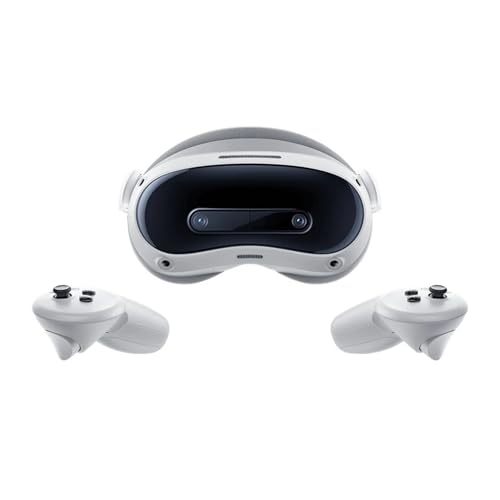
PICO 4 Ultra
The PICO 4 Ultra places its battery at the rear of the strap, so the front of the headset sits light on the face. Pancake lenses and a 105 degree field of view give it a roomy image for the weight. Availability and store depth vary by region, so check what is supported where you live before buying.
Pros
- Rear battery balances weight nicely
- Wide field of view for the class
- High resolution pancake optics
Cons
- Smaller store than the Meta ecosystem
- Regional availability is inconsistent

HTC VIVE Focus Vision
The Focus Vision is aimed at training rooms and enterprise deployments, with eye tracking, dual swappable batteries and support for wired PC VR when you need more graphics power. It is heavier than consumer headsets and the setup is more involved. For shared or managed use that extra structure is the point.
Pros
- Highest panel resolution in this roundup
- Eye tracking supports foveated rendering
- Hot swap batteries suit all day training use
Cons
- Bulky and heavy for casual gaming
- Consumer game selection is limited

Meta Quest Pro
The Quest Pro adds eye and face tracking plus an open peripheral design that lets you glance down at a real keyboard. That makes it the most usable headset here for virtual desktop work. The trade is a heavier build and a much older chipset than the Quest 3 for the same library.
Pros
- Open sides help with desk and keyboard work
- Eye and face tracking for social apps
- Self tracking controllers avoid occlusion
Cons
- Older chipset than the Quest 3
- Heavy for extended gaming
DPVR P2 Pro
The DPVR P2 Pro is a lightweight Android based headset built for guided experiences such as museum content, showrooms and video playback rather than a broad game library. It is easy to hand to a first time user and quick to reset between people. Treat it as a video and demo headset, not a gaming rig.
Pros
- Very light on the face
- Simple to hand off to new users
- Good for video and demo content
Cons
- Almost no mainstream game library
- Basic controller and tracking
Compared at a glance
| # | Model | Resolution per eye | Best for | Score | Price |
|---|---|---|---|---|---|
| 1 | Meta Quest 3 512GB | 2064 x 2208 | Best overall | 9.4 | Check price |
| 2 | Meta Quest 3S 128GB | 1832 x 1920 | Best value | 9.2 | Check price |
| 3 | HTC VIVE XR Elite | 1920 x 1920 | Best for portability | 9.0 | Check price |
| 4 | PICO 4 Ultra | 2160 x 2160 | Best for wide field of view | 8.8 | Check price |
| 5 | HTC VIVE Focus Vision | 2448 x 2448 | Best for business and training | 8.6 | Check price |
| 6 | Meta Quest Pro | 1800 x 1920 | Best for productivity | 8.3 | Check price |
| 7 | DPVR P2 Pro | 1920 x 2160 | Best for simple deployments | 8.0 | Check price |
How to choose
Standalone or PC powered Every headset here runs on its own, but some also connect to a gaming PC for higher end graphics. If you already own a capable PC, a headset with wired or wireless PC streaming stretches its useful life. If you do not, buy purely on the standalone library, because that is what you will actually use day to day.
Lenses matter more than raw resolution Pancake lenses give a wider sweet spot and less glare than older Fresnel designs, which is why a pancake headset can look sharper than a higher resolution Fresnel one. Owners consistently report fewer complaints about god rays and edge blur on pancake models. If you plan to read text in VR, prioritise lens type first.
Comfort and weight balance A headset that is front heavy presses on the cheekbones within twenty minutes. Rear mounted batteries or a battery equipped strap move that load to the back of the skull and make longer sessions realistic. Budget for a strap upgrade on any model that ships with a soft fabric band, because that single change fixes most comfort complaints.
Battery, storage and play space Expect roughly two to three hours of mixed use from most standalone headsets based on published specifications, less in demanding games. Storage matters if you install large titles, so 128GB fills quickly for heavy users. Also measure your room, because room scale games want a clear area of about two metres square.
Good to know
Do wireless VR headsets need a gaming PC?
No. Every headset in this roundup runs games and apps on its own processor with nothing else attached. A PC is optional and only adds higher end graphics for titles that support streaming or a cable link.
How long does the battery last?
Based on published specifications, most standalone headsets run about two to three hours of mixed use. Demanding games shorten that. A battery head strap or an external pack roughly doubles the session length.
Can you use a wireless VR headset with glasses?
Yes, most ship with a glasses spacer that adds clearance. The HTC VIVE XR Elite goes further with built in diopter dials, which let many people take their glasses off completely.
How much space do you need to play?
Seated and standing apps need very little. For room scale games, plan on a clear area of roughly two metres by two metres with nothing breakable inside the boundary.
Is passthrough good enough to walk around in?
Colour passthrough on newer headsets is clear enough for short tasks such as picking up a drink or finding a controller. It is not sharp enough to read a phone screen comfortably, so treat it as awareness rather than vision.
Does motion sickness go away?
Owners report it usually eases within a week or two of short sessions. Start with seated or teleport movement games, keep sessions to about twenty minutes at first, and stop as soon as you feel uneasy rather than pushing through.
How much storage should you buy?
128GB is enough for casual play with a handful of installed titles. If you install large games or record video, the 512GB tier avoids constant uninstalling, since none of these headsets take a memory card.
Can two people share one headset?
Yes. Most platforms support multiple accounts on one device, so each person keeps their own saves and friends list. Plan on wiping the facial interface between users, and silicone covers make that much easier.
Our take
The Meta Quest 3 is the wireless headset we would point most buyers to, because pancake optics and the deepest standalone library cover gaming, fitness and mixed reality without a PC. If the budget is tighter, the Meta Quest 3S runs the same software for less spec, and the HTC VIVE XR Elite is the one to pick when portability and glasses friendly optics matter most.
You might also need
