Wood Jointers That Actually Keep Edges Square
JET JJ-6CSDX handles long boards and rabbet cuts with three quick-set knives, making it the strongest all-around pick. Cutech 40160H-CT brings a spiral cutterhead to a benchtop footprint for far less than stationary machines. WEN JT6561 keeps a cast iron table and two-blade cutterhead within reach of tight budgets.
JET JJ-6CSDX suits anyone who joints boards several times a week and wants the closest thing to a professional machine. Cutech 40160H-CT is the pick when a spiral cutterhead matters more than a full stationary footprint. WEN JT6561 fits shops with just one project a month and a fixed budget.
Two jointers with identical table lengths can still leave opposite results on the same board, because cutterhead type changes how grain tears out. We compared motor power, knife or insert systems, fence travel and table length across seven models, then checked owner reports for recurring complaints like snipe, table sag or knife changes that eat an afternoon.
What matters most
What actually matters when choosing a wood jointer Table length decides how well a jointer supports long boards during a pass. Short infeed and outfeed tables let a board rock, producing a bowed edge instead of a flat one. Cutterhead type affects tear-out on figured grain, while motor power decides how deep a cut the machine handles without stalling. Fence travel matters for bevels and rabbets, and dust collection keeps chips from packing under the cutterhead guard. Compare these four factors before brand names enter the decision.
Benchtop vs stationary jointers Benchtop models like the WEN JT6561 and Shop Fox W1829 bolt to a workbench and store on a shelf between projects. Weight stays under 60 pounds, which keeps them portable but also lets a board push the fence out of alignment on a hard cut. Stationary jointers such as the JET JJ-6CSDX sit on a fixed base with a longer bed, spreading the same cut across more table surface. That extra length reduces snipe on boards over four feet. Choose stationary once jointing becomes a weekly task rather than an occasional fix.
Straight knife, helical and spiral cutterheads Straight knife cutterheads, found on the WEN JT6561 and Shop Fox W1829, cut the full width of a board at once and stay simple to sharpen or replace. A nick in one knife shows up as a ridge across every pass until it is swapped. Helical and spiral cutterheads, used on the Rikon 20-600H, Cutech 40160H-CT and Grizzly G0814X, break that same cut into a dozen or more small inserts set at an angle. Each insert only handles a narrow slice of the board, so one nick affects a fraction of the width. Insert cutterheads also run quieter and leave less tear-out on curly or figured grain.
Matching a jointer to your shop and stock size A one-project-a-month hobbyist rarely needs more than a 6-inch benchtop jointer and a straight knife cutterhead. Furniture makers working figured hardwoods benefit from an insert cutterhead that resists tear-out on reversing grain. Shops that regularly face boards wider than 6 inches need the extra capacity of an 8-inch machine like the Powermatic PJ-882HH. Production shops running boards all day should weigh a stationary frame over a benchtop one, since rigidity holds up better under constant use.
Our top picks

JET JJ-6CSDX 6-Inch Jointer
Three high-speed steel knives snap into a quick-set carrier, so changing all three takes minutes instead of an hour of individual adjustment. A 56-inch combined table steadies boards up to four feet without extra support. An integrated rabbeting ledge cuts rabbets up to a half inch deep, a feature most benchtop jointers skip entirely.
Pros
- Quick-set knives simplify blade changes
- Long bed supports boards other benchtops cannot
- Built-in rabbeting ledge adds a second function
Cons
- Needs floor space a benchtop model avoids
- Straight knives still nick on embedded grit

Cutech 40160H-CT 6-Inch Spiral Cutterhead Jointer
Twelve two-sided carbide inserts replace the usual pair of straight knives, cutting tear-out on grain that reverses direction mid-board. A one-piece fence tilts from 90 to 135 degrees for bevels without repositioning stock. Table length reaches 30 inches, long enough for face frame stock and most drawer parts.
Pros
- Spiral cutterhead price rivals straight-knife benchtops
- Inserts rotate instead of needing full replacement
- Fence tilts well past a basic 45-degree stop
Cons
- Table shorter than stationary alternatives
- Dust port needs a shop vac to stay clear
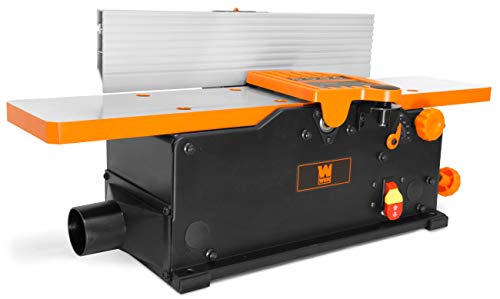
WEN JT6561 10-Amp 6-Inch Benchtop Jointer
A 10-Amp motor drives a two-blade, 6-1/8 inch cutterhead through up to 20,000 cuts per minute. Cast iron construction on the table and fence resists the flex that plagues stamped-steel benchtop jointers. Fence bevels to 45 degrees in either direction for angled edges on trim and picture frames.
Pros
- Cast iron table beats stamped steel at this price
- Straight blade design keeps replacement parts cheap
- Compact enough for a shared workbench
Cons
- Two-blade head needs more frequent changes
- No helical option in this model line
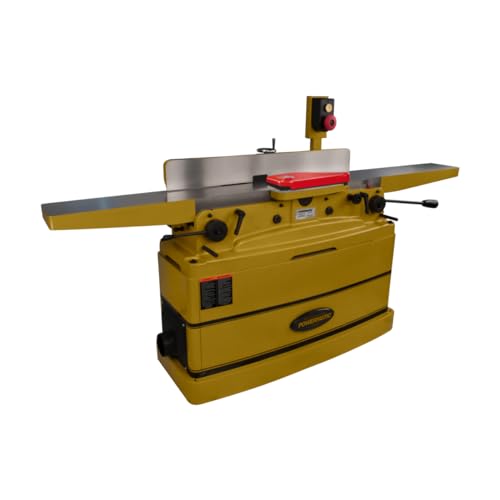
Powermatic PJ-882HH 8-Inch Parallelogram Jointer
Fifty-four four-sided carbide inserts wrap a helical cutterhead built for continuous daily use. An 82-inch bed supports full-length boards through a face-jointing pass without a helper. A single handwheel tilts the fence with stops at plus and minus 45 degrees and at 90 degrees.
Pros
- 8-inch capacity handles wider rough lumber
- Helical inserts stay quiet through long runs
- Five-year manufacturer warranty backs the castings
Cons
- Footprint needs a dedicated shop bay
- 230V circuit required for the motor

Rikon 20-600H 6-Inch Helical Benchtop Jointer
A six-row helical cutterhead carries 12 HSS insert cutters set at a shearing angle, cutting noise and tear-out compared with a straight blade. Machined aluminum tables keep weight down for benchtop mounting. Fence tilts from 90 to 45 degrees, and two push blocks ship in the box for safer narrow-stock passes.
Pros
- Helical head runs noticeably quieter than straight knives
- Insert cutters rotate rather than needing full swaps
- Push blocks included for narrow board safety
Cons
- Aluminum tables dent easier than cast iron
- HSS inserts dull faster than carbide

Grizzly G0814X 6-Inch Jointer with V-Helical Cutterhead
Twenty-four indexable carbide inserts arranged in a V-helical pattern shear through curly and figured grain that would tear out under straight knives. Each insert rotates up to three times before it needs replacing, stretching time between cutterhead service. A cabinet stand with a foot-pedal mobile base lets the jointer roll into position and lock down for use.
Pros
- V-helical pattern handles reversing grain cleanly
- Carbide inserts last through repeated rotations
- Mobile base moves the machine without a dolly
Cons
- Heavier footprint than any benchtop option here
- Cabinet stand adds to the overall cost
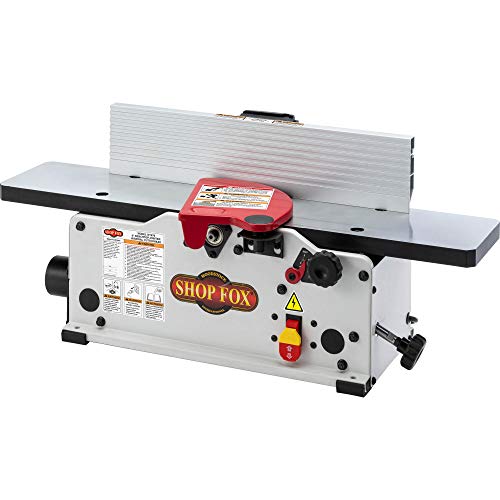
Shop Fox W1829 6-Inch Benchtop Jointer
A 1-1/2 HP motor turns a two-knife cutterhead at 10,000 RPM for 20,000 cuts per minute, matching output most hobbyists never fully use. Table length stops at 28-1/2 inches, short enough to store on a shelf between projects. Cast iron fence holds tilt stops at 45 and 90 degrees for repeatable bevels.
Pros
- Compact table stores easily between projects
- Motor output exceeds most occasional-use needs
- Cast iron fence holds bevel angles reliably
Cons
- Shorter table struggles with boards over 3 feet
- Two-knife head lacks a helical upgrade option
How they compare
| # | Model | Motor | Best for | Score | Price |
|---|---|---|---|---|---|
| 1 | JET JJ-6CSDX 6-Inch Jointer | 1 HP, 115/230V | Best overall | 9.4 | Check price |
| 2 | Cutech 40160H-CT 6-Inch Spiral Cutterhead Jointer | Spiral type, 12 two-sided inserts | Best value | 9.2 | Check price |
| 3 | WEN JT6561 10-Amp 6-Inch Benchtop Jointer | 10 Amp | Best budget | 9.0 | Check price |
| 4 | Powermatic PJ-882HH 8-Inch Parallelogram Jointer | 2 HP, 230V | Best for wide stock and production shops | 8.8 | Check price |
| 5 | Rikon 20-600H 6-Inch Helical Benchtop Jointer | 6-row helical, 12 HSS inserts | Best for a quiet, tear-out-resistant finish | 8.5 | Check price |
| 6 | Grizzly G0814X 6-Inch Jointer with V-Helical Cutterhead | V-helical, 24 carbide inserts | Best for figured and reversing-grain wood | 8.3 | Check price |
| 7 | Shop Fox W1829 6-Inch Benchtop Jointer | 1-1/2 HP, 110V, 12 Amp | Best for a small shop or compact space | 8.0 | Check price |
Good to know
What size jointer do I need for woodworking?
Six-inch jointers cover most furniture and cabinet parts, since face frames, drawer parts and most retail lumber fall under that width. Eight-inch machines like the Powermatic PJ-882HH matter once you buy rough lumber wider than 6 inches. Match the jointer to the widest board you plan to face regularly, not the widest board you might someday buy.
Is a 6-inch jointer big enough for most home shops?
Yes, for the majority of furniture, boxes and cabinet components built from standard lumber widths. Wider panels can still be edge-jointed on a 6-inch machine even when the full face cannot be flattened. Only shops routinely working slabs or wide glue-ups outgrow the 6-inch capacity.
What is the difference between a jointer and a planer?
A jointer flattens one face and squares one edge relative to that face, creating a reliable reference surface. A planer then takes that flattened face and makes the opposite side parallel to it. Skipping the jointer step leaves a planer copying any existing warp instead of removing it.
Can a jointer fix a warped or bowed board?
A jointer removes warp by cutting the high spots down until the face sits flat against the table. Cupped or twisted boards need multiple light passes rather than one deep cut. Severe warp can use up the entire board thickness before it flattens, so check stock for defects before buying it.
Are helical cutterhead jointers worth the extra cost over straight knives?
Owners report noticeably quieter running and less tear-out on figured or reversing grain with helical and spiral heads. Individual inserts also cost less to replace than a full set of straight knives after a nick. Anyone jointing mostly clear pine or poplar may not notice enough difference to justify the added cost.
How wide of a board can a benchtop jointer face-joint?
Benchtop jointers such as the WEN JT6561, Cutech 40160H-CT and Shop Fox W1829 top out at 6 inches of width. Boards wider than that can only be edge-jointed, using the fence and one narrow face. Ripping a wide board into two narrower pieces before facing is a common workaround.
Do jointer knives need sharpening, or should they be replaced?
Straight knives on machines like the WEN JT6561 are typically replaced rather than resharpened once they dull. Insert-style cutterheads, as used on the Rikon 20-600H, let each carbide tip rotate to a fresh edge before replacement. Either system needs attention sooner when jointing resinous or gritty reclaimed wood.
Is a stationary jointer better than a benchtop model for a home shop?
Stationary jointers like the JET JJ-6CSDX offer a longer bed and heavier castings, which steady long boards better. Benchtop models save floor space and cost less, which suits occasional projects. Weekly use tips the balance toward a stationary machine, since its rigidity holds tolerances longer.
The bottom line
JET JJ-6CSDX earns the top spot for shops that joint often and want a long bed with quick-set knives. Cutech 40160H-CT brings spiral-cutterhead results to a benchtop budget, and WEN JT6561 covers occasional projects without straining a tight budget. Match cutterhead type and table length to how often boards actually need facing before choosing a size.