Workshop Jointers That Make Flattening Effortless
For most workshop owners, the Jet JJ-6CSDX is the top pick because it offers a powerful 1 HP motor and a spiral cutterhead at a price that won’t break the bank, but its 6-inch capacity may limit larger projects.
A jointer is essential for flattening warped boards and creating straight edges for glue-ups. Choosing the right one depends on your space, budget, and project scale.
We analyzed current models from leading brands like Jet, Powermatic, and WEN, focusing on cutterhead type, motor power, and table size.
The top picks, ranked

Jet JJ-6CSDX 6-Inch Closed Stand Jointer
This 6-inch jointer features a spiral cutterhead with indexable carbide inserts, delivering smooth, quiet cuts and long insert life. The closed stand reduces vibration, and the fence tilts both ways for beveling.
Pros
- Exceptionally smooth finish
- Low noise operation
- Easy to adjust
Cons
- Heavy at 240 pounds
- Price is higher than benchtop models

Powermatic 1791210K 8-Inch Jointer
This 8-inch jointer from Powermatic is built for large workshops, with a 2 HP motor and a parallelogram table system that maintains precise adjustments. It includes a spiral cutterhead for exceptional finish.
Pros
- Massive capacity
- Rock solid stability
- Accurate parallelogram design
Cons
- Requires 230V outlet
- Very expensive and heavy
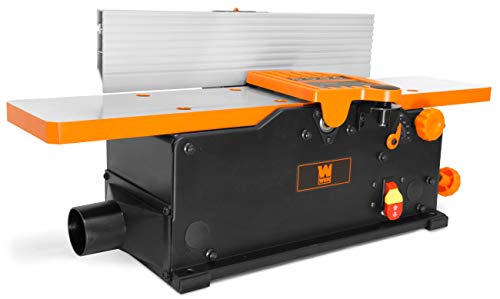
WEN JT-630H 6-Inch Benchtop Jointer
WEN’s benchtop jointer offers a 6-inch cutting width and a helical cutterhead, which reduces noise and tearout. The aluminum tables are lightweight yet sturdy, and the dust port keeps your shop clean.
Pros
- Affordable price
- Helical head at low cost
- Compact for small shops
Cons
- Less powerful than floor models
- Table length limits long boards

Delta 37-460 6-Inch Jointer
Delta’s 6-inch jointer features a traditional three-knife cutterhead and cast iron tables, offering reliable performance at a moderate price. It is a solid choice for those who prefer straight knives for easy sharpening.
Pros
- Cast iron construction
- Easy knife setup
- Proven design
Cons
- Noisier than helical
- Knives require periodic sharpening

Grizzly G0814 6-Inch Jointer
Grizzly’s G0814 is a 6-inch jointer with a spiral cutterhead with carbide inserts, offering smooth cuts at a price lower than many competitors. It comes with a 1 HP motor and a closed stand for stability.
Pros
- Great price for spiral head
- Smooth operation
- Durable build
Cons
- Fence can require fine tuning
- Instructions could be clearer
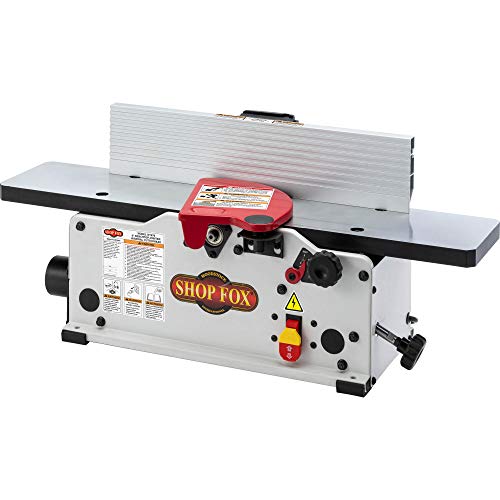
Shop Fox W1824 6-Inch Jointer
Shop Fox offers this 6-inch jointer with a straight-knife cutterhead and cast iron tables. It is a straightforward machine that gets the job done for light to medium work.
Pros
- Inexpensive
- Reliable motor
- Cast iron tables
Cons
- Knife changing is time consuming
- Not as refined as pricier models
Powermatic 1791210K 8-Inch Jointer with Helical Head
This 8-inch Powermatic is similar to the 1791210K but includes a helical cutterhead with four-sided carbide inserts, extending tool life. It offers variable speed for different materials.
Pros
- Variable speed control
- Excellent finish quality
- Long lasting inserts
Cons
- High price point
- Needs 230V power
Side by side
| # | Model | Motor | Best for | Score | Price |
|---|---|---|---|---|---|
| 1 | Jet JJ-6CSDX 6-Inch Closed Stand Jointer | 1 HP, 115V | Best overall for serious hobbyists | 9.4 | Check price |
| 2 | Powermatic 1791210K 8-Inch Jointer | 2 HP, 230V | Best for wide boards and professional use | 9.2 | Check price |
| 3 | WEN JT-630H 6-Inch Benchtop Jointer | 10 Amp, 120V | Best budget benchtop jointer | 8.8 | Check price |
| 4 | Delta 37-460 6-Inch Jointer | 1 HP, 115V | Best for classic straight-knife reliability | 8.5 | Check price |
| 5 | Grizzly G0814 6-Inch Jointer | 1 HP, 115V | Best value helical jointer | 8.7 | Check price |
| 6 | Shop Fox W1824 6-Inch Jointer | 1 HP, 115V | Best for those who want a classic straight knife with a budget | 8.3 | Check price |
| 7 | Powermatic 1791210K 8-Inch Jointer with Helical Head | 2 HP, 230V | Best for pros needing extra width | 9.0 | Check price |
What to look for
Questions worth asking
What is the difference between a jointer and a planer?
A jointer flattens one face and squares one edge of a board. A planer thicknesses the board to a uniform thickness by cutting the opposite face parallel to the jointed face. They work together to produce dimensioned lumber.
Can I use a jointer to make a board narrower?
No, a jointer only straightens an edge, it does not remove significant width. To make a board narrower, use a table saw after jointing one edge.
What is the minimum length of board I can joint safely?
Always use push blocks for safety. The board should be at least 12 inches long to avoid tipping. For shorter pieces, use a planer with a sled or a router table.
How often do I need to replace straight knives?
It depends on usage. For a hobbyist, knives might last a year or more. Signs include tearout or burn marks. You can sharpen them or replace them when they dull.
What are the advantages of a spiral cutterhead over straight knives?
Spiral cutterheads are quieter, produce a smoother finish with less tearout, and carbide inserts last longer. They also reduce the chance of kickback and are easier to replace individually.
Do I need a 220V jointer for a home workshop?
Not necessarily. Many 6-inch jointers run on 120V and are sufficient for most hobbyists. Larger 8-inch models often require 220V for the extra power. Check your shop’s wiring before buying.
Can I joint both faces of a board with a jointer?
Yes, you can joint one face flat, then use a thickness planer to make the other face parallel. Alternatively, you can joint both faces if the board is thick enough, but it’s less common.
What is the typical warranty on these jointers?
Most brands offer a 1 to 2 year limited warranty. Some, like Powermatic, offer up to 5 years on certain parts. Check the specific model’s warranty details.
How do I choose between a benchtop and a floor-standing jointer?
Benchtop models are compact, cheaper, and can be stored on a stand. They are fine for light use. Floor-standing models have longer tables, more power, and greater stability, suitable for professional use.
Is a jointer essential for a woodworking shop?
If you work with rough lumber, a jointer is essential for creating flat, straight surfaces. If you only use pre-milled lumber, you might skip it, but it becomes necessary for accurate joinery.
The verdict
If you want the best mix of performance and value for a typical workshop, choose the Jet JJ-6CSDX. Its spiral cutterhead, quiet operation, and solid build make it a superior choice for most woodworkers. For those who need to joint wider boards, the Powermatic 1791210K is worth the investment, but only if your shop has 230V power and you have the budget. Budget buyers will appreciate the WEN JT-630H, which offers an easy entry into jointing without sacrificing quality.


