Workshop Spindle Sanders That Shape and Smooth
The Jet JOVS-10 leads our list for most workshops because it pairs a solid cast iron table with a powerful 1 HP motor, making it ideal for heavy use. Its main advantage is smooth, chatter free oscillation even on dense hardwoods. The main limitation is its price, which is higher than benchtop models.
Shaping curved edges and smoothing inside cuts demands a tool that removes stock evenly without leaving gouges. A spindle sander rotates and often oscillates to erase tool marks fast, and it works on profiles that belt sanders cannot reach.
We looked at what owners report about each machine, from vibration levels to how easily they change spindles. We also considered the table size and whether the dust port actually keeps the air clear.
The shortlist, ranked
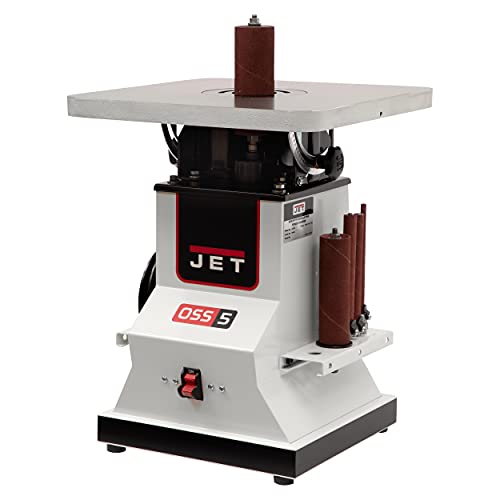
Jet JOVS-10 Oscillating Spindle Sander
The Jet JOVS-10 is a floor standing oscillating spindle sander that delivers smooth, powerful performance. Its 1 HP motor drives spindles from 1/4 inch up to 2 inches, and the cast iron table stays flat. Owners report minimal vibration and excellent dust collection through the 4 inch port.
Pros
- Powerful motor handles hardwoods easily
- Cast iron table is flat and stable
- Quick spindle change with wrench
Cons
- Heavy at over 200 pounds
- Higher price than benchtop models

WEN 6321 Oscillating Spindle Sander
The WEN 6321 is a benchtop oscillating spindle sander with a 2.3 amp motor and six spindles from 1/4 to 2 inches. It offers a decent throat depth and works well for smaller projects. Users like its low price and ease of use, though it struggles with heavy stock removal on dense woods.
Pros
- Affordable for the features
- Includes six spindles
- Compact footprint
Cons
- Table is small and not cast iron
- Motor can bog down on thick hardwood
Delta 31-260 1-Inch Benchtop Oscillating Spindle Sander
Delta’s benchtop oscillating spindle sander features a table that tilts up to 45 degrees, useful for beveled edges. It accepts 1 inch spindles and comes with a few sizes. Owners appreciate the smooth operation and easy spindle changes, but note the motor is not as powerful as floor models.
Pros
- Tilting table for angled sanding
- Compact and affordable
- Dust collection is decent
Cons
- Limited spindle size range
- Not for heavy industrial use

Shop Fox W1673 1-1/2 HP Oscillating Floor Spindle Sander
The Shop Fox W1673 is a heavy duty floor sander with a 1-1/2 HP motor and a large 19 x 24 inch cast iron table. It handles huge panels and thick stock without slowing down. Users praise its smooth oscillation and low vibration, but it requires a dedicated space.
Pros
- High power for demanding jobs
- Large table supports big pieces
- Smooth and quiet operation
Cons
- Very heavy and bulky
- Price is on the high side

Ridgid EB4424 Oscillating Edge/Belt Spindle Sander
The Ridgid EB4424 combines an oscillating spindle sander with an edge belt sander. It offers a 4 x 24 inch belt and includes spindles from 1/4 to 3/4 inch. This versatility saves space and money. However, the table is smaller and the dust collection is not as good as dedicated units.
Pros
- Two tools in one
- Saves bench space
- Affordable for the versatility
Cons
- Spindle size limited to 3/4 inch
- Dust collection could be better

Grizzly Industrial T28143 1/2 HP Oscillating Spindle Sander
The Grizzly T28143 is a floor standing oscillating spindle sander that offers a cast iron table and a 1/2 HP motor. It includes six spindles and provides good value for the price. Owners report that it works well for most tasks, but the motor may not handle continuous heavy use.
Pros
- Cast iron table at an affordable price
- Includes all standard spindles
- Sturdy and stable
Cons
- Motor is less powerful than others
- Some users report vibration at high speed

Porter-Cable 7800 Oscillating Spindle Sander
The Porter-Cable 7800 is a benchtop oscillating spindle sander that includes a tilting table and a 2.5 amp motor. It comes with a variety of spindles and is easy to store. While it is not built for heavy production, it serves well for small projects and crafts.
Pros
- Tilting table for angled sanding
- Lightweight and portable
- Includes useful spindle assortment
Cons
- Table may flex under pressure
- Dust collection is mediocre
How to choose
Side by side
| # | Model | Motor | Best for | Score | Price |
|---|---|---|---|---|---|
| 1 | Jet JOVS-10 Oscillating Spindle Sander | 1 HP, 120V | Serious woodworkers with floor space and a budget for pro grade gear | 9.6 | Check price |
| 2 | WEN 6321 Oscillating Spindle Sander | 2.3 amps, 120V | Hobbyists who need a reliable benchtop sander at a good value | 9.1 | Check price |
| 3 | Delta 31-260 1-Inch Benchtop Oscillating Spindle Sander | 2.5 amps, 120V | Users who want a compact sander with a tilting table for angled work | 8.9 | Check price |
| 4 | Shop Fox W1673 1-1/2 HP Oscillating Floor Spindle Sander | 1-1/2 HP, 110V/220V | Shops that need extra power for large workpieces | 9.3 | Check price |
| 5 | Ridgid EB4424 Oscillating Edge/Belt Spindle Sander | 5.5 amps, 120V | Users who want a combo sander with both belt and spindle functions | 8.7 | Check price |
| 6 | Grizzly Industrial T28143 1/2 HP Oscillating Spindle Sander | 1/2 HP, 110V | Budget minded woodworkers who need a floor model with a cast iron table | 8.5 | Check price |
| 7 | Porter-Cable 7800 Oscillating Spindle Sander | 2.5 amps, 120V | Users who prefer a lightweight benchtop sander with a tilting table | 8.2 | Check price |
Questions worth asking
What is the difference between a spindle sander and an oscillating spindle sander?
A spindle sander only rotates, while an oscillating spindle sander also moves up and down. The oscillation helps sand more evenly and prevents the abrasive from loading up. It also produces a smoother finish on curved edges.
Can I use a spindle sander to shape wood?
Yes, but it is not a shaping tool like a router. Spindle sanders are designed for smoothing and finishing. They remove small amounts of material to refine shapes and erase saw marks. You should not force the wood into the spindle to remove large amounts of material.
What spindle sizes do I need?
Common sizes are 1/4, 1/2, 3/4, 1, 1-1/2, and 2 inches. The size you use depends on the radius of the curve you are sanding. Smaller spindles fit tighter curves, while larger spindles work on gentle arcs and straight edges.
How do I change spindles on a spindle sander?
Most models require you to loosen a screw or use a wrench to remove the spindle. Some premium models have quick release mechanisms that allow tool free changes. Always make sure the sander is unplugged before changing spindles.
Do spindle sanders come with different grits of sanding sleeves?
Yes, sanding sleeves are available in various grits, from coarse to fine. Some sanders come with a starter set, but you will likely need to buy additional sleeves. Look for sleeves that match your spindle diameter and length.
Can I use a spindle sander on metal or plastic?
Spindle sanders are primarily for wood. You can use them on some soft metals or plastics, but you need to use appropriate abrasives and go slowly. However, this may void the warranty and can cause premature wear. It is better to use dedicated metal sanding equipment.
How important is dust collection on a spindle sander?
Dust collection is very important because sanding creates fine dust that can be harmful to breathe and can clutter your workspace. A good dust port that connects to a shop vac or dust collector keeps the air cleaner and helps you see your work.
What safety precautions should I take when using a spindle sander?
Always wear safety glasses and a dust mask. Keep your fingers away from the spindle and use push blocks or jigs when possible. Do not wear loose clothing or gloves that could get caught. Ensure the sander is stable and the work area is clean.
How do I maintain a spindle sander?
Regularly clean the table and the area around the spindle to remove sawdust. Check the sanding sleeves for wear and replace them when they become dull. Lubricate moving parts as recommended by the manufacturer. Tighten any loose bolts or screws.
Can I use a spindle sander to sand inside curves?
Yes, spindle sanders are excellent for sanding inside curves. The spindle goes into the cutout and sands the edge. You need to choose a spindle that fits the radius of the inside curve.
Final word
For most woodworkers, the Jet JOVS-10 is the best spindle sander because it offers the ideal balance of power, precision, and durability. If you are on a budget or have limited space, the WEN 6321 provides solid performance at a fraction of the cost. Serious professionals who need maximum power should consider the Shop Fox W1673.


