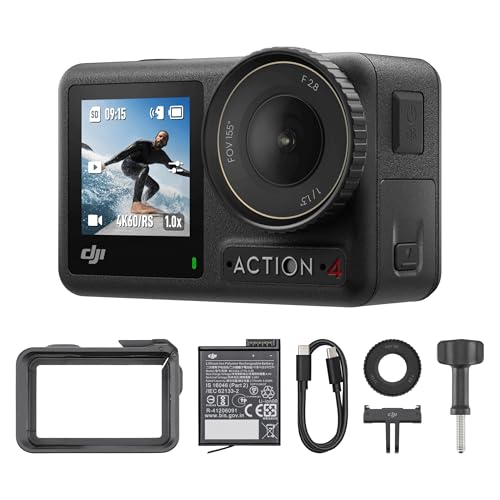
Cheap 4K Action Cameras That Punch Way Above Their Weight
For most people the AKASO Brave 7 LE hits the sweet spot of stabilization and price. The Dragon Touch 4K is the true budget pick, while the Insta360 Go 3S wins if you want a tiny wearable that still shoots sharp 4K.
If you want smooth 4K clips without paying flagship money, the AKASO Brave 7 LE is the camera to beat, with the Dragon Touch 4K taking the true budget crown and the Insta360 Go 3S covering tiny wearable shots. All three keep footage sharp without emptying your wallet.
Action cameras are tricky because the marketing headline number rarely matches what you get. A camera can claim 4K yet interpolate the resolution or shoot at a choppy frame rate, and stabilization quality varies wildly between models. We leaned on published specs, sensor size, native versus upscaled resolution, and the mount ecosystem to sort the genuinely capable from the merely cheap.
What matters most
Native 4K versus interpolated The single biggest trap in this price bracket is interpolated 4K, where the camera records at a lower resolution and stretches the pixels to fake a higher number. Native 4K comes straight off the sensor and looks noticeably crisper. Check the listing for the word interpolated and favor cameras that state a true sensor resolution.
Frame rate matters as much as resolution A camera that shoots 4K at 24fps will look slightly less fluid than one hitting 30fps, especially for fast motion like biking or skating. If smoothness is your priority, prioritize the higher frame rate even if it means dropping to a lower resolution setting. For slow scenic shots the frame rate matters far less.
Stabilization and mounting Electronic stabilization is what separates watchable footage from a shaky mess when the camera is strapped to your body. Budget models vary a lot here, so read the stabilization description closely. Also confirm the camera uses the standard action-cam mount fingers, since that unlocks a huge and cheap accessory ecosystem.
Waterproofing you can trust Some cameras are waterproof on their own to a shallow depth, while others need a bundled case to survive real submersion. Caseless bodies are convenient for rain and splashes, but a rated case is what you want for snorkeling. Match the depth rating to how you actually plan to use it rather than the biggest number on the box.
The best picks, ranked

AKASO Brave 7 LE
The Brave 7 LE blends dual color screens, respectable electronic stabilization and a waterproof body into a package that feels far more expensive than it is. It is the camera most people should reach for first when the budget is tight.
Pros
- Front screen makes vlogging framing easy
- Waterproof body without an extra case
- Comes with two batteries and a remote
Cons
- 4K capped at 30fps
- Low-light footage gets noisy

Dragon Touch 4K Action Camera
The Dragon Touch is about as affordable as a real 4K action camera gets, and it still ships with a waterproof case and a generous mount bundle. Expect basic but usable footage in good light.
Pros
- One of the lowest entry costs around
- Large accessory and mount bundle
- Wi-Fi transfer to your phone
Cons
- 4K frame rate is low at 24fps
- Stabilization is minimal

Insta360 Go 3S
The Go 3S is a thumb-sized camera that magnetically clips almost anywhere, letting you capture first-person angles no bulkier rig can match. It stays reasonable on price for what it does.
Pros
- Incredibly small and light
- Magnetic mounting is genuinely clever
- Strong stabilization for the size
Cons
- Short battery life on the pod
- Costs more than basic rivals

AKASO EK7000 Pro
The EK7000 Pro adds a touchscreen and adjustable view angle to AKASO’s long-running budget line. It is a dependable pick for helmets, bikes and pool days when you do not need the latest features.
Pros
- Touchscreen simplifies menus
- Deep waterproof rating with case
- Adjustable field of view
Cons
- No built-in waterproofing
- Frame rate limited at 4K

Campark V40 Action Camera
The Campark V40 keeps things simple with dual screens and a large mount kit, making it a friendly first action camera. Image quality is solid outdoors and the controls are hard to get lost in.
Pros
- Beginner-friendly dual displays
- Big bundle of mounts
- Two batteries in the box
Cons
- 4K is partly interpolated
- Audio quality is weak

AKASO Brave 4 Pro
The Brave 4 Pro pairs a touchscreen with a robust waterproof case rated for real depth, so it suits snorkeling and pool sessions. It is a sturdy, no-drama choice for water-heavy filming.
Pros
- Deep waterproof case included
- Touch control on the rear
- Wrist remote for hands-free start
Cons
- Needs the case for water use
- Only 24fps at 4K
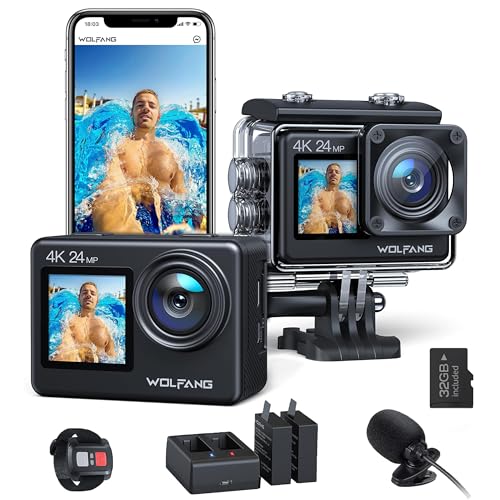
WOLFANG GA420 Action Camera
The WOLFANG GA420 leans on strong battery endurance and native 4K without a case for shallow water. It is a practical grab for full days of casual shooting where recharging is a hassle.
Pros
- Native 4K without upscaling
- Good battery endurance
- Shallow water use without a case
Cons
- Menus feel dated
- Limited accessory support
How they compare
| # | Model | Video | Best for | Score | Price |
|---|---|---|---|---|---|
| 1 | AKASO Brave 7 LE | 4K at 30fps | Best overall | 9.2 | Check price |
| 2 | Dragon Touch 4K Action Camera | 4K at 24fps | Best budget | 8.6 | Check price |
| 3 | Insta360 Go 3S | 4K at 30fps | Best for wearable shots | 9.0 | Check price |
| 4 | AKASO EK7000 Pro | 4K at 25fps | Best value | 8.8 | Check price |
| 5 | Campark V40 Action Camera | 4K at 30fps interpolated | Best for beginners | 8.3 | Check price |
| 6 | AKASO Brave 4 Pro | 4K at 24fps | Best for underwater | 8.4 | Check price |
| 7 | WOLFANG GA420 Action Camera | 4K at 30fps | Best for long battery | 8.2 | Check price |
Frequently asked questions
Do cheap action cameras really shoot in 4K?
Many do, but watch for interpolated 4K where a lower-resolution sensor is stretched to fake the number. Cameras that state a true native 4K sensor look sharper, so read the spec sheet before buying.
Are budget action cameras waterproof out of the box?
It varies. Some bodies handle shallow water on their own, while others rely on a bundled case for deeper dives. Always check the depth rating and whether it applies with or without the case.
Can I use GoPro mounts with these cameras?
Usually yes, because most affordable action cameras use the same two-prong mount design. That means the enormous library of inexpensive clips, straps and poles will fit without extra adapters.
Why does my footage look shaky?
Budget stabilization is weaker than on flagship cameras, so hard vibration still shows. Mounting the camera firmly, enabling the anti-shake setting and avoiding the highest resolution mode often smooths things out.
How long do the batteries last?
Most affordable models record roughly 60 to 90 minutes per charge at 4K. Many bundles include a spare battery, which is why carrying a second pack is the easiest way to extend a shooting day.
Do I need a fast memory card?
Yes. 4K recording writes a lot of data, so a card rated U3 or V30 prevents dropped frames and recording errors. A slow card is a common cause of a camera refusing to record 4K.
Is a front screen worth it?
If you film yourself, a front screen makes framing far easier and reduces wasted takes. For helmet or bike mounting where you never see yourself it matters much less.
Can these cameras replace a GoPro?
For casual clips, travel and pool days they get close for a fraction of the cost. The gap shows in low light, extreme stabilization and audio, where premium cameras still pull ahead.
The bottom line
For the best mix of price and capability the AKASO Brave 7 LE is the one to buy, thanks to its dual screens and caseless waterproofing. Reach for the Dragon Touch 4K if you want the lowest possible entry cost, or the Insta360 Go 3S when tiny wearable footage matters more than anything else.