Picking the Right 4K Monitor for a Home Office Desk
Dell’s UltraSharp U2723QE leads for two-computer home offices, pairing a built-in KVM switch with IPS Black contrast for deeper video-call blacks. Samsung’s ViewFinity S8 suits glare-prone rooms through its matte anti-glare coating. LG’s 27UP850-W matches strong USB-C charging at a lower cost, better suited to single-computer desks that skip the KVM feature.
Home offices running two computers off one desk get the most from Dell’s UltraSharp U2723QE, thanks to its built-in KVM switch and IPS Black contrast. Video calls and spreadsheet work look sharper against its deeper blacks than a standard IPS screen manages. A textured panel coating does soften fine text slightly compared with glossier alternatives.
Panel type, USB-C wattage, and stand adjustability vary widely once several 4K monitors sit side by side. We lined up published specifications for resolution, connectivity, and ergonomics, then weighed owner feedback on glare and cable clutter against how each screen suits a specific home office task.
The shortlist, ranked

Dell UltraSharp U2723QE
A 27-inch IPS Black panel doubles typical IPS contrast, reaching 2,000:1. Built-in USB-C carries 90W of charging plus video and data over one cable, and a KVM switch lets one keyboard and mouse run two computers. Height, tilt, swivel, and pivot adjustments cover most desk setups without extra mounting hardware.
Pros
- IPS Black contrast doubles standard IPS for deeper video-call blacks
- 90W USB-C charges a laptop while carrying video and data
- KVM switch removes the need for a separate hardware switcher
Cons
- Textured coating softens fine text slightly at 100 percent zoom
- Stand footprint needs about 9 inches of desk depth

Samsung ViewFinity S8 (S27B800)
Reflections from windows or overhead lighting fade under this panel’s matte anti-glare coating. USB-C supplies 65W of charging alongside video, enough for most ultrabooks on one cable. A cable-management channel in the stand column keeps the desk behind it clear.
Pros
- Matte coating cuts glare without dulling on-screen color
- 65W USB-C powers a laptop through a single cable
- Slim metal stand keeps the desk footprint compact
Cons
- 65W falls short for higher-draw gaming laptops
- Swivel range is narrower than Dell’s stand offers

LG 27UP850-W
USB-C output here reaches 96W, enough to charge most 16-inch laptops without a separate charger. Every unit ships with a factory calibration report showing color accuracy out of the box. Height adjustment and pivot rotation on the stand suit portrait-mode document review.
Pros
- 96W USB-C covers larger laptops without an extra charger
- Factory calibration report included with every unit
- Pivot rotation suits portrait-orientation reading and coding
Cons
- Stand base takes up noticeable desk space
- No KVM switch for managing two source computers
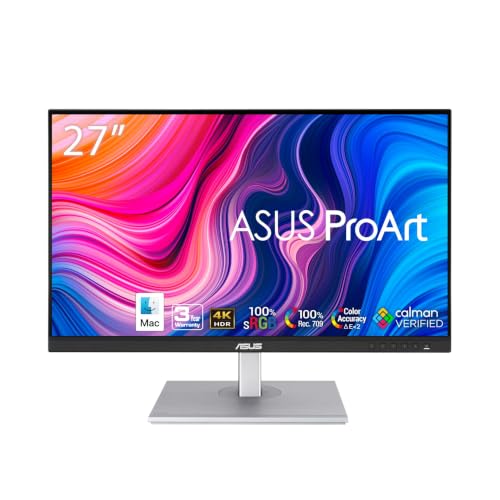
ASUS ProArt PA279CV
Delta E under 2 comes factory-calibrated on every unit, a tolerance tight enough for print and photo work. Coverage spans 100% sRGB and 100% Rec.709, keeping color consistent between documents and video. USB-C at 65W with DisplayPort Alt Mode connects a laptop over a single cable.
Pros
- Factory Delta E under 2 suits color-sensitive design work
- 100% sRGB and Rec.709 coverage documented on the spec sheet
- QuickFit grid lines assist print layout and photo cropping
Cons
- 65W charging cannot fully power larger workstation laptops
- Joystick menu navigation takes some getting used to

BenQ PD2705U
A detachable shading hood blocks side glare during photo and video editing near windows. Hotkey Puck controls switch between color modes and inputs without digging through on-screen menus. USB-C at 65W charges a connected laptop while passing through video.
Pros
- Included shading hood blocks glare without an extra purchase
- Hotkey Puck speeds up switching between color modes
- CAD/CAM and Animation picture modes built in for design work
Cons
- Hood and puck add setup steps versus plug-and-play monitors
- Glossy bezel shows fingerprints more than matte alternatives

LG 32UN880-B
An Ergo stand clamps to the desk edge and extends on an arm, clearing space underneath for a keyboard tray. At 32 inches, two full documents fit side by side without dropping below 100 percent zoom. USB-C at 60W handles moderate laptop charging alongside video.
Pros
- Clamp-on Ergo arm frees the desk surface for other equipment
- 32-inch size fits two windows side by side at native scale
- Built-in speakers remove the need for external ones
Cons
- 60W USB-C will not fully charge higher-wattage laptops
- Clamp mount needs a desk edge thin enough to fit

Dell S2721QS
Skipping USB-C in favor of HDMI and DisplayPort keeps this model’s entry cost down. AMD FreeSync reduces screen tearing during light gaming between work tasks. A tilt-only stand covers basic ergonomic adjustment without swivel or height movement.
Pros
- Lower cost than USB-C-equipped alternatives in this lineup
- AMD FreeSync smooths motion during casual gaming breaks
- Thin bezels suit dual-monitor arrangements
Cons
- Tilt-only stand lacks height and swivel adjustment
- No USB-C means a separate charger for laptops
Compared at a glance
| # | Model | Panel | Best for | Score | Price |
|---|---|---|---|---|---|
| 1 | Dell UltraSharp U2723QE | 27-inch IPS Black, 3840×2160 | Best overall | 9.4 | Check price |
| 2 | Samsung ViewFinity S8 (S27B800) | 27-inch IPS, 3840×2160, matte coating | Best for glare reduction | 9.2 | Check price |
| 3 | LG 27UP850-W | 27-inch IPS, 3840×2160 | Best value | 8.9 | Check price |
| 4 | ASUS ProArt PA279CV | 27-inch IPS, 3840×2160 | Best for color-accurate work | 8.6 | Check price |
| 5 | BenQ PD2705U | 27-inch IPS, 3840×2160 | Best for design professionals | 8.4 | Check price |
| 6 | LG 32UN880-B | 32-inch VA, 3840×2160 | Best for multitasking | 8.2 | Check price |
| 7 | Dell S2721QS | 27-inch IPS, 3840×2160 | Best budget | 8.0 | Check price |
What matters most
What Actually Matters in a 4K Home Office Monitor Panel type sets the baseline for color and viewing angles, and IPS or IPS-variant panels dominate this category over VA or TN options. Operating system scaling at 3840×2160 determines whether text renders sharp or blurry, so compatibility matters as much as the panel itself. USB-C power delivery, where included, lets one cable carry video, data, and laptop charging together. Height, tilt, swivel, and pivot adjustments reduce neck strain over long sessions, though not every model offers all four.
27 Inch Versus 32 Inch: Screen Size and Desk Depth Most home office 4K monitors ship at 27 inches, balancing sharp pixel density against manageable desk space. LG’s 32UN880-B steps up to 32 inches, adding room for two documents side by side without lowering zoom below 100 percent. Larger screens also demand more desk depth and a slightly greater viewing distance to avoid excess eye movement. Anyone working from a small or shared desk should measure available depth before choosing a 32-inch option.
USB-C Wattage and KVM Switches for Multi-Computer Desks USB-C wattage across this lineup spans 60W to 96W, and that gap decides whether a monitor fully charges a laptop or only tops off its battery. Dell’s U2723QE pairs 90W charging with a KVM switch, letting one keyboard and mouse control two separate computers. Samsung’s ViewFinity S8 charges most ultrabooks at 65W but may not keep up with power-hungry 16-inch laptops under full load. Buyers who do not need USB-C at all can save with Dell’s S2721QS, which relies on HDMI and DisplayPort instead.
Color Accuracy and Glare Control for Design Work Photo editors and print designers need color that matches across screens, which is why ASUS calibrates the ProArt PA279CV to Delta E under 2 at the factory. BenQ’s PD2705U adds a detachable shading hood plus CAD/CAM and Animation picture modes built for studio work near windows. Glare matters just as much as color for anyone near a bright window, and Samsung’s matte-coated ViewFinity S8 cuts reflections that glossier design monitors let through. Buyers doing occasional photo touch-ups rarely need factory calibration, but daily print or video work benefits from it.
Good to know
Do I need a 4K monitor for everyday office work?
Text and icons render noticeably sharper at 4K than at 1080p or 1440p, especially on 27-inch and larger screens. Spreadsheet and document-heavy work benefits most from the extra pixel density, though video calls and email do not strictly require it.
What size 4K monitor works best for a home office desk?
27 inches suits most single-monitor desks, balancing sharpness with a comfortable viewing distance. Desks with at least 24 inches of depth can fit LG’s 32-inch 32UN880-B for extra multitasking room.
Is USB-C power delivery worth it on a home office monitor?
A single USB-C cable can replace separate power, video, and data cables on a compatible laptop. Wattage matters here: 90W or 96W ports on Dell’s U2723QE or LG’s 27UP850-W charge larger laptops fully, while 60W to 65W ports suit lighter ultrabooks.
Can a 4K monitor cause eye strain over a full workday?
Resolution itself does not cause strain, but incorrect display scaling or excess brightness can. Matte-coated options like Samsung’s ViewFinity S8 also cut glare-related squinting in bright rooms.
What is display scaling and why does it matter on a 4K monitor?
At native 3840×2160 resolution, text and icons appear tiny without scaling applied. Windows typically defaults to 150 percent scaling on 27-inch 4K monitors, keeping interface elements readable while preserving sharp detail.
Dell UltraSharp U2723QE vs LG 27UP850-W, which fits a two-computer desk better?
Dell’s KVM switch lets one keyboard and mouse control two connected computers, something LG’s panel does not include. LG answers back with higher 96W charging and a factory color report, which suits a single-computer desk needing a bigger laptop charge.
Is a curved monitor better for spreadsheets and multitasking?
None of the models here are curved, since flat 4K panels keep straight lines in spreadsheets and documents from warping at the edges. A larger flat panel like LG’s 32UN880-B adds multitasking space without curvature.
Do I need a graphics card upgrade to run a 4K monitor at 60Hz?
Most integrated graphics in recent laptops and desktops handle 4K at 60Hz for browsers, spreadsheets, and video calls. Heavier creative or gaming workloads may benefit from a dedicated graphics card, though standard office tasks generally do not need one.
Which 4K monitor is best for photo editing or print design?
ASUS ProArt PA279CV ships with factory Delta E under 2 and full sRGB and Rec.709 coverage for consistent color. BenQ’s PD2705U adds a shading hood and CAD/CAM picture modes for studio work near windows.
How much desk depth does a 27-inch or 32-inch 4K monitor need?
A 27-inch monitor on a standard stand typically needs 8 to 9 inches of desk depth, while 32-inch models or clamp-mounted arms like LG’s 32UN880-B may need slightly more clearance depending on the mount style.
Our pick
Dell’s UltraSharp U2723QE earns the top spot for home offices running two computers or heavy multitasking, backed by its KVM switch, 90W USB-C charging, and IPS Black contrast. Anyone working in a bright room with window glare should pick Samsung’s ViewFinity S8 instead, since its matte coating cuts reflections the Dell’s glossier finish lets through. Designers who need factory color accuracy get more from ASUS’s ProArt PA279CV, while budget-focused buyers who skip USB-C can save with Dell’s S2721QS and still get a sharp 4K IPS panel.


