Door Alarms Compared for Home Security on a Budget
Ring’s Alarm Contact Sensor (2nd Gen) tops this roundup for fast app alerts and simple pairing. SimpliSafe’s Entry Sensor suits full monitored security systems. For flexible smart home setups, Aqara’s Door and Window Sensor P2 adds Matter compatibility without ecosystem lock-in.
Ring’s Alarm Contact Sensor (2nd Gen) leads this list for fast phone alerts inside the Ring ecosystem. For monitored security plans, SimpliSafe’s Entry Sensor is the stronger fit. Value shoppers who want cross platform support should look at Aqara’s Door and Window Sensor P2.
Two sensors with near identical listing photos can work completely differently once installed. Some are standalone units that blare a siren with no app in sight. Others stay silent until a separate hub relays the signal to your phone. We ranked these seven by comparing decibel ratings, hub and battery requirements, mounting method, and what owners report about false alerts and adhesive strength.
How to choose
Standalone Alarm or Contact Sensor: Which Fits Your Door? This choice decides whether you will be happy with the purchase. Standalone units such as the GE or SABRE alarm make their own noise and need no hub, so they still work during a power outage. By contrast, contact sensors like the Ring, SimpliSafe or Aqara model stay silent until a base station or app relays the alert. Renters and travelers often prefer standalone units. Anyone wanting a phone alert while at work needs a contact sensor paired with a hub. Buying the wrong category was the most common complaint pattern in the owner feedback we reviewed.
How Loud Does a Door Alarm Actually Need to Be? Listings lean on the word loud, but the decibel figure tells you more. Around 100 decibels startles someone in a quiet apartment. Ratings near 120 decibels are unpleasant to stand next to and hard to ignore from another floor. Keep in mind that manufacturers measure decibels at close range, so a closed door and background noise cut what you actually hear from a bedroom.
Will a Door Alarm Fit Your Door Gap? Contact sensors work by keeping a magnet within a fixed distance of the sensor body. Older doors, sliding patio doors and warped frames often leave a wider gap than the sensor tolerates. That mismatch causes false alerts whenever wind or temperature shifts the frame. Measuring the gap before ordering avoids most of this. Slim designs such as the Doberman unit handle tighter clearances than standard two piece sensors. Some sensors ship with spacer shims to extend the magnet side.
What to Check on Batteries and Mounting Before You Buy Coin cells are compact but drain faster in cold garages or damp entryways. AAA and CR123A batteries generally last longer in those same conditions. Adhesive mounting suits rentals, though owners report it struggles on rough, dusty or freshly painted surfaces. Cleaning the area with alcohol and letting it cure improves adhesion. Multipacks make more sense than single units when covering several doors.
The best picks, ranked

Ring Alarm Contact Sensor (2nd Gen)
Pairing takes under a minute inside the Ring app once you already own a base station. This is a contact sensor, not a standalone siren, so alerts route through the hub or a paired chime. Owners report the second generation body sits noticeably flatter against door frames than the original.
Pros
- Pairs with the Ring app in under a minute
- Compact body fits flush on most door frames
- Integrates with Ring routines and mode schedules
Cons
- Produces no sound without a paired base station
- Locked to the Ring ecosystem

SimpliSafe Entry Sensor
SimpliSafe designed this sensor to work inside a full alarm system, not as a standalone unit. Adhesive strips hold the magnet and transmitter in place, so no drilling is needed. Interior wall range holds up well in typical homes, based on owner feedback.
Pros
- Adhesive mounting suits rental properties
- Connects to optional professional monitoring plans
- Slim magnet fits most standard door gaps
Cons
- Needs a SimpliSafe base station to function
- Full monitoring features require a paid subscription

Aqara Door and Window Sensor P2
Thread and Matter support let this sensor join Apple Home, Google Home or Alexa. That cross platform flexibility is rare at this price point. It still needs a compatible Thread border router or hub to reach your phone.
Pros
- Matter support avoids single brand lock-in
- CR123A battery lasts longer than typical coin cells
- Can trigger connected lights, sirens and routines
Cons
- Requires a Thread border router or hub
- No built-in siren of its own

GE Personal Security Window and Door Alarm
A magnet, a switch and a piercing tone make up this classic standalone alarm. No app, hub or account is involved, which keeps setup to seconds. Owners report the tone startles anyone opening the door, even in a small room.
Pros
- Works with no hub, app or subscription
- Chime mode helps track kids or pets at home
- Sold in multipacks for covering several doors
Cons
- Sends no phone notification when you are away
- Housing feels thin compared to pricier units
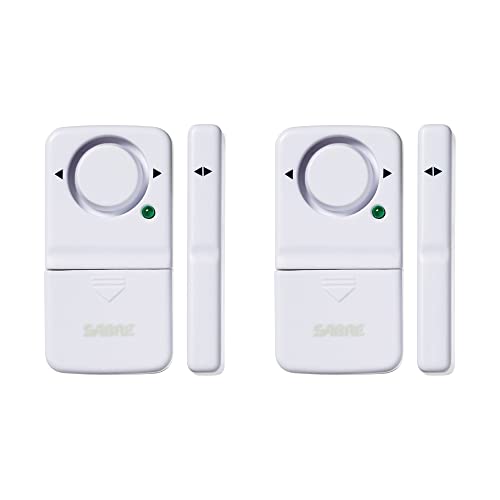
SABRE HS-DWA2 Wireless Home Door Alarm
Adhesive mounting means no drilling, which is why renters and travelers favor this alarm. A switchable chime mode adds a quieter option for daytime use. Because it needs no wifi or hub, it also works on sheds and garage doors with weak signal.
Pros
- Needs no drilling, wiring or wifi connection
- Loud enough to carry through a small home
- Works well for travel or temporary rooms
Cons
- Adhesive can lift from textured door frames
- Sends no smartphone alerts at all

Doberman Security SE-0137 Ultra Slim Entry Defense Alarm
A thin profile lets this unit fit gaps that swallow bulkier sensors. Running as a standalone device, it offers a daytime chime setting and a full alarm mode for overnight. Owners report it suits sliding patio doors and narrow window sashes.
Pros
- Slim body fits tight window and door gaps
- Chime setting doubles as an entry notifier
- Three position switch keeps operation simple
Cons
- Quieter than the loudest standalone alarms
- Battery compartment is fiddly to open

YoLink Door Sensor
Long range, low power radio replaces wifi in this sensor, reaching detached garages and barns. A YoLink hub is required to relay alerts to your phone. Based on specifications, the tradeoff is a smaller app ecosystem than mainstream smart home brands.
Pros
- Reaches outbuildings that wifi sensors miss
- AAA batteries are cheap and easy to replace
- Can trigger other YoLink sirens and plugs
Cons
- Requires purchasing a separate hub
- Smaller app ecosystem than major smart home brands
Side by side
| # | Model | Type | Best for | Score | Price |
|---|---|---|---|---|---|
| 1 | Ring Alarm Contact Sensor (2nd Gen) | Contact sensor, requires Ring Alarm base station | Best overall | 9.4 | Check price |
| 2 | SimpliSafe Entry Sensor | Contact sensor for SimpliSafe base station | Best for monitored systems | 9.2 | Check price |
| 3 | Aqara Door and Window Sensor P2 | Thread and Matter contact sensor | Best value | 9.0 | Check price |
| 4 | GE Personal Security Window and Door Alarm | Standalone chime and alarm | Best budget | 8.7 | Check price |
| 5 | SABRE HS-DWA2 Wireless Home Door Alarm | Standalone door and window alarm | Best for renters | 8.5 | Check price |
| 6 | Doberman Security SE-0137 Ultra Slim Entry Defense Alarm | Standalone slim entry alarm | Best for tight door gaps | 8.2 | Check price |
| 7 | YoLink Door Sensor | Long range contact sensor | Best for long range | 8.0 | Check price |
Common questions
Do door alarms work without wifi?
Standalone models like the GE and SABRE units need no wifi, hub or account, since the siren sits inside the device. Contact sensors from Ring, SimpliSafe, Aqara and YoLink all rely on a base station or hub to send alerts, so an outage limits what they can report remotely.
How loud should a door alarm be?
In a small apartment, around 100 decibels is usually startling enough. For a larger home with a bedroom far from the entry, look for ratings closer to 120 decibels, or pair a contact sensor with a central siren so the sound comes from a spot you will hear.
Which is better, a standalone alarm or a smart contact sensor?
Standalone alarms work instantly with no setup and suit renters or outbuildings without wifi. Contact sensors integrate with a phone app and smart home routines, but need a hub and sometimes a subscription. Pick based on whether you want noise on site or an alert when you are away.
Can I use a door alarm on a sliding glass door?
Yes, though clearance is the main challenge. Sliding doors often leave little room for a standard two piece sensor, which is why slim options like the Doberman unit exist. Mount the sensor body on the fixed panel and the magnet on the moving panel.
Is a door alarm safe to install in a rental?
Most standalone alarms and several contact sensors mount with adhesive strips and leave no holes. Clean the frame first and avoid pressing adhesive onto freshly painted surfaces, since paint can lift when you remove it later.
What causes false alarms on door sensors?
Common causes include a door gap wider than the sensor tolerance, a misaligned magnet, or a weak battery affecting the reed switch reading. Re-seating the magnet closer to the sensor and replacing the battery resolves most cases.
How long do door alarm batteries last?
Manufacturer figures range from about one year for coin cells in high traffic doors to roughly three years for low power contact sensors on doors that open rarely. Cold garages and humid entryways shorten those numbers.
Should I buy a standalone door alarm or a full security system?
A system such as SimpliSafe or Ring Alarm makes sense if you want phone alerts, event history and optional professional monitoring. A standalone alarm covers immediate noise on entry with far less setup and no ongoing account.
Does a door alarm actually deter intruders?
Owners report that sudden noise draws attention and often interrupts someone entering quietly. No alarm physically blocks entry, so treat it as one layer alongside solid locks, exterior lighting and visible cameras.
Final word
Ring’s Alarm Contact Sensor (2nd Gen) earns the top spot for phone alerts inside an existing Ring setup. SimpliSafe’s Entry Sensor is the stronger choice when professional monitoring matters most. For noise right now with no hub, app or account, the GE Personal Security Window and Door Alarm covers that need with minimal setup.